Tim Cook's Impeccable Timing (15 minute read)
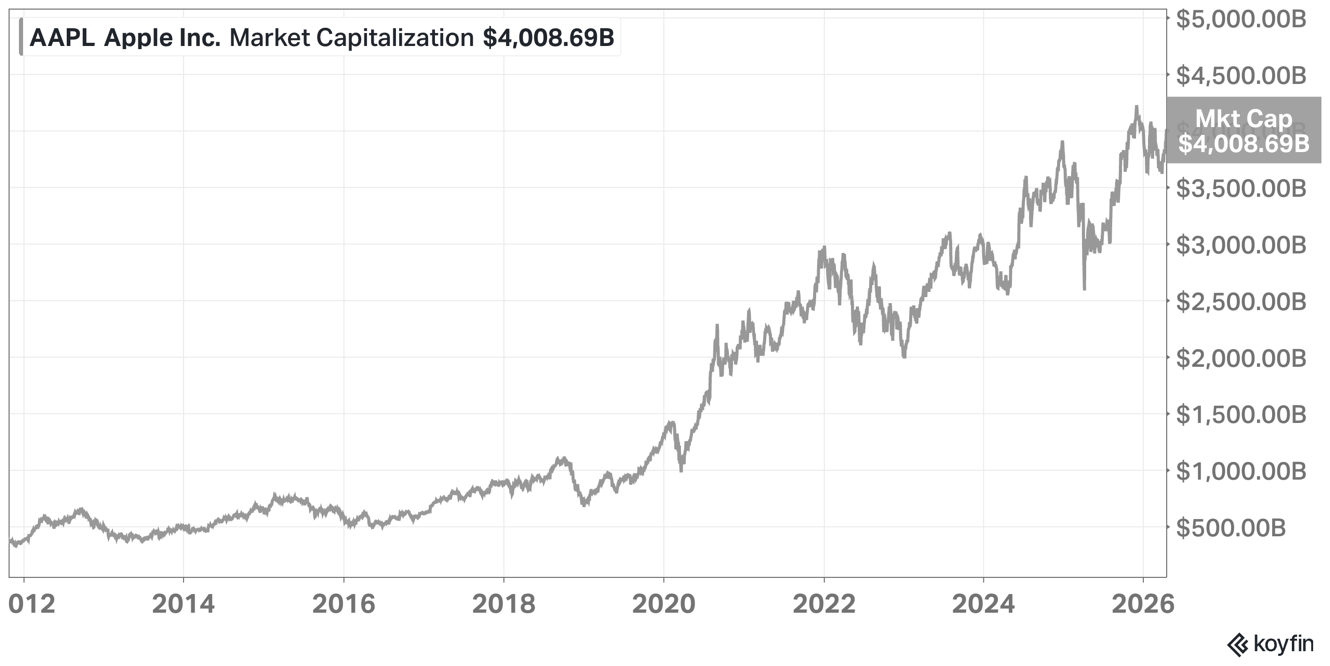
Tim Cook is stepping down as Apple CEO after growing the company's value from $297 billion to $4 trillion, but leaves his successor facing critical questions about China dependence and AI strategy.
What: Tim Cook announced he will transition from Apple CEO to Executive Chairman on September 1, 2026, after 15 years leading the company through extraordinary financial growth including a 303% revenue increase and 1,251% market cap expansion.
Why it matters: While Cook excelled at scaling Steve Jobs' innovations (especially iPhone) and building a massive Services business, the article argues he may have prioritized short-term financial results over long-term sustainability by creating heavy dependencies on China manufacturing and deciding to use Google's Gemini AI instead of building Apple's own competitive AI capabilities.
Deep dive
- Cook became CEO just six weeks before Steve Jobs died in 2011, inheriting Apple shortly after its most important product launch (iPhone) rather than during a mature phase, which positioned him uniquely among non-founder CEOs
- The Cook Doctrine emphasized making great products, owning primary technologies, saying no to thousands of projects, and deep collaboration—essentially a framework for maintaining and scaling what Jobs built
- Cook's operational genius transformed Apple's supply chain by shutting down company-owned factories and building a just-in-time manufacturing system based in China that scaled to hundreds of millions of units annually without major recalls
- The Services business became Cook's most significant revenue contribution, growing to 26% of revenue and 41% of profit through aggressive monetization of the App Store's 30% cut and the Google search deal
- Phil Schiller suggested in 2011 that Apple should lower App Store fees once profits hit $1 billion per year, but Cook never did—a decision that maximized shareholder returns but potentially damaged long-term developer relationships
- Apple's China dependence, while operationally brilliant, violated Cook's own doctrine about owning and controlling primary technologies, leaving Apple vulnerable to US-China tensions
- The decision to use Google's Gemini AI for the new Siri represents a potentially permanent concession in AI, as Apple will struggle to replace a working third-party solution with its own technology that hasn't faced market pressure
- Cook is stepping down after Apple's best-ever quarter, with the Mac poised for expansion via Apple Silicon and iPhone sales at record pace—timing that protects his legacy
- John Ternus takes over as the new CEO inheriting both Apple's strongest traditional business position ever and its most uncertain strategic future regarding AI
- The article questions whether Cook, in optimizing for financial performance, created conditions for a future "crash out" by forgetting his own doctrine about controlling core technologies
Decoder
- Zero to One: Peter Thiel's concept distinguishing revolutionary innovation (creating something entirely new, 0→1) from scaling existing ideas (1→n)
- The Cook Doctrine: Cook's 2009 statement of Apple's core values emphasizing great products, simplicity, owning key technologies, focus, collaboration, and excellence
- Apple Silicon: Apple's custom-designed ARM-based processors for Macs, replacing Intel chips and enabling better performance and power efficiency
- Gemini: Google's AI model that Apple decided to integrate into Siri rather than building competitive in-house AI capabilities
- App Tracking Transparency: Apple's iOS feature requiring apps to ask permission before tracking users across other apps and websites
Original article
Apple is in the best place it's ever been, but there is something that needs to change.