Mistral replaces one-shot document retrieval with a navigable search loop
Mistral's new Agentic Search replaces one-shot RAG with a multi-step iterative loop that allows models to navigate and verify information.
Deep dive
- Implements five core operations: search, open, navigate, read, and grep.
- Reduces p90 latency by up to 39.6% by replacing repeated broad searches with targeted drilling.
- Increases accuracy on the OfficeQA Pro verifiable numeric benchmark for table-heavy PDFs.
- Shifts the bottleneck from chunking/embedding quality to the model's ability to plan and execute retrieval steps.
- Enables cross-document reasoning and comparison.
Decoder
- RAG (Retrieval-Augmented Generation): A technique where a model retrieves information from an external source to improve the accuracy of its generated answers.
- Grep: A command-line utility used to search for patterns within text files.
Original article
Agentic Search. More accurate and efficient results from your AI systems.
Mistral Agentic Search delivers more accurate search results while reducing turns, token use, and latency against FinanceBench and OfficeQA Pro benchmarks. Agentic Search is the retrieval layer that enables AI systems to navigate, read, and verify information inside even the most complex documents. Available through Mistral Search Toolkit and Libraries.
Mistral Agentic Search helps enterprises get better results from their AI systems by letting models search and navigate their organization’s most complex data and documents. Agentic Search introduces a multi-step retrieval loop for finding, inspecting, and verifying information across data sources, wherever it is stored. Agentic Search is available through Mistral Search Toolkit, built into Libraries in both Studio and Vibe, and gives you:
- Support for sensitive domain-specific data. Mistral’s portable and open tooling helps you unlock value from your data without crossing your isolation boundaries in the cloud or on-premises.
- Improved search results. Your models can search and navigate your data beyond retrieved chunks–inside long, dense documents or across multiple sources.
- Access to existing indexes. Agentic Search builds on your existing search index using five tools:
search,open,navigate,read, andgrep. - Higher accuracy. Agentic Search delivers to 3x correctness on financial filings, from 26.7% to 86%, based on FinanceBench. On table-heavy, multi-doc questions of the OfficeQA Pro benchmark, we measure a +45.6 point gain (6.3% to 51.9%).
- Lower latency and token use. Targeted navigation enables Agentic Search to reduce p90 latency up to 39.6%. Fewer repeated searches reduce token consumption by up to one-third.
Data creates competitive advantage
Competitive edge is built upon years of real-world operations–your data, your processes, and your domain expertise. Proprietary knowledge is both critical to your success and highly confidential, meaning it lives behind isolation boundaries, segmented deployments, and self-hosted platforms. It accumulates in financial filings, legal contracts, internal resources, and government records–long, dense documents that traditional search methods can’t navigate effectively.
Agents that learn and improve continuously can help you compound your competitive advantage, but these agents are often separated from confidential data and proprietary knowledge for security reasons. Getting real impact from AI means pairing frontier reasoning with retrieval tools that can safely reach your most sensitive material.
Traditional RAG falls short
Traditional, one-shot RAG retrieves a fixed set of text chunks and asks a model to answer in a single pass. This works when the answer appears in one of the top results, but falters when the model must navigate a long report, follow references, compare multiple documents, or verify the underlying evidence.
The limitation is more pronounced on dense, complex data and documents. The information needed to answer a question may be spread across documents or buried in a particular table, footnote, or clause. One-shot RAG-based search fails to use the full power of frontier AI and to provide reliable answers for three reasons:
- Retrieval without reasoning: The model must answer from the chunks selected during the initial retrieval, even when they are incomplete or not relevant. It cannot decide that it needs a different document, another section, or more context before responding, which limits the impact of the model’s reasoning.
- Chunk-level limit: Critical data is often held in complex multi-modal documents. When asked, “What was the company’s effective tax rate in Q3?” an index may find the correct document but cannot open it, navigate to the table, read the surrounding context, or verify the answer.
- No iteration: Many questions need more than one retrieval pass to get the correct answer. The model may need to refine its search, inspect a promising document, follow a reference, compare multiple sources, keep track of what it has seen, and try a new route when the first results are insufficient. One-shot RAG provides no way to take these next steps.
How Agentic Search works
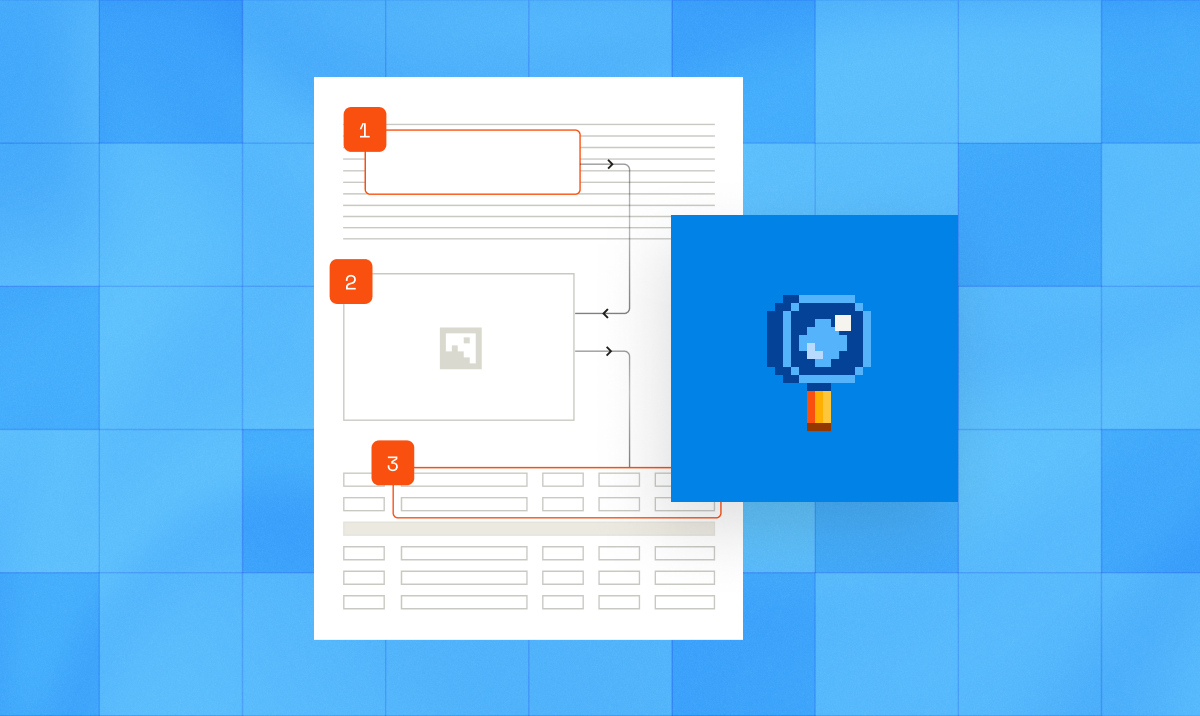
Mistral Search Toolkit provides open modules for ingesting, embedding, and indexing critical and complex data in the cloud or on-premises. Agentic Search builds on this index by giving the model five tools that resemble familiar file-system operations:
searchfinds relevant documents across the corpus using the existing index.openopens a specific document.navigatemoves to a page, section, or region within it.readretrieves the content at that location.grepfinds a pattern within an open document.
Rather than answering only from the initial top-k results, the model can inspect what it finds, refine its search, open relevant documents, navigate to specific sections, and read the source material before answering. The index identifies likely sources; Agentic Search determines what to inspect within and across them.
These tools do not require fine-tuning or model-specific training. As models get better at reasoning and tool use, retrievals get better without infrastructure changes. This is a key property: retrieval quality scales with model capability instead of being capped by your chunking strategy.
Use Agentic Search for
- Long documents. Filings, contracts, manuals, technical specifications, and reports where the answer may appear on a particular page or in a specific table, clause, figure, or footnote.
- Questions across multiple sources. Research that requires the model to find, compare, or reconcile evidence from several documents before reaching an answer.
- Answers that must be verified. Financial figures, legal clauses, regulatory references, and operational data, where the response can be referenced in a stable and specific document location.
- Tables and structured documents. Financial statements, government records, and scanned PDFs where meaning depends on rows, columns, page position, or surrounding context–not narrative text alone.
Indexed retrieval is the right starting point for
- Direct lookups. Short, clean documents where the answer is likely to appear in one of the first retrieved chunks.
- High-volume search. Keyword or semantic lookups that need to return relevant passages without reasoning over or navigating through them.
- Simple, predictable questions. Use cases where the likely source and location of the answer are known in advance and additional retrieval steps are unlikely to improve the result.
More relevant results, faster
We benchmarked Agentic Search on two industry-standard evaluations, using the out-of-the-box Mistral Search Toolkit stack: default chunking, default ranking, no tuning. These results are floors, not ceilings, meaning you can further improve result quality with use-case-specific tuning.
Benchmark results are consistent: the agentic loop delivers substantive quality improvements and navigation tools increase accuracy while reducing wasted tokens, turns, and latency.
FinanceBench: 368 SEC filings, 150 questions
FinanceBench tests financial question-answering over 368 SEC filings. We found:
- The search-only Agentic loop is the biggest quality lever. Moving from one-shot RAG to a search-only loop lifts accuracy by +47.3pp for MM 3.5 and +52.6pp for GLM-5.2–a ~3x improvement for both models.
- Navigation adds accuracy. Adding open, navigate, read, and grep lifts accuracy again.
- Token and performance efficiency improve with better retrieval tools. The full loop with Navigation answers more questions correctly while using fewer tokens.
- Latency goes down where it matters. Across FinanceBench, adding navigation retrieval tools improves latency.
OfficeQA Pro: 696 Treasury Bulletins, 133 questions
OfficeQA Pro is a verifiable numeric benchmark over historical U.S. Treasury Bulletins. We found:
- Agentic Search and the Agentic loop + Navigation are successful against a harder, verifiable benchmark. OfficeQA Pro has numeric answers, scanned PDFs, and deep table lookups.
- Navigation improves quality while cutting waste. Using the full loop improves accuracy while reducing token consumption.
- The harder the benchmark, the more important the retrieval loop becomes. One-shot RAG barely gets started, while the agentic loop allows the model to search iteratively.
Getting started
Learn more about Agentic Search in the documentation. You can get started across cloud and on-premises deployments using either:
- Mistral Search Toolkit. Integrate Agentic Search into your own agents, workflows, and customer deployments.
- Libraries. Use Agentic Search out-of-the-box in Studio and Vibe, without building the retrieval system yourself.
Fresh dev news, AI-digested daily. Never miss a trend at devoured.fyi