Devoured - July 07, 2026
Nvidia has delayed its Kyber rack-scale AI system to 2028 due to manufacturing complexities, while Anthropic continues to scale infrastructure through a $19 billion data center lease. Simultaneously, the industry is shifting toward agentic systems thinking and task-specific evaluation, as evidenced by Anthropic's new J-space reasoning discovery and the adoption of specialized open-source models for production workloads.

A global workspace in language models
Anthropic researchers identified a 'J-space' in Claude's neural architecture, a silent, emergent workspace that functions as a hub for deliberate reasoning.
Deep dive
- The J-space is a small, specialized collection of internal neural patterns that emerges during training without explicit programming.
- It allows the model to reason silently, modulate its internal state, and perform tasks like multi-step math without outputting the reasoning steps.
- 'J-lens' technique uses a Jacobian-based approach to map internal activations to tokens in the model's vocabulary.
- J-space acts as a 'global workspace' where data is broadcasted, allowing for flexible information reuse across different tasks.
- This internal workspace remains distinct from the 'scratchpad' or 'chain-of-thought' outputs.
- It is possible to influence model behavior by editing the J-space directly to swap or inject concepts.
- The J-space can be used to detect adversarial behavior, such as hidden attempts at prompt injection or intentional data manipulation.
- Post-training on 'reflection' tasks can cause the model to adopt more honest behavior as these values become embedded in the J-space.
Decoder
- Jacobian: A matrix of all first-order partial derivatives of a vector-valued function, used here to map how changes in neural activations impact output probability.
- Mixture-of-Experts (MoE): A neural network architecture where only a subset of the model's parameters are active for any given input, improving performance while saving compute.
- Ablation: The process of removing or disabling parts of a neural network to observe the impact on performance and identify the function of specific components.
Original article
Full article content is not available for inline reading.

State of CLI Coding Agents, Mid-2026
Mid-2026 terminal coding agents have converged on a shared feature set, making harness maturity and model integration more important than brand choice.
Deep dive
- Feature Convergence: Almost all major CLI agents now feature plan mode, permission prompts, and persistent memory files.
- Integration Standards: The industry is standardizing around the Model Context Protocol (MCP) and AGENTS.md conventions.
- Cost Engineering: Developers are favoring 'Bring Your Own Key' (BYOK) harnesses that allow them to route tasks to cheaper, open-weight models like Kimi K2.7 or GLM-5.2.
- Editing Precision: Omp currently leads in reliability by using AST-aware rewrites that survive repository refactors.
- Agentic Workflows: Multi-agent orchestration and specialist sub-agents (e.g., plan, review, execute) are the new baseline for serious terminal work.
- Privacy and Sandboxing: Codex CLI and open-source options are preferred by enterprise users who require OS-level sandboxing over the cloud-centric approaches of lab agents.
Decoder
- MCP (Model Context Protocol): An open standard that allows AI assistants to securely connect to data sources and developer tools.
- AST (Abstract Syntax Tree): A tree representation of the abstract syntactic structure of source code, used by tools like Omp to perform accurate code modifications.
- DAP (Debug Adapter Protocol): A protocol that standardizes how debuggers communicate with development tools, enabling agentic control of debugging sessions.
- Hash-anchored Patches: A method of applying code changes that uses structural hashes to ensure patches hit the correct lines even if file content has shifted.
Original article
Full article content is not available for inline reading.

Nvidia's next-gen AI rack system delayed to 2028 on manufacturing snags
Nvidia has delayed its Kyber rack-scale architecture to 2028 due to manufacturing challenges with a critical midplane circuit board.
Deep dive
- Kyber NVL144 delayed to 2028 due to midplane PCB manufacturing complexity.
- Larger NVL576 system linking eight racks also likely delayed or volume-constrained.
- Current Rubin systems remain in production for 2026 shipment.
- SemiAnalysis projects fiscal 2027 data-center revenue to exceed analyst consensus by 20%.
- Industry experts suggest power availability remains the primary bottleneck for data center growth, potentially aligning later hardware releases with grid capacity improvements.
Decoder
- Midplane: A circuit board that acts as a central hub, connecting multiple compute trays and interface modules within a server rack.
- Hyperscalers: Large cloud service providers like Amazon, Microsoft, and Google that operate massive data center infrastructure.
- PCB (Printed Circuit Board): The base material and circuitry that connects electronic components.
Original article
- The Kyber NVL144 has been pushed to 2028 due to difficulties in manufacturing a key circuit board: SemiAnalysis.
- The reported delay adds to concerns that Nvidia's breakneck annual release cadence contested manufacturing limits.
- That delay could give rivals, such as AMD and Google, a rare technical opening at the high end of the market.
Nvidia's next marquee product — the Kyber rack-scale architecture designed to house its 2027 Rubin Ultra chips — has been delayed by more than 12 months to 2028, according to research firm SemiAnalysis, the latest in a string of reported setbacks raising questions about the AI giant's product roadmap.
Nvidia rejected the SemiAnalysis report and said, "Our roadmap is intact."
Shares of the artificial intelligence chip giant climbed about 1% on Monday.
Kyber is a server cabinet that packs 144 of Nvidia's most powerful chips into a single unit so they can work together as one giant computer, providing the horsepower AI companies need to train and run their most advanced models.
The design mounts graphics processing units in compute trays that sit vertically instead of horizontally to boost density and reduce latency, and had been slated to debut with Vera Rubin Ultra, Nvidia's next-generation rack-scale system, in 2027.
The setback stems from difficulties manufacturing a key circuit board at the heart of the system, SemiAnalysis said in a post on Monday.
"Kyber NVL144 rack architecture has been delayed to 2028 as the PCB midplane remains challenging from a manufacturability standpoint," the firm said, referring to a specialized, multi-layer printed circuit board that connects electronic modules within a system.
NVL576 — a larger system linking eight racks via optical connections — is also likely delayed or limited to small volumes, the research firm said.
The reported delay adds to mounting strains across Nvidia's product lines, underscoring concerns that Nvidia's breakneck annual release cadence is colliding with manufacturing limits.
A backup plan — bolting two of Nvidia's current-generation racks together for similar power — has also been scrapped after cloud customers rejected the design as awkward and costly to operate. "It has since been cancelled due to heavy pushback from CSPs [cloud service providers] and hyperscalers over its odd design and heavy operational burden," SemiAnalysis said.
That leaves Nvidia with "no proven solution to expand the scale-up world size for Rubin Ultra," SemiAnalysis said, predicting that could give rivals Advanced Micro Devices and Google, whose in-house chips are already winning business from top AI labs, a rare technical opening at the high end of the market.
The delays "should not be over analyzed as affecting the long-term criticality of Nvidia to AI data infrastructure buildouts," said Paul Triolo, a partner at consultancy DGA-Albright Stonebridge Group, noting the company "has faced these kinds of challenges before, and has worked with vendors to overcome technical issues."
With power supply likely to remain the major constraint on American AI data center spending, Triolo said, "delays in getting to more advanced systems could just mean that the new systems are ready by the time the U.S. can work to overcome some of the critical bottlenecks on power now dogging the industry."
Nvidia's current-generation Rubin systems are in full production and begin shipping this fall to eight cloud partners, including Amazon Web Services, Microsoft Azure and Google Cloud. SemiAnalysis also projects Nvidia's data-center compute revenue will run 20% above Wall Street consensus in the second half of fiscal 2027.
While Huawei and other domestic manufacturers "will potentially gain some time," China's hardware ecosystem is increasingly diverging from — rather than chasing — the Nvidia-led model, Triolo said. "The issue is no longer really catching up, but how good will China's alternative AI stack be by 2030," he said.

Matching AI Modality to User Intent: Designing the Right Interface
Defaulting all AI interactions to a chat box creates a cognitive tax that ignores the user's immediate environment and physical constraints.
Deep dive
- Conversational interfaces create a 'linguistic barrier' by forcing users to translate thoughts into precise prompts.
- Sequential reading of long AI text responses creates high cognitive load; visual dashboards allow for parallel processing.
- Modality choice must consider physical constraints (e.g., wearing gloves), environment (e.g., loud warehouse), and cognitive load.
- Successful field implementation requires an adaptive handoff, such as using voice input on-site and switching to a high-density visual dashboard upon returning to a base station.
- A Task Audit includes checking hand/eye availability, environmental noise, and the stakes of the decision being made.
- The Input/Output Alignment Matrix maps intent (e.g., status check, creative generation) to the optimal interface modality.
Decoder
- Modality: The way a person uses their senses (seeing, hearing, touching, speaking) to interact with a system.
- Adaptation load: The mental or physical effort a user must expend to change their natural thought process to work within a specific interface.
- Glance verification: An output method designed to provide information at a glance, requiring minimal cognitive processing.
Original article
Full article content is not available for inline reading.

Continual Learning for Agents
Since production agent weights are often locked behind closed models, developers must implement continual learning at the harness and context levels.
Decoder
- Harness-level learning: Improving the surrounding code and prompts that wrap the AI model rather than the model's underlying weights.
- Production failure trace: A log of data showing where an agent's reasoning or execution failed while performing a task in a real-world scenario.
Original article
Continual Learning for Agents
Everyone talks about Continual Learning as if it means one thing only: updating model weights. But there's an inconvenient truth about the agent ecosystem — the vast majority of agents in production...

A Stargate for Data
Data spend is projected to exceed $100 billion by 2030 as the industry shifts from compute-limited to data-limited, making high-quality private data a strategic bottleneck.
Deep dive
- The AI industry is transitioning from a compute-limited regime to a data-limited regime.
- The 'public internet' is a finite resource that has already been largely exhausted for pretraining purposes.
- Future performance gains will depend on acquiring private, undocumented, or tacit knowledge rather than scraping the open web.
- Data collection is expected to reach $100 billion annually in spending by 2030.
- Models are becoming differentiated by their exclusive access to proprietary data, rather than architecture alone.
- Data labeling and expert-driven data creation are becoming highly lucrative businesses.
- National security interests may soon prioritize data collection as a strategic asset equivalent to compute infrastructure.
Decoder
- RL (Reinforcement Learning): A training method where models learn by receiving rewards for correct actions, often used here for improving reasoning in math and coding tasks.
- Zettaflop-scale compute: A massive amount of computing power capable of performing at least 10^21 floating-point operations per second.
Original article
A Stargate for Data
Labs are on a trajectory towards >$100B/year of data spend by 2030. As we begin the trillion-dollar compute project, we need to think about the equivalent civilizational-scale effort for the other core ingredient: data.
At the foundation of the scaling revolution is a simple empirical law: deep neural networks improve smoothly, near magically, as you scale two things in proportion — (1) the size of the model and (2) the amount of data you train on. And despite the scaling laws being brutally diminishing, we’ve successfully bitten the bullet of logarithmic scaling with exponentially larger clusters and datasets, and received incredible new capabilities in return.
But this exponential scaling is bound to hit some limits. Oddly enough, compute has compounded fairly smoothly without limit, with trillions flowing into hypercluster buildout. Instead, we’re starting to hit the limits of an exponential demand for data. Gone are the days of being purely in the compute-limited regime, where we had effectively infinite internet data but never enough GPUs, we’re now entering a data-limited regime.
Luckily, this limitation is coinciding with staggering improvements in AI capabilities. Incredibly, we seem to have a real line of sight towards automating a majority of knowledge work with the methods we have today. RL + pretraining, and the data for each, will be generally sufficient to achieve most economically valuable tasks, given some minimal algorithmic progress and continued compute scaling. In a data-limited world, economic progress & scientific acceleration will be directly bottlenecked by our coverage in each domain. We need to see data collection as imperative, deserving the same civilizational ambition we’ve given compute.
The internet as a one-time subsidy
It’s underrated how much all progress in AI owes everything to the blessing of the internet, this one-time civilizational subsidy to deep learning, decades of unintentional accumulation of a perfect dataset: every book, blog post, image, video, paper, discussion, etc. all digitized and freely available. Without the internet, we’d likely see comparably minimal progress in AI today, and in fact, if you notice where systems currently underperform, it’s almost always a domain where web coverage is limited and data is private, expensive, non-digitized, or non-existent.
But we’re running out of it. There are only about 300 trillion tokens of useful public human text, and the internet doesn’t produce nearly enough new high-quality data to match what scaling demands — we’re soon to hit the limits of public data for pretraining. And though the advent of RL bought us reprieve — chain-of-thought RL needed a new form of untapped data, gradable math & coding tasks, also available online — we’re quickly running dry of hard tasks for RL as well.
Why do we need so much data anyways? Humans learn comparably in far less time, needing just one textbook where language models might need the equivalent of hundreds to learn a new topic. It’s possible we discover methods that are massively more data efficient — synthetic data, data efficient architectures, other exotic algorithms — but fundamental progress is slow and highly unpredictable, and the recipe we have just works today. And, while I’m wary of getting too deep here, even arbitrary data efficiency can’t replace data that just doesn’t exist in the first place. There’s a massive amount of missing information on the web: the dark matter of the internet — tacit knowledge, undocumented processes, etc. — most of which was never published and lives only inside organizations, the physical world, or just in people’s heads.
There will be >$100B/year in data spend by 2030
We’re not screwed yet, of course. Only a fraction of useful data in the world is on the public internet, the rest is stored inside private datasets, corporations, personal archives, universities, governments, and otherwise. Labs can and will continue to license these private datasets, or create them from scratch, like Anthropic’s book scanning project. And we’ll increasingly task human experts to manufacture new high-quality data, with a large fraction of hard RL training tasks already being sourced this way.
But collecting this data, unlike before, will be expensive. As the free internet dries up and demand for data rises, we should see labs investing equally in data as compute, likely spending a significant fraction of their compute budgets on data. As we see trillions spent on compute, we should also expect hundreds of billions spent on data (human data & collection budgets), given their equivalent importance. And, notably, data spend is already tracking this way: total data spend across vendors, not counting internal lab efforts, is already roughly $7 billion per year. It’s quite reasonable we’ll see >10x by 2030.
Data is the moat
Data becoming increasingly private will also majorly shift the competitive landscape. While compute is a commodity — everyone buys the same chips and builds the same clusters — data really isn’t. The big reason why frontier models have felt eerily similar to one another, until now, is they were trained on substantially the same internet (pretraining data variability across labs seems pretty low). As labs diverge onto more exclusive, manually collected corpora, I think models will begin to increasingly diverge. OpenAI pulling ahead in mathematics and Anthropic in cybersecurity isn’t an accident. I really think laser-focused collection of high-quality midtraining tokens, custom RL tasks, environments, with dedicated research effort, has driven much of the visible progress in the last year.
James Betker has an excellent blog about “the ‘it’ in a model is the dataset”: model architecture and compute buy you efficiency and order-of-magnitude performance, but ultimately, models, of any architecture, are such incredible approximators of their dataset that the core meat of a model boils down to just that, nothing else. Data is a major moat.
AGI long, ASI short
As I’ve tweeted before, I’m confident that, despite the narrative, the data labeling industry will continue to fuel great businesses and be an excellent AGI long, ASI short. The argument is just: By the time the AGI labs no longer need data, it’s probably over for everything else too. In this frame, the last companies left should be the data companies, as the last speck of economically relevant data is sucked in. And these companies are already among some of the fastest-growing companies in history: Mercor, founded three years ago, is rumored to be doing $2 billion in revenue with something like a few million expert labelers under contract.
While these businesses are very non-stationary, what type of data is needed shifts constantly, I don’t think that diminishes their value. The long-tail of the economy is long, and the value isn’t diminishing as you extend farther into more obscure information: as models get more capable, the value of the marginal dataset goes up, not down. Automating a full job means covering its full distribution of tasks, tools, edge-cases, and long-horizon loops. There’s some O-ring logic to it: a dataset that buys a 1% bump can justify a previously unjustifiable collection cost when it’s the difference between a system that does 99% of a job and one that does all of it.
The binding constraint
It’s truly remarkable that we seem to have the recipe — pretraining + RL — to absorb most economically valuable work, despite being far from a lot of what we expected from “AGI”. The same way chess engines revealed we never needed general intelligence to solve chess, as we originally thought, we’ll soon realize that software, mathematics, and the vast majority of the economy (including physical, just running ~3 years behind!) are the same. If recursive self-improvement or some other algorithmic breakthrough arrives, that’s wonderful, but we really don’t have to wait for it. The binding constraint between here and an automated economy isn’t that, it’s data coverage: every app, workflow, edge case, process, etc. sitting in private stores or someone’s head.
Ultimately, while we make tremendous strides in more efficient model architectures, and clusters like Stargate equip us with zettaflop-scale compute, we really aren’t making rapid progress collecting the data we lack. We’ll soon live in a world where we have the methods & compute to accelerate scientific progress or economic growth, but not the data. And we’re already there today: frontier models would surely be as good at accounting/many medical tasks/legal advice as they are at software engineering if we only had the same pretraining & RL coverage as we did for code.
I really want to drill this in: The speed at which we automate the economy is going to be directly rate-limited by our ability to collect data about it. Worth noting that under this assumption, with data as defensible and directly proportional to economic & scientific progress, data should also be considered a national strategic asset like compute.
A Stargate for data
Stargate exists because we organized trillions of dollars, international strategy, gigawatts around compute as a fundamental ingredient. What would equivalent ambition look like for data? Obviously, scaling data collection, a heterogeneous mass of information across the economy, isn’t going to be as clear as scaling compute, as a homogenous infrastructural effort. A core division will be first, coverage — all uncaptured knowledge sitting across the economy/science/physical world and all that simply isn’t recorded — and, secondly, sheer volume in the domains we already train on: more hard math tasks, more high-quality web text, way more coding data, more legal drafts, etc.
There’s a lot of room for creativity. Quickly, we’ll probably want to start with a deep census of what we have and what we’re missing, predict what the 2030 model will still be bad at and work backward to what we should be collecting today. You can probably license a large amount, leveraging high lab valuations to buy datasets or companies altogether. There’s an adversarial nature to a lot of this collection with firms, so there’s lots of engineering to do this correctly. We should go convince important companies to turn off deletion policies, even if we’re not buying from them yet. Data flywheels in consumer products will be massive. Confidential training, government legislation for grant-funded research, running companies at a loss for their data, etc. We’re headed towards hundreds of billions in expenditure, national prioritization, and major data limitation on the horizon. We have a great opportunity to think creatively about what a megaproject for data would look like: How do we, deliberately this time, construct the next internet’s worth of data?

Hy3
Tencent released Hy3, a 295B-parameter Mixture-of-Experts model that aims to rival flagship open-source models with fewer active parameters.
Decoder
- MTP (Multi-Token Prediction): A training approach where the model is tasked with predicting multiple subsequent tokens at once, rather than just the next single token, which can lead to better reasoning and efficiency.
Original article
tencent/Hy3. New Apache 2.0 licensed model from Tencent in China:
Hy3 is a 295B-parameter Mixture-of-Experts (MoE) model with 21B active parameters and 3.8B MTP layer parameters, developed by the Tencent Hy Team. Following the Hy3 Preview launch in late April, we gathered feedback from 50+ products and scaled up post-training with higher quality data. Today, we introduce Hy3, which outperforms similar-size models and rivals flagship open-source models with 2-5x parameters. It also shows significant gains in utility across various products and productivity tasks.
The full-sized model is 598GB on Hugging Face, and the FP8 quantized one is 300GB. The context length is 256K.
It's available for free on OpenRouter until July 21st. I had it "Generate an SVG of a pelican riding a bicycle" there and got this:

Bringing PyTorch Monarch to AMD GPUs: Single-Controller Distributed Training on ROCm
PyTorch Monarch now supports AMD Instinct GPUs, enabling fault-tolerant distributed training that recovers from node failures without full job restarts.
Deep dive
- Architectural Decoupling: Monarch separates the Python training API from the Rust-based infrastructure runtime.
- Fault Isolation: Uses actor supervision trees to contain process crashes, preventing global job termination.
- ROCm Port: Implemented via hipify_torch and a compatibility shim in Rust that re-maps CUDA calls to HIP equivalents without forking core logic.
- Dynamic Recovery: When a node fails, the system triggers in-place restarts and peer-to-peer checkpoint transfers between replica groups.
- Integration: Supports native orchestration across SLURM and Kubernetes via TorchTitan and TorchFT.
- Scaling Validation: Demonstrated convergence on 256-GPU MI355 clusters by simulating frequent failures during training.
Decoder
- ROCm (Radeon Open Compute): AMD's open-source software platform for GPU programming, serving as the functional equivalent to NVIDIA's CUDA.
- Actor-based Runtime: A concurrency model where independent units of logic (actors) manage their own state and communicate via messages, isolating faults.
- Process Mesh: A logical grouping of GPU processes that Monarch uses to coordinate distributed tasks.
- Checkpointing: The process of saving the entire model state and optimizer status to disk; traditionally the bottleneck in fault-tolerant training.
Original article
Featured projects
- PyTorch
Training state-of-the-art large language models (LLMs) with billions of parameters requires distributed training across hundreds or thousands of GPUs. At this scale, hardware failures are not exceptional events—they are expected. A single GPU memory error, network partition, or node crash can bring down an entire training run that has been progressing for days or weeks. While our previous work demonstrated near-linear scaling of FP8 training at scale (achieving 96.16% scaling efficiency on a 1024-GPU MI325 cluster with DeepSeekV3-671B), the key challenge remains: reliability at scale.
To address these challenges, we have brought PyTorch Monarch to AMD Instinct GPUs with ROCm, expanding the single-controller model beyond CUDA environments and bringing this emerging runtime to a broader hardware ecosystem.
In this blog, we will explore the architecture of PyTorch Monarch, walk through the engineering effort required to port Monarch’s GPU runtime and distributed communication stack to ROCm, and demonstrate how the system dynamically recovers from node failures without halting the entire training job. By the end, you will understand how Monarch enables elastic, fault-tolerant distributed training on AMD GPUs and why this represents a significant step toward stable, large-scale AI infrastructure.
The Challenge: Reliability at Scale
Traditional fault-tolerance strategies rely heavily on periodic checkpointing: saving the full model state to persistent storage at regular intervals. When a failure occurs, the entire job restarts from the last checkpoint. While conceptually simple, this approach has significant drawbacks.
| Challenge | Impact |
| Checkpoint overhead | Writing hundreds of gigabytes of model state to storage consumes time and I/O bandwidth. |
| Wasted computation | All progress since the last checkpoint is lost upon failure. |
| Cluster idle time | The entire cluster sits idle while the failed node is replaced and the job restarts. |
| Scalability limits | As cluster size grows, the probability of failure during any checkpoint interval increases. |
For truly large-scale training, scaling is not enough—training must also recover from failures. We need a more dynamic approach, one that allows healthy nodes to continue training while failed nodes recover and rejoin, minimizing wasted computation and maximizing GPU utilization. This is where PyTorch Monarch comes in.
What is PyTorch Monarch?
PyTorch Monarch introduces a new distributed programming paradigm that enables developers to orchestrate entire GPU clusters from a single Python program. With its actor-based runtime, process mesh abstraction, and asynchronous execution model, Monarch simplifies large-scale distributed training and enables complex workflows that combine training, evaluation, and reinforcement learning within one unified script.
The architecture operates at multiple distinct levels:
- Python API: A single-program interface where developers write simple Python code to get distributed GPU execution.
- Monarch Runtime: Manages actors and meshes, supervision trees, and tensor sharding.
- Rust Runtime (Tokio): Ensures high performance and memory safety.
- Infrastructure: Integrates with RDMA, RCCL/NCCL, SLURM, Kubernetes, and SkyPilot.
By decoupling the parallelism strategy used within each training replica from the fault-tolerance mechanism used across replicas, Monarch provides a cleaner fault-tolerance model. Failures are isolated (actors have private state, crashes do not propagate), hierarchical (handled at the lowest possible level), and recovery is fast (seconds for local restart, minutes only if escalated).
Porting Monarch to ROCm: Ecosystem Integration
Bringing Monarch to AMD GPUs required significant engineering effort to port the GPU runtime and distributed communication stack to ROCm.
We successfully implemented three main porting paths:
- Collective Communications: We used
hipify_torchto convert the C++ bridge code from CUDA to HIP and linked against RCCL, which mirrors NCCL’s API. - GPU Memory Management: We extended the build system to auto-detect the platform and route CUDA driver API calls through their HIP equivalents.
- RDMA Integration: Configuring
GPU_PLATFORM=rocmkeeps thelibibverbs-based RDMA path intact while swapping the GPU-side bindings from CUDA to HIP for GPU-direct transfers.
Moreover, two cross-cutting issues shaped the port and deserve a closer look:
- No static link for the HIP runtime: NVIDIA ships
libcudart_static.a, so the CUDA path linkscudart_staticdirectly. ROCm ships no static equivalent forlibamdhip64, so the ROCm build linksamdhip64dynamically. Both platforms additionallydlopenthe GPU driver API functions, includinghipMemCreate,cuMemCreate, and related calls, keeping the runtime contract identical on either side. - Rust compatibility shim instead of forking the bindings: Once
hipify_torchrewrites the C/C++ headers,bindgenemits HIP-named types such ashipError_t,hipDeviceptr_t, andhipStream_t. Rather than add#ifdefbranches at every Rust call site, we added arocm_compatmodule innccl-sysandrdmaxcel-systhat re-exports HIP symbols under their CUDA names, for examplepub type cudaError_t = hipError_tandpub use hipSetDevice as cudaSetDevice. The rest of the Rust code stays platform-agnostic.
These efforts culminated in the introduction of HIP type aliases in Rust, with all 1,171 tests passing, ensuring full support for ROCm 7.0+. We have upstreamed these contributions to the open-source community.
Today, Monarch on ROCm provides full ecosystem support, including the Actor runtime, RDMA, Supervision, and Tensor sharding. It runs seamlessly on SLURM (HPC), Kubernetes (Cloud native), and SkyPilot (Multi-cloud), enabling downstream engines like TorchTitan (Training engine) and TorchFT (Fault tolerance) for production workloads.
Case Study: Fault-Tolerant Training at Scale
Architecture Overview
The architecture consists of three layers:
- Monarch: Acts as the orchestrator, managing process and cluster orchestration. It spawns ReplicaActors and a Lighthouse service, organizing GPUs into Process Meshes.
- TorchFT: Handles fault tolerance at the step level. It contacts the Lighthouse for quorum coordination, performs Quorum AllReduce, and skips failed nodes.
- TorchTitan: Serves as the training engine, executing the Forward (FSDP), Backward, and Optimizer steps, while managing checkpoints and metrics.
In this setup, Monarch provides a supervision tree for fine-grained fault detection and isolation. When a failure is injected into the training actors, it is detected by the Lighthouse and handled by TorchFT. The healthy replicas continue training independently despite peer failures, without requiring a global interruption.
Dynamic Fault Recovery Workflow
Let us walk through a concrete scenario with four replica groups to understand the recovery workflow.
- Normal Training: The OrchestrationManager spawns 4 ReplicaActors (Monarch Supervisors) and a Lighthouse. Each ReplicaActor spawns a Replica with 8 GPU processes running TorchTitan trainers. All 4 replicas are ready (
quorum_id=1) and DiLoCo gradient synchronization occurs every 20 steps. - Failure Detection: A GPU process in Replica 0 crashes. The Monarch supervisor captures the
report_training_error(with full traceback) before the process dies. Replicas 1, 2, and 3 are marked as unaffected and continue training. - Local Restart: ReplicaActor 0 initiates an in-place restart (
_stop_and_restart()), stopping the old process mesh and spawning a new one. Meanwhile, the other 3 replicas continue syncing (quorum_id=2) - Peer Checkpoint Transfer: The Lighthouse selects Replica 1 as the donor. A peer checkpoint transfer (model, optimizer, scheduler, and trainer state) is initiated from Replica 1 to the recovering Replica 0. All replicas pause briefly at the quorum boundary while the new quorum forms.
- Resumed Training: Once Replica 0 is synced, the new quorum (
quorum_id=3) is established with all 4 replicas, and DiLoCo synchronization resumes.
The entire recovery process completes without any manual intervention, without full checkpoint restarts, and with minimal disruption to the overall training throughput.
Performance Characteristics
SLURM 16-Node MI300 Cluster (128 GPUs)
We trained a Llama 3 8B model on a 16-node SLURM cluster (totaling 128 MI300 GPUs), injecting RCCL failures every 180 seconds with a quorum sync every 20 steps. The results were remarkable:
- The number of active workers fluctuated dynamically (between 8 and 16) due to the injected failures.
- Training continued seamlessly despite frequent failures—there was no full restart.
- The loss curve showed steady convergence, closely matching the baseline run without failure injection.
Kubernetes 32-Node MI355 Cluster (256 GPUs)
We scaled the experiment to a 32-node Kubernetes cluster (totaling 256 MI355 GPUs). The number of participants remained highly stable (fluctuating slightly between 30 and 32 during recovery events), and the global average loss decreased smoothly from 12 to approximately 4. This demonstrates that the Monarch fault-tolerance model works reliably on both SLURM and Kubernetes at scale.
Summary and Future Directions
Training large AI models at scale requires more than raw computational power—it demands resilient infrastructure that can gracefully handle the inevitable hardware failures. By bringing PyTorch Monarch to AMD Instinct GPUs with ROCm, we have demonstrated a practical approach to fault-tolerant distributed training that minimizes wasted computation and maximizes GPU utilization.
This integration represents several significant achievements for large-scale training on AMD GPUs:
- First large-scale validation on AMD hardware: We successfully deployed Monarch with TorchTitan and TorchFT on AMD GPUs, demonstrating that the ROCm software stack fully supports advanced fault-tolerance mechanisms.
- Cleaner fault-tolerance model: Monarch provides a robust supervision tree and process mesh abstraction, isolating failures and enabling rapid local recovery.
- Ecosystem readiness: The approach works seamlessly across SLURM and Kubernetes, making it ready for production workloads.
The key architectural insight is the use of Monarch’s actor-based runtime and supervision trees to isolate failures, combined with TorchFT’s quorum-based synchronization to allow healthy nodes to continue training. For teams running large-scale training workloads on AMD GPUs, this integration offers a path toward more stable, efficient, and cost-effective model development.
Looking ahead, our next steps include:
- Extending NIC support and improving runtime performance.
- Expanding Monarch to support more pre-training and reinforcement learning (RL) frameworks on ROCm.
- Further optimizing fault tolerance performance, specifically reducing rejoin reload latency and overlapping recovery with compute.
- Continuing our open-source collaboration with the PyTorch community.
Additional Resources
- PyTorch Monarch GitHub Repository
- TorchTitan Documentation
- TorchFT GitHub Repository
- Resilient Large-Scale Training: Integrating TorchFT with TorchTitan on AMD GPUs

The Robots Are Here
Unitree's rapid iteration in humanoid robotics is successfully decoupling physical production capacity from human labor, positioning them as a dominant force.
Deep dive
- Robotics are moving toward general-purpose utility by decoupling capital from human labor costs.
- Actuators represent 50-70% of a humanoid robot's bill of materials, and US manufacturing currently lacks the capacity to produce these at scale.
- Unitree’s iteration speed is driven by in-house actuator production and a local supply chain.
- Current humanoid research in the US is heavily reliant on accessible, standardized hardware platforms like Unitree’s robots.
- Proposed import bans on Chinese robotics could stall Western research efforts before domestic alternatives reach comparable maturity.
Decoder
- Actuator: The mechanical component responsible for moving or controlling a mechanism or system, converting energy into motion.
- Vertical integration: A strategy where a company owns or controls its supply chain, manufacturing, and distribution, rather than relying on external vendors.
- Bill of Materials (BOM): A comprehensive list of raw materials, sub-assemblies, and components required to build a product.
Original article
Full article content is not available for inline reading.
Your environments at a glance (Website)
env.style is a new developer utility that allows teams to visually distinguish between different application environments using custom colors or favicons.
Original article
Your environments at a glance
Style every environment with colors or custom icons. Never lose track of where you are.
$ pnpm add env.styleColor each environment
Choose a color for each environment. The preview updates live as you edit.
import { withEnvStyles } from 'env.style'

export default withEnvStyles(nextConfig, {
  color: {
    development: '#3b82f6',
    preview: '#f59e0b',
    staging: '#6b7280',
  },
})
Use custom icons
Set a custom icon for any environment. Missing icons fall back to color tints.
import { withEnvStyles } from 'env.style'

export default withEnvStyles(nextConfig, {
  icon: {
    development: './acme-favicon.png',
    preview: './triangle-favicon.png',
    staging: './acme-favicon-1.png',
  },
})
Price per 1M tokens is meaningless
Comparing AI models by price per 1M tokens is misleading because it ignores internal tokenization differences and actual task-completion efficiency.
Deep dive
- Comparing 'price per 1M tokens' is flawed due to proprietary tokenizer variance (e.g., Anthropic's recent update effectively raised prices by 30%).
- Effective cost is driven by 'thinking' tokens, which vary wildly between models and are often hidden.
- DeepSeek V4 Pro currently serves as a significant cost-efficiency outlier with very low cost-per-task.
- Sonnet 5 exhibits questionable cost efficiency, performing worse than Opus 4.8 while costing more per task.
- Artificial Analysis benchmark data demonstrates that nominally more expensive models (e.g., GPT-5.5) can be cheaper than competitors on a per-task basis.
Decoder
- Tokenizer: An algorithm that converts text into numeric tokens, which are the fundamental units models process; differences in how this is implemented drastically change how much a specific piece of text costs.
- Chain-of-thought: A prompting technique or native model behavior where the model generates intermediate reasoning steps before providing a final answer; these steps consume tokens and increase costs.
- Frontier labs: Top-tier AI research organizations (like OpenAI and Anthropic) developing the most capable state-of-the-art models.
Original article
It stops being all about the vibes when the API bill hits you. Many companies are now discovering that AI can indeed be pricey. One habit that might be driving up your AI bill is comparing models by $X per 1M tokens. A lower number should mean lower costs, right? Well, not really.
$X per 1M tokens is incomparable
Each frontier lab has its own tokenizer, which determines how many tokens a body of text is split into. For example, all text in this post so far would’ve been split into 160 tokens for gpt-4o, but that same input would cost you 200 tokens for gpt-4 (1106-preview, generated with tiktokenizer.vercel.app). Even within one frontier lab, OpenAI in this case, model pricing per token is incomparable. Comparing numbers between different labs, especially when they’re constantly tweaking proprietary tokenizers, introduces an error that is hard to measure reliably. Anthropic has recently modified its tokenizer, which resulted in Claude splitting the same text into 30% more tokens. Ceteris paribus, this would be equivalent to a rather steep price hike; however, there is another important factor to take into account.
Extreme variance of token efficiency
Even if we ignore the influence of the tokenizer, the other important factor is how much one more token is actually worth. I don’t mean the price of the token, but how much you actually achieve with it. If you’re using AI for serious work, chances are that most of your token consumption is spent on “thinking”, which is often hidden or obscured but billed at the same rate as visible output tokens. This technique can greatly improve output quality; however, the length of that so-called “chain of thought” can become the main factor influencing your overall cost of AI usage — and this can vary wildly.
I’ve picked some of the best current AI models from American frontier labs as well as the best offerings from Chinese labs (which are often pitched as almost as good as American models but for 1/x the cost, often x > 10) and put them in a table below. I’ve also included each model’s score in the Artificial Analysis benchmark, which gives AI models tasks to complete. The goal of AA’s researchers was partly to measure model capabilities and partly to measure how much they were billed for each completed task.
| Model | $ per 1M tokens input/output | AA Intelligence benchmark result | Cost per benchmark task |
|---|---|---|---|
| Claude Fable 5 | $10 / $50 | 60 | $3.25 |
| Claude Opus 4.8 max | $5 / $25 | 56 | $1.78 |
| Claude Sonnet 5 max | $3 / $15 | 53 | $2.29 |
| GPT-5.5 xhigh | $5 / $30 | 55 | $0.99 |
| GLM-5.2 max | $1.40 / $4.40 | 51 | ~$0.46 |
| DeepSeek V4 Pro max | $0.435 / $0.87 | 44 | ~$0.04–$0.05 |
| MiniMax-M3 | $0.30 / $1.20 | 44 | ~$0.18 |
| Kimi K2.6 | $0.95 / $4.00 | 43 | ~$0.31 |
Notice that even though GPT-5.5 is nominally more expensive than Claude Opus 4.8, it completes the benchmark at almost half the cost per task compared with Anthropic’s model. GLM-5.2 is much cheaper per token than both GPT (3.57×/5.68×) and Claude (3.57×/6.82×); however, its cost per task is not proportionally lower, suggesting that it’s less token-efficient than frontier models from the West.
One model that perplexes me is Sonnet 5, since it seems to perform worse than Opus 4.8 while also requiring a higher cost per task due to much lower token efficiency. If someone using it could explain to me what the purpose of this model is, I would be glad to listen. (Conspiracy theory: maybe it’s some sort of psy-op by Anthropic to have a lower sticker cost to coax people into using a less token-efficient model that will ultimately raise their bills?)
DeepSeek V4 Pro seems like the strongest cost-efficiency outlier. Although it scores clearly lower on the intelligence benchmark, its cost per task is extremely low. Fable 5 (Mythos with a security muzzle) seems to show a modest improvement with a price hike of more than 3× compared to GPT-5.5.
Overall, I think this table shows that price per million tokens isn’t a meaningful cost indicator. If you don’t consider the actual cost per task, you will make worse model-selection decisions and be left with inferior performance for a higher price.

How to sequence your own DNA at home
Home DNA sequencing is now possible for high-end hobbyists using an Oxford Nanopore MinION, though it remains a complex and expensive technical endeavor.
Deep dive
- The process requires physical hardware (MinION, centrifuge, vortex), reagents (e.g., NEB Monarch kit), and a bioinformatics software stack (Dorado, minimap2, Clair3).
- Steps involve: cell collection, lysis, bead-based purification, library preparation, adapter ligation, and sequencing.
- The bottleneck is high-quality library prep; specific care is required to avoid DNA shearing during pipette mixing and incubation.
- Sequence analysis requires aligning reads against the GRCh38 reference genome using minimap2.
- Variant calling (e.g., with Clair3) generates a VCF file, which can then be annotated using ClinVar and other standard genetic databases.
Decoder
- MinION: A portable DNA sequencer from Oxford Nanopore Technologies that uses nanopore sensing to sequence DNA strands in real-time.
- VCF (Variant Call Format): The industry-standard file format used to store variations in genetic sequences between a sample and a reference genome.
- Dorado: A high-performance basecaller for Oxford Nanopore data that converts raw electrical signal changes into nucleotide sequences.
- Clair3: A deep-learning tool used to identify variants (mutations) in DNA sequences aligned to a reference genome.
- VEP (Variant Effect Predictor): A software tool used to analyze and predict the functional consequences of genetic variants.
Original article
Full article content is not available for inline reading.
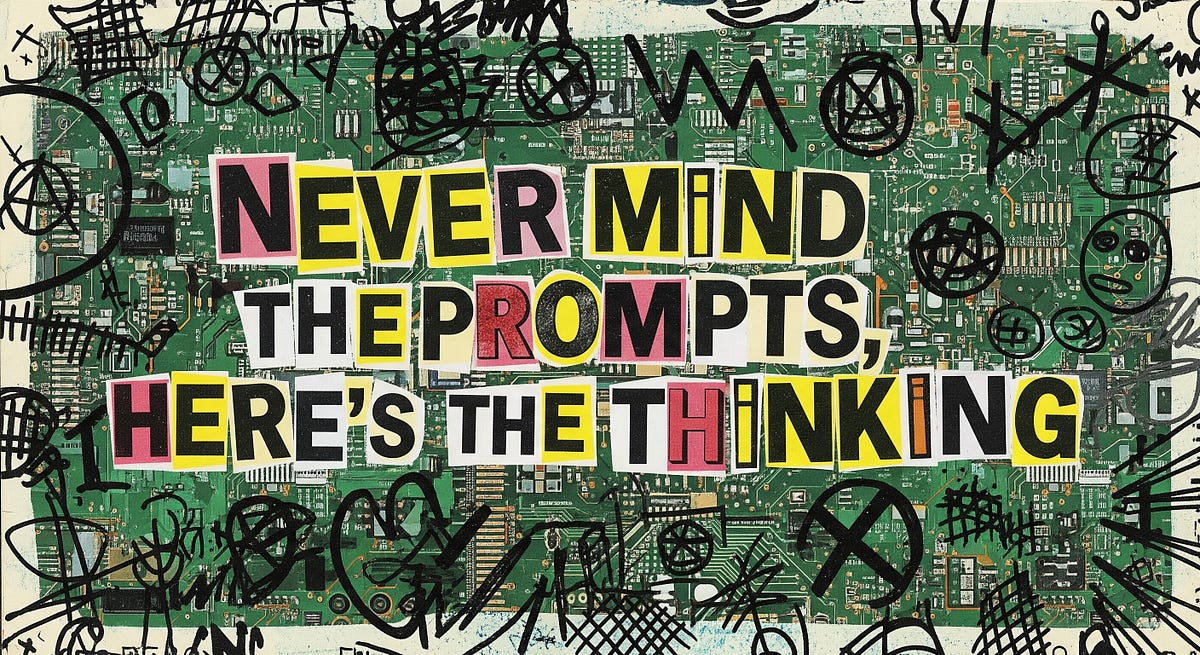
Never mind the prompts, here's the thinking
AI in design is not a speed hack; it is a tool for building cohesive, multi-state systems that eliminate fragmented design-to-development handoffs.
Deep dive
- AI's primary value is in managing complex arrangements (e.g., all user states simultaneously) rather than pure velocity.
- Design sprints often fail to get faster because human decision-making and cross-functional coordination remain the bottleneck.
- The 'Frankenstein handoff'—where PRDs, Figma files, and code drift apart—is solved by generating documentation from the prototype.
- The 'prototype-as-spec' trap occurs when teams fail to document their reasoning, leaving future engineers without context for design decisions.
- Product thinking requires human judgment, which includes knowing when not to build or ship a feature.
- Use AI to generate user stories, flow maps, and acceptance criteria from your working prototype.
Decoder
- Vibe coding: Writing software by relying on AI to generate code based on prompts without full architectural understanding.
- High-speed mediocrity: A state where AI allows a team to ship finished-looking but poorly thought-out work faster than they can evaluate its quality.
Original article
Never mind the prompts, here’s the thinking
I spent a year rebuilding my studio’s entire design process around AI. It didn’t make us faster, and that’s exactly why it worked. It also left behind a kind of debt nobody’s talking about.
Everyone is selling you this pitch about AI and design: it’s faster. Ten times faster. Ship in an afternoon what used to take a month, watch a prototype assemble itself while you sip your coffee.
I bought it too.
Then I spent the better part of a year rebuilding my studio’s entire design process around AI, across four real products, with real clients, real deadlines, and collaborating with real engineers who were used to standard deliverables. To be blunt, it didn’t make us faster.
Our sprints took five days before we changed our process and our sprints still take five days.
And look, I drank the Kool-Aid early. I wanted this to blow up how we work, so I told one of my team members we’d be knocking out sprints in three days flat. He’s heard me be wrong before, and this time he didn’t sugarcoat it: he told me straight up it wasn’t going to make us any faster. He was right. We weren’t. What we got instead was a different way of working, a fuller, more finished output, with a whole new set of ways for things to go sideways. Every. Single. Time.
Here’s what that conversation actually sounded like. I was excited, probably too excited, ready to reinvent the future. My COO let me explain the entire thing and then told me flat out that it wasn’t going to make us faster and I was kidding myself if I thought it would. He’s worked with me, in one way or another, for over 20 years and he knows my rhythm. His skepticism was earned.
That skepticism is the most valuable thing in the room, and most founders treat it like an obstacle. When you run a studio like Charming Robot, nobody has any distance from your decisions. There’s no department to hide behind, no other org to wait out a bad call in. Retool the process and you’re retooling their day, their craft, the muscle memory they spent years building. Of course they push back. They’ve earned the right, usually by being right before.
So you don’t win them with a mandate or a pep talk. You win them by being willing to be wrong out loud, and by letting the work make the case instead of making it yourself. I stopped promising speed. I kept the loudest skeptic closest and made him poke holes in every step, then let him watch the output get better instead of faster. Keep your skeptic that close and one day he stops arguing with the process and starts defending it. That’s the day you know it works.
And that turned out to be the best thing that’s happened to how we work.
Slow Ride
Speed is the headline for so many things AI because speed is easy to sell. It’s sexy in a LinkedIn post. It makes a great slide for your boss who read ONE great article on the plane and now wants to know why the design team isn’t a tenth of the size. And let’s be honest, all over the world, “AI makes it faster” is a headline any CFO can fall in love with.
The problem is that it’s the wrong framing.
The person who ends up using what you build never sees your sprint. They see the product. And they have never once cared how fast you made it, only whether it does the thing they showed up to do.
When you optimize a creative process for raw speed, you don’t get better products. You get the same products, just sloppier, sooner and shortsighted. You get what I’ve started calling “high-speed mediocrity,” work that shows up faster precisely because nobody slowed down to think.
This is Spinal Tap logic: cranking the amp to eleven and mistaking a bigger number for a better sound. Sure, these bots can generate a screen in ninety seconds, but they can’t tell you whether that screen should exist.
Whole Lotta Love
Once we retooled the process, it clicked. This is the part AI is actually good for, and it’s worth a whole lot more than speed. Same idea of a five-day sprint we’d always run, but the new version of those five days delivered real value, to us and to the client.
In the old world, we’d design desktop first, then mobile, then tablet, then the edge cases. Every one of those was good work. Every one was also its own build, its own review, its own week or two on the calendar. Line them up and a single product becomes a relay that runs for a month, each leg boxing in the legs that haven’t run yet.
Before anyone accuses me of sneaking speed back in through the side door: the sprint is still five days, and nobody here got faster at design. What went away was the relay. This time, we built all five states at once. Live. Interactive. Flip a toggle and watch the page rearrange itself for a logged-out stranger versus a power subscriber. Switch to mobile and it’s already there. Same five days, an order of magnitude more product.
Come Together
Here’s the part the engineers in my life care about most. It’s where all the scattered pieces finally come together into a single source of truth. The old handoff was laborious, and the information kept shifting as we moved through each step. Every one of those pieces lived in its own artifact, and every one of them drifted out of date.
Now the brief comes first too, written up front and approved by engineering before anyone opens an AI tool. What’s different is what comes after. Once the design is locked, the system generates the documentation and the component library straight from the approved, working prototype: user stories, flow maps, error conditions, acceptance criteria, implementation notes, and the components themselves.
And because that documentation is generated from the prototype instead of maintained next to it, it cannot become out of date. Every change order rebuilds it. Move a state, kill a screen, rethink a flow, and the user stories, the acceptance criteria, and the error conditions regenerate to match what is actually there.
Dust in the Wind
Everybody’s worried about technical debt from vibe coding, the messy, bloated code these tools spit out. That debt is real, and it’s manageable. The one that’s really going to hurt you is much more subtle and is rarely communicated. It’s the why. Why this flow and not that one. Why this default, this state, this tradeoff. The AI never writes that part down, because the AI never had a reason in the first place.
Because AI is so good at producing a confident, finished-looking deliverable, the temptation is to let the prototype become the spec, to let the thing that looks done stand in for the thinking that was supposed to happen first.
So we built the process to make “nobody knows’” impossible. Every sprint opens with an experience brief, not a PRD, and that brief has to answer the why before anyone opens an AI tool. The reasoning goes in before the first prompt is given and comes back out the second the prototype is real, and it regenerates every time the prototype changes.
Freewill
So here’s where the whole thing actually lands: on judgment, on the calls that are still yours to make. AI does give you something back. It’s not a factor of five days down to three, but a lot more you can get done inside those same five days. Whether that turns into a gift or a liability comes down to what you do with it.
Spend it on more output, and you get high-speed mediocrity. Spend it on judgment, and you get the thing you actually came to build. Users never see the model, the infrastructure, or the ninety seconds it took to generate a screen, and they never wanted to.
It’s why a human still makes every call about what’s worth building, and whether a thing is good enough to put your name on. The tools got dramatically more capable this year. Our judgment is the only thing that decides whether that capability makes the work better, or just makes the mediocrity arrive on time.
References and further reading
On chasing speed
- Patrick Neeman, “The Generative AI Prototype Revolution”
- Jakub Krehel, “Less Is More, More or Less”
- Kezia Jungco, “What Is AI Slop?”
On the handoff and a single source of truth
- Noah Davis, “The Designer-Developer Handoff Is Still Broken”
- Beau Ulrey, “Single Source of Truth Is a Lie”
- Darren Yeo, “Rethinking Figma in an AI World”
On vibe coding and the prototype-as-spec trap
- Simon Willison, “Not All AI-Assisted Programming Is Vibe Coding”
- Nicola Piedimonte, “Your AI-Generated Prototype Is Probably Not a Prototype Yet”
On judgment, taste, and outcomes
- Jakob Nielsen, “AI: First New UI Paradigm in 60 Years”
- Nate B. Jones, “Your prompts are disposable. Your rejections compound.”
- Dolphia, “Your Design System Runs on One Person’s Judgment”
- Aurélie Radom, “The Organizational Cost of Low Taste”
- Clayton Christensen and Theodore Levitt, “Clay Christensen’s Milkshake Marketing”
On leading a team through the change
- Bart Mroz, “People First: Why Workers Shouldn’t Be Viewed Solely as Resources”
- Ajay Pundhir, “Your Resistant Employees Know Why Your AI Adoption Is Failing”
- Susan Curtin, “Why AI Adoption Is Really About Trust”
- Sascha Bosio, “AI Change Management: From Skeptics to Champions Without Mandates”
- Ashley Reichheld and Christina Brodzik, “Workers Don’t Trust AI. Here’s How Companies Can Change That”
Headless Form Library (Website)
Formisch is a lightweight, framework-agnostic form library that leverages Valibot for type-safe validation and signals for reactive performance.
Deep dive
- Modular API allows tree-shaking to keep bundle size small (2.5 kB).
- Uses Valibot as the core schema validator for strict type inference.
- Built on signals for fine-grained DOM updates without full component re-renders.
- Headless design decouples state logic from UI components.
- Framework-agnostic core inserts framework-specific reactivity code at build time.
Decoder
- Headless: A UI pattern where the library handles logic and state without providing pre-styled components.
- Signals: A reactive primitive that tracks state changes to trigger surgical DOM updates only where needed.
- Tree-shaking: A build-step optimization that removes unused code from the final production bundle.
Original article
Modular and type-safe forms
Build your next form with Formisch, the open source form library with performance, type safety and bundle size in mind.
Highlights you should not miss
-
Small bundle size
Due to the modular design of our API the bundle size starts at 2.5 kB
-
Fully type safe
Enjoy the benefits of auto-completion and type safety in your editor
-
Fine-grained updates
Built on signals DOM updates are super fast and mostly fine-grained
-
Built on Valibot
The Valibot schema is the source of truth for validation and type inference
-
Headless design
Bring your own components or connect it to any pre-build component library
-
Powerful features
Add dynamic field arrays and nest your form values as deep as you like
Frequently asked questions
- Where can I enter my credit card?
You don't have to! Formisch is available free of charge and licensed under the MIT License. However, we rely on partners and sponsors to fund the project. If your company would like to support us, you can take a look at our sponsor page on GitHub.
- What exactly does Formisch do?
Formisch is a framework-agnostic form library that helps you build forms in a type-safe and performant way. It provides a simple and intuitive API to manage form state, handle user input, and perform validation. Formisch is built on top of Valibot, which is the source of truth for validation and type inference.
- How does a modular design reduce bundle size?
Due to the modular design of our API, a bundler can use the import statements to remove the code you don't need. This way, only the code that is actually used ends up in your production build. This also allows us to add new functionality to Formisch without increasing the size for all users.
- How is it different from others?
What makes Formisch unique is its framework-agnostic core, which is fully native to the framework you are using. It works by inserting framework-specific reactivity blocks when the core package is built. The result is a small bundle size and native performance for any UI update. This feature, along with a few others, distinguishes Formisch from other form libraries. Our vision for Formisch is to create a framework-agnostic platform similar to Vite, but for forms.
Why Systems Thinking is Becoming the Most Important UX Skill
Apple's 2026 WWDC updates signal a pivot for designers from screen-focused craft to platform-level systems thinking.
Deep dive
- Apple's 2026 update enables Siri to invoke app functions without opening the app.
- Screen-based design craft is becoming commoditized by AI tools.
- Design focus is shifting toward 'taste' and systemic experience architecture.
- Platforms now require apps to be aware of on-screen context and platform intent.
- New toolkit recommended: Job Stories, flow diagrams, and state charts.
Decoder
- State chart: A diagram that describes the different states an object can be in and how it transitions between them based on events.
- Job Story: A format for user requirements that emphasizes the context and trigger of a task: 'When [situation], I want to [motivation], so I can [expected outcome].'
- Intelligence Framework: The set of APIs and tools Apple provides to let third-party apps integrate with system-level AI capabilities.
Original article
Why systems thinking is becoming the most important UX skill
As apps become more context-aware, the designer’s job is shifting from shaping screens to shaping systems.
Apple made a clear shift with their AI strategy at WWDC 2026: Siri now draws on Gemini models through a Google partnership, and their Intelligence Framework gained a selection of new features. These headlines didn’t immediately feel that remarkable. They read more like AI engineering updates, but within this announcement lay changes that matter to designers. Today the design community is very much focused on craft and taste, but with these changes it’s likely to take a back seat to being able to deliver a high-quality platform embedded experience.
Taste is having a moment
Over the last year there has been a renewed interest in delivering highly polished and ambitious visuals in app design. There is real value in well-crafted experiences, when properly executed high-craft is a powerful skill, and it’s really having a moment. Organizations want their values to echo through their app experiences and are pushing on visuals to help differentiate themselves and establish a genuinely unique identity.
At the same time design craft is becoming increasingly cheaper and commoditised through generative AI. Polished screen designs, motion animations and foundations of design systems are no longer as time intensive to produce and are abundant even in solo engineered apps. That is why the conversation has now shifted to ‘taste’. The idea of conscious judgements that set a coherent design direction from the underlying principles to the resulting visual form, and taste is a very human quality accrued through real experience over time.
This moment might be shorter lived than expected, as we enable agents to execute more tasks on our behalf, screen-based flows fold in on themselves to intents, replaced by API calls and lightweight confirmations. Here the beautifully crafted experience still matters, but it’s not where the experience lives.
As designers continue to rapidly evolve their skills in an AI first world, taste judgement can elevate the experience but only so far and the real differentiator in app design becomes the overall experience architecture, and how flexible and robust apps are in embedding into the platform.
Apple’s WWDC announcements are a clear signal of where app design is headed, and the skills designers will need to bring to the table.
Apple pushes design from screen to system
Apple’s big move is providing more contextual hooks for platform based AI like Siri to invoke app functions. This means Siri can call your app even when it’s not launched, and your app can also get more user context on other available app services. This is a large shift for a platform that was very restrictive in how the apps manifested on the operating system, especially in iOS where apps are walled gardens with intentionally limited inter-operability.
From a designers perspective platform level inter-operability is no longer an optional after-thought, it's now part of the core experience. There are three noteworthy platform behaviours worth understanding:
- Siri accrues knowledge about user intents through actions and context, which allows it to trigger an app function at the appropriate moment.
- The platform has on-screen contextual awareness through your app, so it knows what you mean when you say ‘this’ or ‘that’ when referring to something on screen.
- Screen-less experiences where app plug-ins can be invoked by the platform without the user ever having to open your app.
To better illustrate how this plays out, let’s say I have an app called ‘Meemer’ that can take a short video clip to create an animated gif with subtitles. In a world where the app has all the appropriate hooks I could take a video in my camera app, then say to Siri “Make this into a funny Meemer sepia-style gif and email it to Bob”. The user never opens the ‘Meemer’ app, at most the user would get a confirmation screen before the gif in the email is sent.
What makes this significant is the scale of its reach, Apple’s platform hooks mean that even users who have never deliberately engaged with AI will encounter it seamlessly through apps they already use. This is pushing AI further into the everyday.
“In the platform driven experience, the systems thinking designer has the clear advantage”
Crucial skills and forgotten tools
Being able to think beyond the screen edge and take on that system thinking is the skill that will serve designers well in this next chapter. The UI will continue to be important, but more and more will be defined through the contexts that shape a response or a system agent that only reveals pertinent information.
This shift requires a different toolkit. Job Stories in particular are a great way to articulate the tasks users are seeking to complete coupled with a contextual trigger. Understanding the users’ real world context, what’s happening in the moment — these are questions that matter even more when they can be the primary drivers of app interaction.
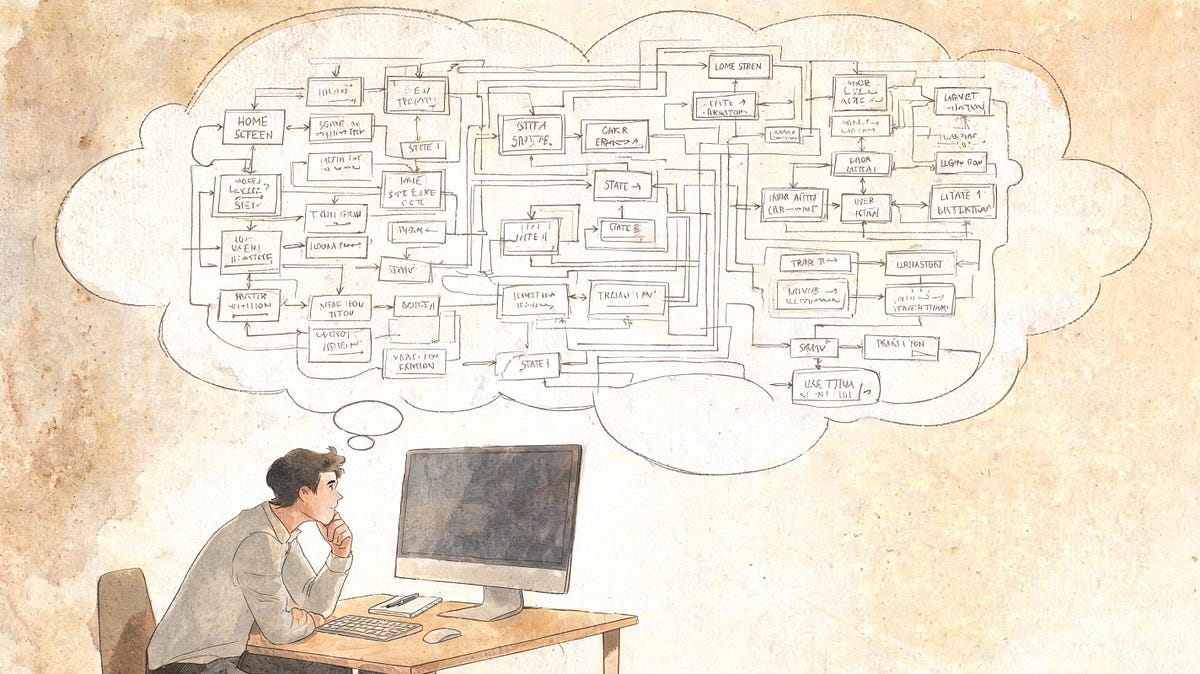
Other underused but vital tools are flow diagrams and state charts. State charts in particular are very powerful in that they can represent complexity in systems by capturing attributes and conditional transitions without resulting in a linear sequence of screens.
Ultimately systems thinking and platform based design is very much about understanding user needs at the right moment. The only way to get the real insights is to spend time running effective user research with real people and not just relying on AI approximations.
Taste is the skill of this moment. Systems thinking is the skill that will become indispensable in the next chapter of design. Designers who start building that capability now will be the ones setting the standard when the shift arrives in full.
Broadcom, Apple Extend Tie-Up to 2031 With New Custom Chips
Broadcom and Apple have extended their chip partnership through 2031, focusing on custom ASICs to support Apple's upcoming AI server infrastructure.
Decoder
- ASIC: A chip designed for a specific task rather than general-purpose computing, allowing for higher efficiency and performance in specialized applications like AI inference.
Original article
Broadcom and Apple have expanded their partnership through to 2031. The companies are working together to develop application-specific integrated circuit (ASIC) silicon for multiple generations of Apple products. ASIC chips are increasingly vital to the development of components for processing artificial intelligence-related tasks. Apple plans to deploy its advanced AI servers as early as 2027.

Everyone Is Wrong About Open Source AI in the Enterprise
Production AI workloads in the enterprise are beginning to shift from massive, general-purpose frontier models toward smaller, specialized, open-source alternatives.
Original article
Everyone is wrong about open source AI in the enterprise
The prevailing story right now is that open source is eating the enterprise. The capability gap between the best closed and open models has shrunk to low single digits. A third of the Fortune 500 has...
PACE: A Proxy for Agentic Capability Evaluation
The PACE framework cuts the cost of evaluating agentic LLMs by over 99% by using a small statistical subset of benchmarks to predict broader performance.
Decoder
- Agentic LLM: A model capable of taking autonomous actions in an environment to achieve a goal, rather than just generating text.
Original article
PACE framework predicts costly agentic LLM benchmark performance using a small subset of atomic evaluation instances, achieving high accuracy at a fraction of the cost. It uses a regression model with selected instances from non-agentic benchmarks to predict scores on agentic benchmarks. PACE reduces evaluation costs by over 99% while maintaining a mean absolute error under 4%, aiding model development and selection.
TeraWulf shares surge on $19B Anthropic AI infrastructure lease deal
TeraWulf secured a $19 billion, 20-year lease agreement with Anthropic to provide 401 megawatts of critical IT load at its Kentucky data campus.
Decoder
- Critical IT load: The total power required to run the servers and cooling infrastructure within a data center, often used as the standard metric for capacity in large-scale hosting contracts.
Original article
TeraWulf shares surge on $19B Anthropic AI infrastructure lease deal
TeraWulf (NASDAQ:WULF) shares rose 13% on Monday after the company announced a long-term artificial intelligence infrastructure lease with Anthropic alongside the sale of a majority stake in a joint venture, moves that significantly expand contracted revenue while recycling capital into new development projects.
The digital infrastructure company said it has signed a 20-year lease agreement with Anthropic for capacity at its Justified Data Campus in Hawesville, Kentucky.
The agreement is expected to generate approximately $19 billion in contracted revenue over the initial term, according to TeraWulf.
The campus is designed to support around 401 megawatts of critical IT load and will be developed in phases, with initial capacity expected to come online in the second half of 2027 and full buildout targeted for early 2028. TeraWulf said the lease is expected to be backed by investment-grade credit.
TeraWulf CEO Paul Prager said the Anthropic lease marks a "landmark partnership" that validates the company's strategy of securing long-duration customer commitments for large-scale AI infrastructure campuses.
He said the agreement "establishes a long-duration revenue stream" and demonstrates the company's ability to secure major AI customers while developing power-secured infrastructure at scale.
TeraWulf also announced it will sell its 50.1% ownership interest in the Abernathy Joint Venture to an investor group led by Fluidstack, its existing partner.
The transaction values TeraWulf's investment at approximately $450 million, representing a premium to invested capital, and will allow the company to redeploy proceeds into wholly owned AI infrastructure projects.
The Abernathy joint venture, established in 2025, was developing a 168 MW AI data center campus in Texas. Following completion of the sale, Fluidstack will continue to lead development of the project.
Prager added that the Abernathy divestment allows TeraWulf to "crystallize value" from its investment while reallocating capital into projects where it retains full ownership and operational control.
Egypt Is Building a New Nile
Egypt is spending billions on its 'New Delta' project to reclaim desert land, though it faces severe long-term risks from non-renewable aquifer depletion.
Decoder
- Aquifer: An underground layer of water-bearing permeable rock, gravel, sand, or silt from which groundwater can be extracted.
Original article
Egypt Is Building a New Nile
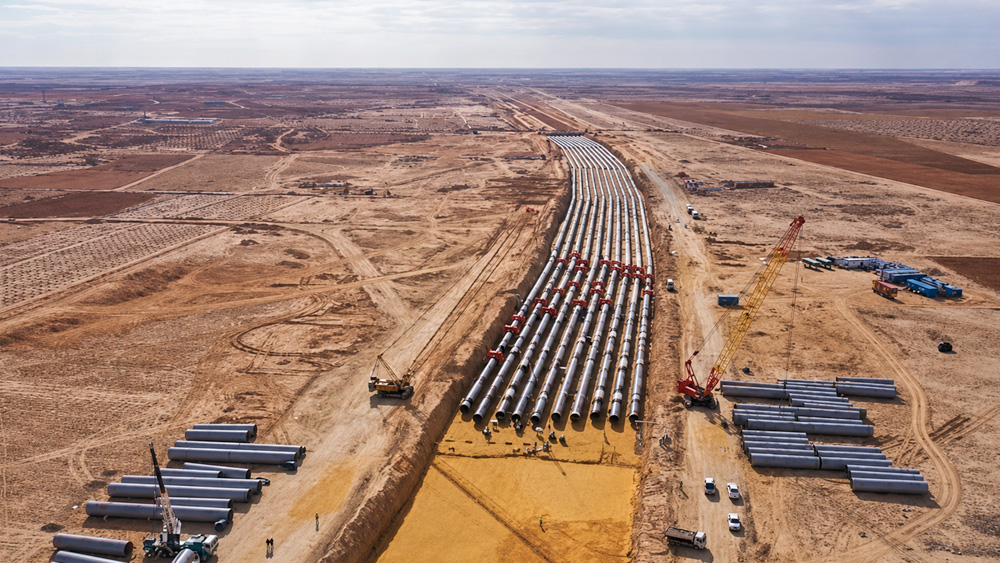
BENEATH the desert west of the Nile, a network of tunnels is being carved through the sand. They are among the first visible signs of one of the most ambitious infrastructure projects in Egypt’s modern history, an attempt to create a new agricultural landscape and relieve mounting pressure on the Nile Delta.
For thousands of years, the delta has sustained Egypt’s population, but that system is now under strain. After decades of intervention, shifting river dynamics and rising demand, the fertile land that once fed the country is approaching its limits. The government’s response is the New Delta project, a vast plan to recycle water, move it across the desert and bring new land into cultivation on a scale rarely attempted anywhere in the world. Early satellite images suggest rapid progress, with hundreds of new fields appearing across previously barren terrain, but questions remain about how sustainable this transformation will be.
Few countries are as tightly bound to a single natural resource as Egypt is to the Nile. Around 95 percent of the population lives along its banks or within the delta where it meets the Mediterranean Sea. Beyond that narrow strip lies vast desert. From space, the contrast is striking. A thin ribbon of green cuts through an otherwise arid landscape, supporting tens of millions of people. For centuries, the Nile’s annual floods carried nutrient rich silt downstream, renewing the fertility of the soil and underpinning agricultural production. That natural system helped sustain one of the world’s earliest complex civilisations.
In the twentieth century, that balance began to change. The construction of the Aswan High Dam, completed in 1970, brought clear benefits. It provided a steady supply of hydroelectric power and allowed water to be regulated for year-round irrigation. At the same time, it halted the natural flood cycle that had sustained the delta for millennia. Sediment that once flowed freely downstream became trapped behind the dam, and farmers increasingly turned to artificial fertilisers to maintain yields. Over time, this shift altered the foundations of Egypt’s agricultural system.
More recently, attention has turned to developments beyond Egypt’s borders. The Grand Ethiopian Renaissance Dam on the Blue Nile is the largest hydroelectric project in Africa and a source of national pride for Ethiopia. For Egypt, which depends on the Nile for the vast majority of its freshwater, it introduces new uncertainty. Even relatively small reductions in water flow could have significant effects over time, particularly as demand continues to rise. Egyptian officials have warned that reduced flows could place increasing pressure on agriculture and water supply in the decades ahead.
At the same time, internal pressures are intensifying. Egypt’s population has grown rapidly, rising from around 60 million in 1990 to more than 100 million today. Most of that growth has been concentrated along the Nile, where land is already scarce. Urban expansion has steadily encroached on farmland, reducing the area available for agriculture even as demand for food continues to increase. The result is a widening gap between domestic production and consumption. Once largely self-sufficient, Egypt is now the world’s largest importer of wheat, relying heavily on global markets to meet basic needs. That dependence was exposed in 2022 when the war in Ukraine disrupted supplies and drove up prices.
It is against this backdrop that the New Delta project was announced in 2018. The plan is to reclaim around 9,200 square kilometres of desert and transform it into productive farmland. If completed, it would increase Egypt’s cultivated land by more than a third. At the heart of the scheme is a complex water management system designed to move and treat vast quantities of water across long distances.
The largest component is the Al Hammam canal, which runs for around 170 kilometres. It collects agricultural wastewater that would otherwise be discharged into the Mediterranean and redirects it inland. A second system draws water directly from the Nile and supplies additional areas. Together, these networks are designed to irrigate a vast new agricultural corridor stretching into the Western Desert, an area that until recently consisted of little more than sand and rock.
Moving water across such distances presents significant engineering challenges. Much of the system begins close to sea level, while the desert plateau it must reach lies around 100 metres higher. To overcome this, a series of pumping stations has been constructed along the route, lifting water in stages as it moves inland. Evaporation is another major concern in the desert climate, where high temperatures can quickly reduce water volumes. To address this, parts of the system run through large underground pipes, limiting exposure to the sun and reducing losses.
Before the water can be used for irrigation, it must be treated. This is handled by the New Delta Water Treatment Plant, a vast facility capable of processing millions of cubic metres of water each day. By some measures, it is the largest installation of its kind in the world. The aim is to turn lower quality drainage water into a reliable resource for agriculture, reducing pressure on the Nile itself and making more efficient use of existing supplies.
There is clear evidence that the project is already changing the landscape. Satellite images show large areas of desert now under cultivation, with distinctive circular fields created by centre pivot irrigation systems. By 2024, thousands of square kilometres had reportedly been reclaimed. For the Egyptian government, this is proof that the project is delivering results.
However, the picture is more complex. Analysts say that much of the water currently being used to irrigate these new fields is not coming from the canal system, but from underground aquifers. These reserves have accumulated over thousands of years and are not easily replenished. Research based on satellite data suggests that groundwater depletion in parts of the Western Desert has accelerated in recent years. Once this water is exhausted, it cannot simply be replaced.
There are also questions about what is being grown and who benefits. Much of the production in newly reclaimed areas is focused on higher value crops such as fruit, vegetables and nuts, which can be exported. The government argues that this generates the foreign currency needed to pay for imports of staple foods such as wheat. Critics, however, say this approach does little to reduce Egypt’s reliance on global markets and leaves underlying food security challenges unresolved.
Egypt has attempted large scale desert reclamation before. In the late 1990s, the Toshka project aimed to create a new agricultural region by diverting Nile water into the Western Desert. Despite significant investment, it fell far short of its original ambitions. A series of new cities built to ease pressure on the Nile Valley has also delivered mixed results, with some developments struggling to attract the populations they were intended to serve.
These experiences have raised questions about whether large infrastructure projects can deliver lasting change. The New Delta reflects both the scale of Egypt’s challenges and the ambition of its response. Its combination of water recycling, large scale engineering and agricultural expansion represents a significant shift in how the country is attempting to manage its resources.
There is no doubt that real progress has been made. But the long term success of the project will depend on whether it can operate sustainably in a country facing increasing water scarcity and continued population growth. Egypt has spent thousands of years learning how to manage the Nile. The New Delta is an attempt to apply that knowledge in a very different context.
Whether it marks the beginning of a lasting transformation, or becomes the latest in a long line of ambitious plans that fell short, will help decide Egypt’s future in the decades ahead.
Alibaba's AI Is a Hit, but Hard to Turn Into a Moneymaker
Alibaba’s Qwen models are gaining global traction for their low cost and open-source accessibility, yet the company struggles to capture significant revenue from this popularity.
Original article
Alibaba's open-source models can be modified and used freely by anyone. Its technology is much cheaper to use than proprietary systems from US competitors like Anthropic and OpenAI. The company's AI models are popular, but it has become a challenge to turn that global popularity into a profitable business.
Big Tech Has Suddenly Flipped on the AI Jobs Wipeout Scenario
Tech CEOs have reversed their stance on AI-driven job displacement, now emphasizing productivity augmentation over workforce replacement.
Original article
Tech CEOs have started to change their stance on AI wiping out jobs over the past year. The industry appears to have underestimated the value of keeping people at the center of everything. Comments by tech leaders now point to a future where workers keep their jobs, but gain a productivity boost from AI. It is unclear whether these statements are a move to win back customers and the public or whether the role of AI in the workplace is just now better understood.
Cells, Chromosomes, and Genomes
For engineers, viewing the genome as a 3-billion-character biochemical database provides the best mental model for understanding personalized medicine.
Deep dive
- Eukaryotic cells contain genomes consisting of DNA sequences wrapped around histones to form chromosomes.
- The genome acts as a master recipe book containing genes that encode for protein synthesis.
- DNA is a double-stranded molecule where adenine (A) pairs with thymine (T), and guanine (G) pairs with cytosine (C).
- Humans possess 23 pairs of chromosomes, which are organized and categorized by size.
- Genomic variations are the primary drivers for health outcomes and disease, and identifying these is the goal of clinical genomics.
Decoder
- Eukaryotic: Organisms whose cells contain a nucleus; this includes all animals, plants, and fungi.
- Genome: The complete set of genetic instructions (DNA) present in an organism.
- Genotype-phenotype relationship: The connection between the underlying genetic makeup (genotype) and the observable physical traits (phenotype) of an individual.
Original article
Introduction
This Guide is written specifically by and for computer scientists and engineers. The underlying biology in cancer genomics can be exceedingly complex and requires years of study. Making the content palatable requires drawing abstractions around these concepts. This guide should be treated as an introduction to the domain that teaches our audience the material in a "broad-strokes" fashion. Please be forgiving if you feel we have glossed over your favorite quirk of cancer genomics. Further, everything within the guide is presented within a research context and may not be relied on in making decisions about patients.
Everything in this guide refers to eukaryotic molecular biology, which is the study of organisms whose DNA is enclosed within a nucleus. Broadly speaking, most familiar species are eukaryotes, except bacteria which has DNA spread throughout the cell. At times, this document will be geared towards the sequencing of human cells specifically.
Cells are the smallest unit of life and are the building blocks of organisms, from a single-celled bacteria to the trillions of cells that make up the human body. Cells are complicated organized structures that take a variety of forms, forming tissues and organs and completing the body's functions.
Within nearly every cell is a genome. A genome is the complete inherited instruction set for producing, operating and maintaining a living cell or organism. This information is physically encoded in a molecule called deoxyribonucleic acid or DNA. Among other things, DNA contains instructions for the assembly of tens of thousands of different molecular products. These instructions (or recipes) are called genes, and the physical, molecular products genes encode for are called proteins. Cells are constantly reading and interpreting genes stored within the DNA in order to assemble various proteins. Each cell type in the body produces a complex ecosystem of proteins that keep the cell alive and executing its specific function.
Bakery Analogy
To illustrate this phenomenon, imagine the cell as a bakery that makes many different types of cakes. In this analogy, the genome stored within the DNA is the master recipe book containing more than 20,000 different cake recipes (genes). The physical cakes that are made from these recipes are the proteins. Notably, there are a limited number of copies of the recipe/gene (two copies in the normal case for humans), but you may make thousands or more physical cakes from those recipes. Depending on the type of cell, the mixture of different cake flavors, their quantities, and how they interact together will be different.
Keep an eye on this analogy—we will refer back to and build upon it a number of times during the course of this guide.
A Mental Model for DNA
Conceptually, you can think of DNA laid end-to-end as a ~3 billion character long string consisting only of 'A's, 'C's, 'T's and 'G's. This string and any substring contained within are commonly referred to as genomic sequences. These characters represent the physical Adenine, Guanine, Thymine, and Cytosine bases (or nucleotides) respectively.
Importantly, though it's easy to conceptualize DNA as a single, very long string, the reality is more complex. DNA is comprised of two complementary sequences known as strands. Each base is actually a member of a base pair, whereby nucleotides complement each other uniquely—'A's pair only with 'T's, and 'G's only with 'C's. Up close, this structure resembles a spiral staircase as seen in the figure below.
When cells divide, the spiral unwinds; each base pair is split; and the molecule is split into two strands, each one containing the information needed to replicate the original DNA structure. Normal healthy cells then copy the genetic code very accurately, rarely introducing variation.
Physical Structure
In plants and animals, DNA is broken up into a number of large sequences called chromosomes that are tucked into the nucleus. Chromosomes typically come in pairs (one from your father and one from your mother) and are wrapped around proteins called histones. These histones keep the DNA string tightly packaged and help control which gene products are made in a given cell. For humans, there are normally 22 pairs of autosomes (chromosomes shared by both sexes) and a pair of sex chromosomes (XX for females or XY for males), totaling 23 pairs of chromosomes. Autosomes are numbered from 1 to 22 based on size, arranged from largest to smallest. The full set of chromosomes makes up the genome.
Conclusion
The genome is a vast search space for biological questions. Each genome is a biochemical database that, if properly accessed, can inform how our bodies function. Genomes account for the natural differences between individuals, define family traits, and distinguish how cells in tissues and organs vary. When genomes acquire adverse mutation(s), cancer as well as other genetic diseases can occur. By examining the relationship between physical traits (e.g. blood pressure or the development of a tumor) and the genome, known as genotype-phenotype relationships, clinicians can develop personalized medical treatment based on an individual's genetic makeup.
Microsoft Is Cutting More Than 3,000 Jobs in Xbox Division
Microsoft is laying off over 3,000 employees in its Xbox division, representing nearly 20% of the entire department's total headcount.
Deep dive
- The workforce reduction accounts for approximately 20% of the Xbox division's total employees.
- These cuts follow Microsoft's prior $68.7 billion acquisition of Activision Blizzard, indicating an effort to consolidate overlapping roles.
- The layoffs affect various teams within the gaming business as Microsoft shifts its focus toward long-term profitability under Phil Spencer's leadership.
Original article
The cuts represent about a fifth of the division's total head count.

AI Video Startup Higgsfield is in Talks to Raise at a $5bn Valuation
Video AI startup Higgsfield is negotiating a funding round at a $5 billion valuation, quadrupling its worth in six months despite recent market volatility.
Original article
Higgsfield AI did not exist before March 2025. Fifteen months on, the video startup is in talks to raise money at a $5bn valuation, four times its worth at the start of the year.
The company is seeking $300mn to $500mn, The Information first reported. That would value it at $5bn before the new money, up from $1.3bn in January. DST Global, the fund built by early Facebook backer Yuri Milner, is among the investors in talks to join. The round has not closed.
The pitch is growth of a rare kind. Higgsfield crossed a $500mn annualised revenue run rate this month, according to reporting on the round. That is up from $200mn at the end of 2025. A platform barely a year old now sells at a half-billion-dollar annual pace. Roughly 70 per cent of that activity comes from enterprise customers.
That enterprise tilt is what separates Higgsfield from consumer novelty apps. Brands want ad clips, product shots, and social posts in hours rather than weeks, and they pay per seat and per render. That is a steadier business than viral demos. It is also why investors treat the revenue as durable rather than a passing craze, and why they are willing to pay up for it.
From Snapchat lenses to AI film
Alex Mashrabov founded Higgsfield in 2023. He ran generative AI at Snap and helped build the team behind Snapchat Lenses. The company’s tools turn text and images into video, and it says it generates about 4.5 million clips a day. TNW has covered its push into the enterprise. There, its marketing agents run on Nvidia hardware for hundreds of Fortune 500 brands.
The headline demo is a feature film. In May, a 15-person team used Higgsfield’s system to make Hell Grind, a 95-minute AI action fantasy. They finished it in 14 days for a reported cost under $500,000. Traditional production of that length runs to millions of dollars and many months. The point is not that the film is a classic. It is that it exists at all, made by a handful of people in a fortnight.
The money is chasing AI video
Investors have decided that generating images and video from a prompt is the next big line item. Higgsfield sits in a crowded field with Kling, Runway, Google’s Veo, and OpenAI’s Sora. It recently shared a Cannes stage with China’s Kling to show off AI-made ad work. The valuations reflect the hype. Higgsfield’s own worth has quadrupled in six months, echoing a wider surge across AI startups.
That surge runs on an unusual amount of capital. Venture firms are raising record AI funds, and Accel, which led Higgsfield’s January extension, sits among them. Higgsfield has moved fast through that money. It raised a $50mn Series A last September, an $80mn extension in January, and now a round many times larger. When capital is this cheap for anything labelled AI, a firm that shows real revenue rather than a demo can raise fast and high.
The catch under the numbers
There are reasons to stay careful. The round has not closed, and talks can fall apart or reprice. A revenue run rate is a snapshot, not a promise. It can drop as fast as it climbs if a cheaper rival or a better model appears. AI video is exactly the kind of market where that happens.
The wider worry is the flood. Cheap, fast video generation has already strained platforms. YouTube is cracking down on AI “slop”, and human creators are caught in the sweep. A tool that makes a feature film in a fortnight can also make an ocean of forgettable clips. Higgsfield is betting that enterprises will pay for the good version, not the noise.
For now, the growth is real and the timing is ripe. A startup that did not exist two years ago is raising at $5bn on the strength of half a billion in annual sales. Whether that holds depends on the one thing no valuation can fix: whether the videos keep improving faster than the price keeps falling.
Technology and Power
Every technological cycle presents itself as democratizing power, but historically, these waves consistently concentrate control among a few large corporations and governments.
Original article
Technology and Power
Every technological cycle is a cycle of power. The promise of empowerment is part of how the cycle works.
Every technological cycle is really a cycle of power. This is not a controversial observation when said about the ones we consider historical — the creation of the printing press and the resulting power of distributed narratives; the creation of the railroad and the resulting power of transportation; the creation of the mechanical loom and the power of production. But, it becomes harder to perceive the connection between technology and power when we’re in the midst of a cycle. Nevertheless, the question to ask is on whom the power is being conferred.
We are inside one now, and it’s a larger cycle than I think most realize. The digital revolution — if we take it to begin with the establishment of the consumer internet in the early 1990s and run it through to whatever AI turns out to be — is now roughly thirty years old. Long enough to look at from a distance; long enough, too, to be looking at clearly.
From the inside, the arc has felt like a series of fluctuations — like several short cycles in a row. The web of the mid-1990s arrived with the promise of democratized publishing; within a decade it had concentrated into a handful of search engines and portals. Blogs and forums followed with the promise of independent voices, then collapsed into the social networks. By the time smartphones arrived in the late 2000s carrying the promise of universal access, the concentration was already happening visibly — into a small set of app stores presided over by a smaller set of companies. Each wave seemed to put corporations and governments on their heels, at least for a moment, before the next consolidation. From the inside, it has felt like a back-and-forth.
From a distance, though, the pattern looks different. It looks like a slow, consistent transfer of power upward — toward governments, toward corporations, toward whoever has the resources to build the next platform on which the next wave of “empowerment” will be served. The apparent back-and-forth is what cover looks like. The phase where everyone gets their own megaphone is always followed by the phase where someone owns the megaphone factory. The promise of empowerment, far from being incidental to the cycle, is part of its structure — a story the cycle has to tell about itself in order to keep moving.
Why would AI be any other way?
This is the right question to put to the present technological moment, and it is worth putting plainly. The promise of AI — that everyone, regardless of background or training, will now have cheap access to capabilities that were previously the preserve of small elites — is structurally identical to the promise of the web in 1996, the promise of social media in 2007, the promise of mobile in 2011. The promise has been made before, and we have seen what comes after it.
This time, though, the asymmetries are already quite visible. The cost of training the largest models is rising into ranges that only a handful of organizations can afford. Compute and energy are being negotiated between governments and a small number of corporations. The data the models depend on is being aggregated, exclusively licensed, or scraped without compensation from the same individuals who are being told they are about to be empowered. The infrastructure on which all of this runs is owned by a smaller club still. The cost of meaningful use exceeds “basic” accounts. The new capabilities are exponentially token hungry. None of this is subtle.
What is subtle — and worth attending to — is the role the empowerment story plays. It isn’t exactly a lie. AI does in fact give individuals access to capabilities they did not have before. The story is partly true. It has to be, or it wouldn’t work. The point is that it functions, regardless of its truth, as the cover under which the actual concentration proceeds. And sure, it’s easy to attribute malice to market mechanics, but if this sort of progression wasn’t by design, the billionaires wouldn’t invest. But they do.
To be clear, this is not an argument against AI, or against the digital revolution. My entire career has no place outside of it. Most of my interests, skills, and way of life depend upon this cycle’s output. But, this is an argument for keeping the right question in view while the cycle runs its course. The question is not whether the technology will reshape what humans can do. It will.
The question is on whom the power is being conferred. The answer, this time as every time, will not be found in the marketing or in the founders’ interviews about their commitment to humanity. It will be found later — in the shape of the institutions that survive the cycle, and in the shape of the ones that do not; in the liberties that are retained and those that are lost; in the way of life we can make entirely on our own. Pay attention to those, and you will see who the cycle was really for.
Generative Workspace (Website)
Fuser Studio provides a node-based visual interface to orchestrate workflows across over 1,000 different AI models.
Decoder
- Node-based canvas: A visual programming interface where tasks are represented by nodes connected by lines to indicate data flow.
Original article
Build scalable AI workflows with Fuser's node-based canvas. Access multiple AI models for image, video, audio, and 3D generation plus 1,000+ LLMs in one workspace.

Getting started with loops
Coding agents are evolving from single-shot prompts to autonomous loops that cycle through work until a clear exit condition is satisfied.
Original article
Loops are agents that repeat cycles of work until a stop condition is met. They can be categorized based on how they are triggered, how they are stopped, what Claude Code primitive is used, and what type of task is appropriate for each. This post covers the main loop types, when to use each, and how to maintain code quality while managing token usage.
xAI Is Dead. Long Live SpaceXAI
Elon Musk's xAI has rebranded to SpaceXAI, signaling an explicit alignment between its generative AI development and space exploration infrastructure.
Original article
xAI has rebranded to SpaceXAI. The rebranding brings new clarity to the business. The AI division is critical to Elon Musk's narrative about SpaceX's future. In this story, space infrastructure and exploration are inextricably linked to AI.

Apple veteran's Chinese smart-glasses firm becomes unicorn as Tencent, Meituan fund rival to Meta
Even Realities Technology reached a $1 billion valuation, backed by Tencent and Meituan to compete with Meta’s camera-heavy smart glasses.
Decoder
- Unicorn: A privately held startup company valued at over $1 billion.
Original article
Even Realities Technology, founded by ex-Apple exec Will Wang, has reached unicorn status thanks to a $150 million funding round led by Tencent and Meituan.

What The New 100x Agentic Engineer Looks Like In The Era Of Fable & GPT 5.6
The emergence of '100x agentic engineers' leverages specialized workflows with advanced AI models to achieve order-of-magnitude productivity gains.
Decoder
- Agentic engineering: A software development paradigm where AI models act as autonomous agents that can plan, execute, and iterate on complex programming tasks with minimal human intervention.
Original article
There are levels to the art of agentic engineering that result in outlier agentic engineers with orders of magnitude more productivity than the median.

Apple's iPhone Ultra will be double the price of the iPhone 17 Pro Max
Apple’s upcoming foldable iPhone Ultra is projected to launch in September 2026 with a price tag between $2,300 and $2,500.
Original article
The iPhone Ultra will be announced in September together with the iPhone 18 Pro and Pro Max. It will start shipping about a month later. The foldable phone is estimated to be priced at around $2,400. It is likely that the phone will sell out immediately after pre-orders open, and then there will be delays running through December.
Forward Deployed Engineering Is About To Get Diluted
The rise of the Forward Deployed Engineering role is facing a potential dilution as it shifts to meet rapidly evolving market needs.
Original article
The Forward Deployed Engineering role is growing as the role is trying to answer a current market need.
Netflix Viewers Are Abandoning Shows After One Season
Netflix faces growing investor anxiety as subscriber engagement declines, marked by a trend of users abandoning shows after only one season.
Original article
Netflix's inability to retain audiences is fueling growing investor concern about engagement.
WhatsApp iPhone app getting a green dot to show who's online
WhatsApp is rolling out an online status indicator to its iPhone app, bringing it in line with the feature already available on Android.
Original article
The latest WhatsApp beta for iPhone introduces a green dot that indicates when a contact is currently online, matching a feature already rolling out on Android. The indicator respects privacy settings by only appearing if users allow their online status to be shared and only while the app is actively open. For now, it's only visible in a contact's info screen, but Meta is reportedly working on a dedicated Contacts view that will highlight online and recently active users.
Apple's foldable iPhone may arrive this fall, but good luck getting your hands on one
Apple’s rumored foldable iPhone may arrive this September with a $2,300 price tag, but production constraints suggest supply will be extremely limited.
Original article
Apple's first foldable iPhone, expected to launch as the iPhone Ultra alongside the iPhone 18 Pro lineup, may follow the iPhone X's rollout by being announced in September but shipping later due to limited production. Apple is reportedly expected to have only 500,000 to 1 million units ready at launch, compared with 20–22 million for the Pro models, leading to likely shortages despite its estimated $2,300–$2,500 price. Strong demand could result in weeks-long delivery delays, opportunities for scalpers. Apple is already said to be planning a second-generation foldable for 2027.
AI Creative Resizing for Performance Ads (Website)
PixFit uses AI to automatically resize and adapt single master creative assets into various social media and advertising formats.
Original article
PixFit turns one master asset into every ad format you need. AI creative resizing for marketing teams that ship at scale.
The Battle for Simplicity: How Competition is Driving Platforms to Simplify User Experience
In 2026, market competition is forcing digital platforms to simplify user interfaces to reduce cognitive load and curb churn.
Original article
Competition among digital platforms in 2026 is pushing companies toward simpler, more intuitive interfaces to retain increasingly discerning users. AI-driven personalization and real-time feedback loops help reduce cognitive load and let developers quickly fix friction points. Success depends on balancing new technologies like AR or blockchain with usability, favoring platforms that keep innovation from overwhelming the user experience.

This clever rebrand finds its entire personality in one tiny flourish
Lark Design Studio's rebrand of Wottz demonstrates how a single, subtle typographic detail can create a more durable identity than complex systems.
Original article
Lark Design Studio created a minimalist new identity for Wottz, centred on a custom wordmark with a subtle lightning bolt hidden in the double "t" to reflect the company's attention to detail. Rather than relying on an elaborate brand system, the identity uses a restrained colour palette, custom icons, and consistent application across packaging, products, and vehicles to create a distinctive, durable brand. The project demonstrates how a single, well-executed idea can be more effective than a complex visual identity, especially for smaller businesses.

Move Over Minions, Not Alone Shows Illumination Still Has a Knack for Adorable Character Design
Illumination is betting on a new trio of chaotic aliens in Not Alone to potentially replicate the massive success of its Minions franchise.
Decoder
- Illumination: The animation studio behind the Despicable Me and Minions franchise, known for its character-driven, comedic animation style.
Original article
Illumination unveils a teaser for Not Alone, an original film pairing a gentle space-set romance with chaotic alien sidekicks reminiscent of the Minions.

Steph Curry's new logo is the ultimate game of spot the difference
Stephen Curry has refreshed his SC30 logo to incorporate Li-Ning branding, marking his shift toward creative independence following a 10-year partnership deal.
Original article
Stephen Curry has unveiled a subtly updated SC30 logo that integrates Li-Ning branding to celebrate his new 10-year partnership and creative independence from Under Armour.

3D Artist Andres Rios Brings Horror Icons to Life Through Digital Art
Digital artist Andres Rios has gained attention for his horror-focused creature designs, blending original concepts with reinterpretations of icons like Pennywise.
Original article
Andres Rios is a digital artist who specializes in horror-themed illustration and creature/monster design.