Beyond Redaction: Anatomy of a Privacy-Safe Data Platform
True privacy engineering requires governing data usage and proving compliance at the point of use, rather than just redacting values.
Deep dive
- Privacy controls must be selected based on the specific utility required (e.g., deduplication vs. aggregation).
- Deterministic tokenization is useful but pseudonymous; it does not eliminate re-identification risk.
- Classification is an ongoing, versioned control, not a one-time setup.
- Policy-as-data allows for simulation, versioning, and rollback.
- Evidence should link policy version, request, transformation, and enforcement logs in an auditable chain.
- LLM applications require guardrails at the point of retrieval, not just the point of output.
Decoder
- Deterministic Tokenization: A process where the same input value consistently maps to the same token within a specific domain, allowing for data joins without exposing raw identifiers.
- Pseudonymization: A data processing technique that replaces private identifiers with artificial identifiers, reducing risk while still allowing for data linkage.
- Canonicalization: Converting data into a standard format so that equivalent values are processed identically.
Original article
Beyond Redaction: Anatomy of a Privacy-Safe Data Platform
The hard problem is not making personal data disappear. It is preserving the minimum useful properties for an allowed purpose, limiting who can link the data, and producing evidence that the controls actually ran.
The most useful question to ask of a privacy platform is not “Can it hide this column?” Almost every platform can. Ask instead: what property must this recipient retain, for which permitted purpose, and what evidence will prove that the platform enforced the decision?
That framing changes the architecture. A data scientist may need stable equality to deduplicate records. A support agent may need a governed path to re-identify one customer. A partner may need aggregates but must not be able to correlate its copy with another partner’s. An engineer provisioning a test environment may need intact foreign key constraints but no production identities. Those are different jobs. A single control called “mask” cannot answer all of them safely.
Redaction, encryption, tokenization, governed views, aggregation, synthetic data, and clean-room-style access are not competitors in a feature checklist. They are controls with different privacy and utility properties. The mature design selects among them deliberately, then makes the decision inspectable.
One terminology point matters throughout this article: a deterministic token is usually pseudonymous, not automatically anonymous. It can lower exposure while retaining the ability to link records; depending on the recipient, auxiliary data, and access to the key or vault, it may remain personal data under privacy law. That is useful—not a failure—but it means “PII-free” is usually too strong a claim.
This is a technical reference architecture, not legal advice. Legal and privacy teams must review each production policy against the organization’s jurisdictions, contracts, and processing purposes.
TL;DR: Match the Control to the Utility
Need to join approved internal tables?
Use purpose-bound deterministic tokenization. It preserves equality inside the approved domain while keeping raw identifiers out of the analytical copy.
An external partner needs insight?
Use aggregation, a protected query, or a clean-room workflow. These approaches deliver useful results while reducing direct linkability and release risk.
Authorized staff need to re-identify a person?
Use vault-backed reversible tokenization. It makes recovery permissioned, purpose-bound, and auditable.
Does an auditor need proof of a release?
Use a signed manifest plus a protected audit trail. Together, they connect the artifact to its policy, transformation, approvals, and evidence of enforcement.
An LLM or RAG workflow may expose data?
Use retrieval authorization plus output guardrails. Enforce access outside the model and check sensitive output before release.
The five-stage pipeline: discover, authorize, protect, use, prove
1. Discover and classify candidates—not certainty
Discovery begins with metadata: connectors, schemas, column names, lineage, ownership, and tightly controlled sampling. A practical classifier layers cheap signals over expensive ones:
- Column-name and metadata heuristics quickly find well-labeled fields.
- Pattern recognizers find structured identifiers, including region-specific forms.
- NLP and contextual analysis identify names, addresses, and free text that do not match a regex.
The output should be a set of candidates: data type, sensitivity tier, confidence, evidence, recognizer version, and review state. A boolean is_pii loses the uncertainty that operators need. Low confidence may block a high-risk export, route a field to human review, or narrow the downstream purpose; it should not silently become “not sensitive.”
Recognizer count is a weak buying signal. Ask what runs by default, which models or language packs are optional, what data leaves the environment during analysis, and how the system measures false positives and false negatives on your schemas. Discovery is important, but it is not proof that an output is free of personal data.
There is a further operational trap: classification drifts. New fields arrive, owners rename columns, free-text use expands, and upstream sources change their formats.
Treat classification as a versioned, recurring control rather than a one-time migration.
A useful platform records the scan scope and timestamp, compares the latest classification with the last approved state, and sends material changes to a review queue. Without that loop, the policy engine makes precise decisions based on stale assumptions.
2. Authorize the use, not merely the field
Classification tells us what a value may be. Authorization determines whether a particular actor may use it at this time. Good policy evaluation considers at least:
- data class and sensitivity;
- principal, role, and tenant;
- declared purpose and retention window;
- recipient and destination;
- jurisdiction, contract, and approved legal basis;
- consent or opt-out state where applicable; and
- The required control and approval path.
Consent is one input, not a universal switch. The practical pattern is policy-as-data with versioning, approval, simulation, and rollback.
A useful result is not just “allow” or “deny,” but: allow this role to use a pseudonymous join key for fraud analysis until this date; deny raw identifier export; record the decision and policy version.
Enforce at the point of use
The policy engine should express a decision; the platform should enforce it at a dependable point in the data path. This separation also makes change management safer. The lifecycle is propose → simulate → approve → enforce → verify → rollback. Simulation should answer concrete questions before a policy goes live: which tables, columns, users, and jobs would change; which scheduled workloads would fail; and whether a new rule would materially raise or lower exposure.
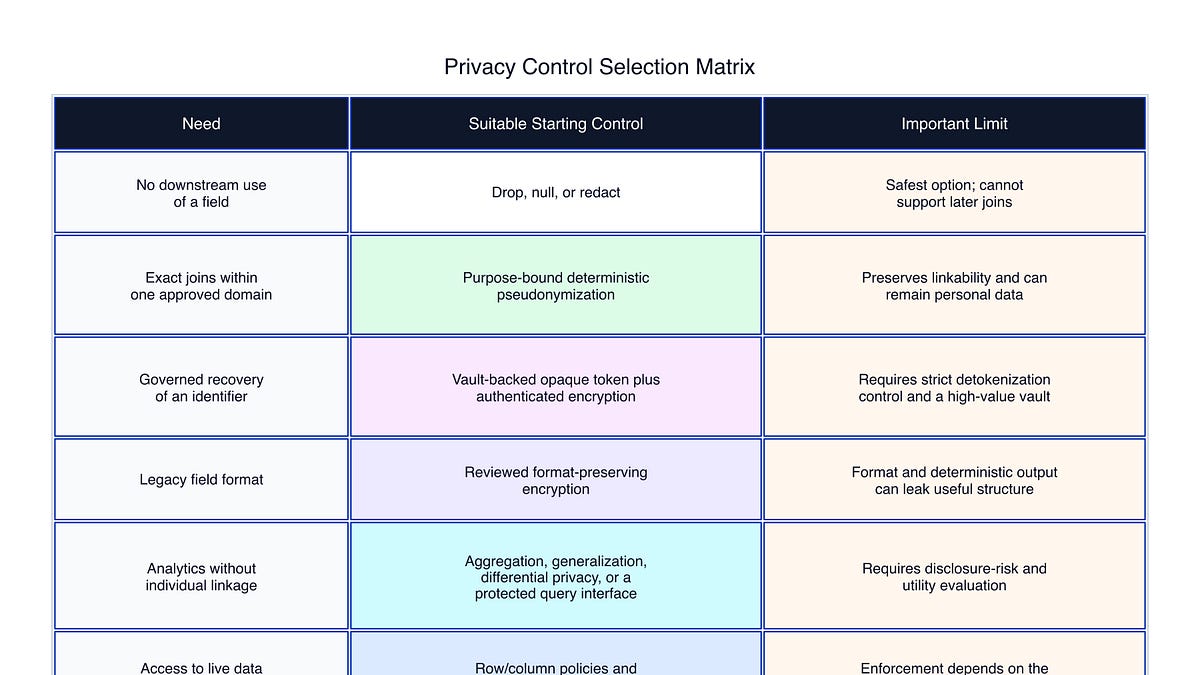
3. Select the smallest control that preserves the required utility
The distinction that matters is not “redaction versus tokenization.” It is which property of the original value the recipient truly needs.
Redaction, therefore, remains a valid privacy strategy. Use it when no downstream utility exists. The mistake is presenting it as sufficient for every purpose—or treating a join-preserving token as if it automatically makes sharing safe.
Control selection should also reflect the recipient. A data scientist working inside a controlled tenant may need a stable token. An external partner may instead need aggregates, a protected query interface, or a narrowly scoped clean-room workflow. The policy can therefore drop the same field in one export, tokenize it in another, and grant access through a governed view in a third. Privacy architecture is a decision system, not a permanent label attached to a column.
Deterministic tokenization: preserve equality, bound linkage
Deterministic tokenization is powerful because it can preserve equality: the same canonical input produces the same token inside an approved domain. Two tables can then join without carrying the direct identifier alongside the analytical copy.
def token_reference(value, tenant_id, entity_type, purpose_domain, key):
    canonical = canonicalize_by_type(value, entity_type)
    message = canonical_json({
        "version": 1,
        "tenant": tenant_id,
        "entity": entity_type,
        "purpose_domain": purpose_domain,
        "value": canonical,
    }).encode()
    mac = hmac.new(key, message, hashlib.sha256).digest()
    return "tok_v1_" + base64.urlsafe_b64encode(mac[:20]).decode().rstrip("=")
This is a design sketch, not a drop-in cryptographic service. Production code needs keys from a managed KMS or HSM, key identifiers and rotation, authenticated service boundaries, telemetry that does not log the input, explicit token-format contracts, and collision detection appropriate to the token length and scale.
Tenant isolation belongs in the same design, not as a metadata afterthought. Derive or select keys by tenant and purpose, bind tenant and entity context into the token request, verify the caller’s tenant before the lookup, and scope every vault read and write.
Three modes, three different promises
Irreversible pseudonymization uses a keyed deterministic reference with no recovery path. Use it when an approved use needs equality but excludes re-identification.
Reversible tokenization normally needs a vault. One sound pattern maps an opaque, stable token to an encrypted original value. Detokenization is a privileged workflow: strong authentication, a purpose check, perhaps dual approval, a rate limit, and an immutable audit event.
Per-recipient tokens add a recipient or purpose domain. This prevents two recipients from directly correlating records by token equality while preserving joins inside each recipient’s domain.
Encryption, format preservation, and the names that must stay honest
- A hash or HMAC is one-way. It is not encryption.
- AES-GCM provides authenticated encryption when implemented with sound key and nonce management; it is not format-preserving.
- Format-preserving encryption (FPE) retains a constrained output format and can help retrofit legacy systems, but it is still encryption and may preserve properties that create re-identification risk.
- SQL substring replacement or repeated characters are masking, not FPE.
Safe exchange is a controlled release, not a file write
Teams often overclaim the export stage, even when they apply sensible controls. A safer release workflow is:
- Authorize the recipient, purpose, destination, and retention period.
- Transform only the approved fields and preserve only the properties the recipient needs.
- Re-scan with versioned detectors and block releases on policy-defined findings.
- Run a quality check: referential integrity, token-domain consistency, and expected row/column counts.
- Produce a signed manifest with the file hash, transformation and policy versions, detector configuration, findings summary, approver, and expiry.
- Deliver through a revocable access channel where possible, then record receipt and revocation events.
Evidence first: a hash chain is a building block, not a guarantee
Evidence connects policy to reality: policy version → request → decision → transformation → enforcement result → delivered artifact. That lineage is more useful than a compliance dashboard because it answers a concrete audit question about a concrete event.
A credible design adds controls such as:
- write-once or independently held storage;
- signatures and externally verifiable checkpoints;
- separation between the audited service and the log store;
- time synchronization, retention rules, access monitoring, and tested verification; and
- Periodic evidence review by someone other than the system owner.
The AI boundary: output scanning is necessary, but not sufficient
The safer design applies controls before, during, and after generation:
- retrieve only documents the requesting principal may access;
- enforce tenant and purpose filters outside the model;
- Minimize sensitive content before it enters prompts where possible;
- treat tool results and model output as untrusted until validated;
- restrict tool egress and log the exact data supplied to the model; and
- Continuously test prompt injection, cross-tenant retrieval, and sensitive-output failures.
What to test in a technical evaluation
- Utility: Can two approved datasets join on a stable pseudonym while direct identifiers stay out of the analytical copy?
- Bounded linkage: Does the same value produce different tokens for two recipients, and can the recipients still join only within their own domains?
- Governed recovery: Who can detokenize, for what purpose, with what approval, rate limit, and evidence?
- Release assurance: Show the policy decision, transformation version, detector result, signed manifest, expiry, and revocation for one export.
- Tenant isolation: Attempt a cross-tenant read, a tokenization request, and an evidence lookup.
- AI resistance: Demonstrate that unauthorized documents cannot enter retrieval and that prompt-injected tool output cannot exfiltrate data.
The bottom line
Redaction remains a valuable data-minimization control. Deterministic pseudonymization is valuable when an approved use genuinely needs stable equality. Encryption, governed views, protected query interfaces, and disclosure controls each solve other parts of the problem. None creates privacy by itself.
The architecture becomes credible when it makes three things explicit: the utility the policy allows a recipient to retain, the linkability that remains, and the evidence that proves the system applied the policy.
Fresh dev news, AI-digested daily. Never miss a trend at devoured.fyi