DEVOURED
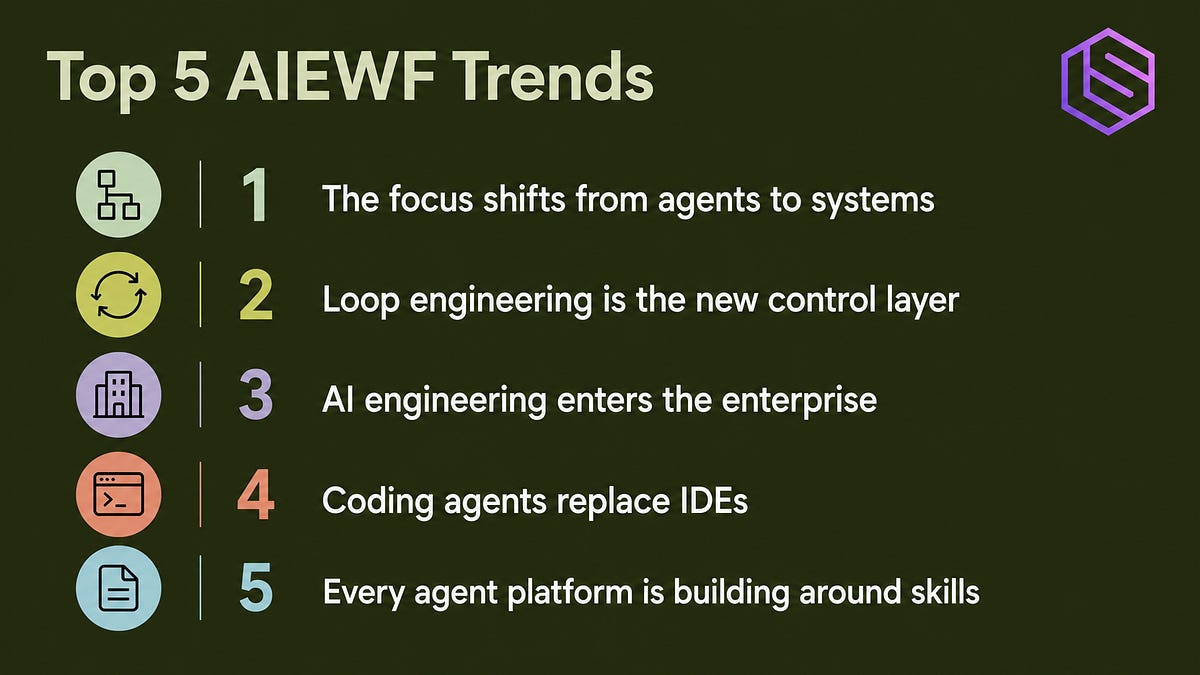
5 Trends That Defined AI Engineering at World's Fair 2026
The 2026 AI Engineer World's Fair revealed a definitive shift from building simple LLM prompts to engineering complex, multi-agent systems.
What: Key trends included the rise of 'loop engineering' for human oversight of autonomous agents, the emergence of the 'forward deployed engineer' role, and using 'skills' to standardize agent workflows.
Why it matters: AI engineering is maturing from experimental tinkering into a disciplined software practice, where the primary challenge is no longer just model capability but architectural reliability.
Takeaway: If you are managing agentic workflows, consider placing yourself in an 'outer loop' by defining explicit feedback signals and validation gates for your agents.
Deep dive
- Shift from agent-centric models to system-centric architectures (harness engineering).
- Emergence of 'loop engineering' for human-in-the-loop oversight.
- Adoption of 'Forward Deployed Engineers' for enterprise implementation.
- Coding agents (Claude Code, Cursor) replacing simple autocomplete IDE plugins.
- Standardization of 'skills' (declarative markdown) for portable model capabilities.
Decoder
- Loop engineering: The design of control structures (loops) that allow human engineers to monitor and steer autonomous agents.
- Forward-deployed engineer: Engineers who work onsite with clients or across teams to integrate specific tools directly into complex workflows.
- Harness: The supporting infrastructure (testing, evaluation, state management) wrapped around a model to make it usable in production.
Original article
Full article content is not available for inline reading.
Explore all 53 articles in today's digest
Fresh dev news, AI-digested daily. Never miss a trend at devoured.fyi