DEVOURED
Language model harnesses are compositional generalizers
Frontier transformers struggle with compositional generalization, suggesting that 'harness' architectures are essential for scaling AI performance.
What: Alex Zhang and Omar Khattab argue that current transformer models are poor at compositional generalization—the ability to solve unseen problems by combining familiar ones. Their proposed 'harness' architecture uses context offloading and programmatic sub-agent calls to reduce complex problems into locally in-distribution segments.
Why it matters: This shift suggests that improving AI performance may depend less on raw data volume and more on developing architectural 'harnesses' that simplify task decomposition, effectively turning complex queries into structures the model is already trained to handle.
Deep dive
- Transformers fail at compositional generalization because their inductive biases are limited to token-level sequences.
- A harness acts as a program between the world and the model, simplifying state inputs into segments that match the model's training distribution.
- Recursive Language Models (RLM) offload context and defer sub-tasks to programmatic sub-calls, preventing 'context rot'.
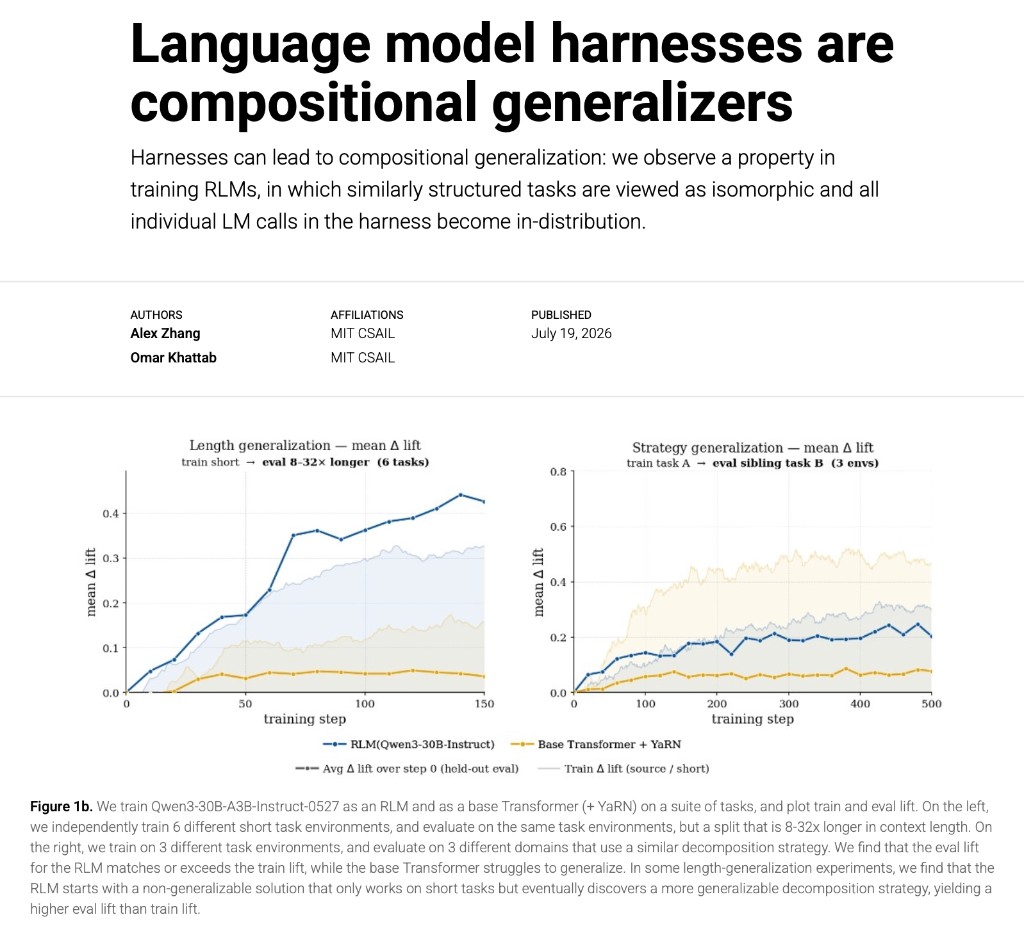
- Experiments show RLMs trained on short tasks significantly outperform standard transformers on tasks 8-32x longer.
- Harnessing allows models to view structurally similar tasks as isomorphic, enabling transitive generalization across domains.
- Cost-efficiency improves as models generalize better with less data, though harnesses add a 1.5-3x runtime overhead per query.
- Scaling laws are contingent on the inductive biases provided by these architectural frameworks, not just the neural network itself.
Decoder
- Compositional generalization: The cognitive ability to understand and produce complex novel expressions by combining known concepts in new ways.
- Inductive bias: The set of assumptions a machine learning model uses to predict outcomes for unseen data.
- Locally in-distribution (LID): When a specific prompt or input segment aligns closely with the data distribution seen by the model during its training phase.
- Isomorphic: A mapping that shows two different structures are functionally identical in their underlying relationships.
Original article
Full article content is not available for inline reading.
Explore all 43 articles in today's digest
Fresh dev news, AI-digested daily. Never miss a trend at devoured.fyi