DEVOURED
Inside Roblox's Bet on World Models
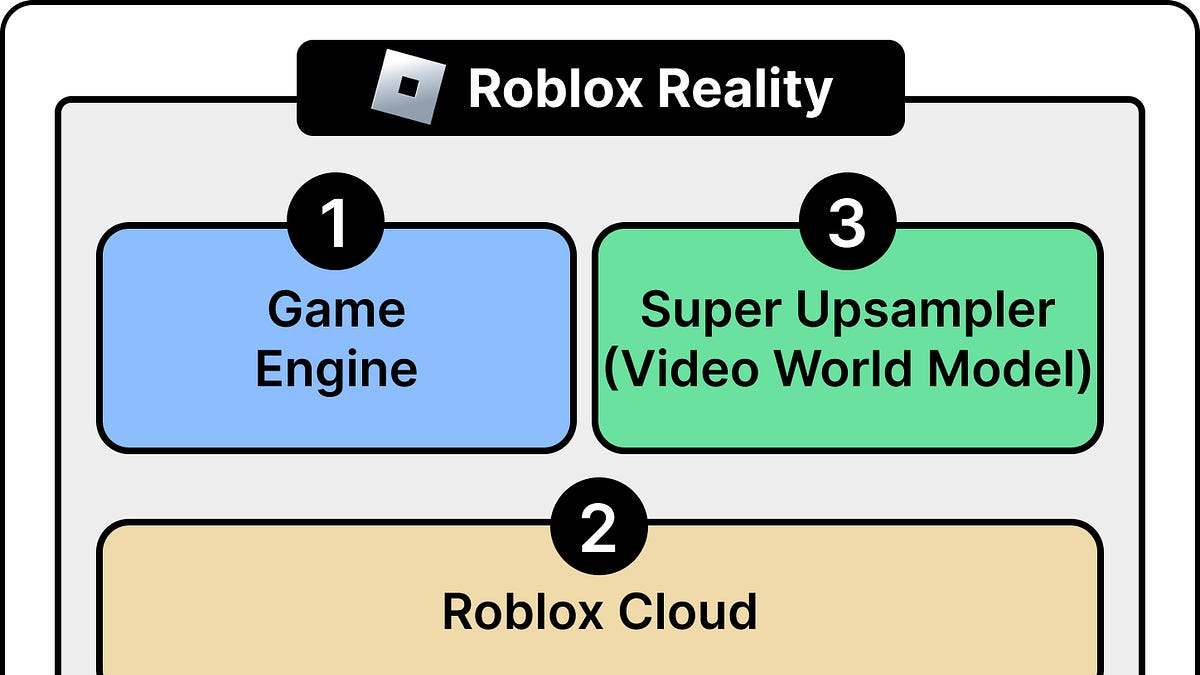
Roblox is developing a hybrid 'world model' architecture that pairs a game engine's state management with an AI-driven 'Super Upsampler' for photorealistic graphics.
What: Roblox Reality splits workloads: the Roblox game engine acts as the authoritative source for physics and state, while an AI model, the 'Super Upsampler,' generates photorealistic visual textures and lighting in real-time.
Why it matters: This hybrid approach bypasses the limitations of standalone video generation models—which lack world consistency and physics—by keeping the 'reasoning' and game logic in deterministic code.
Deep dive
- Roblox Reality utilizes a 'data model' on servers to keep multiplayer states synchronized and fair across millions of users.
- The video model generates pixels, while the game engine handles the 'truth' of where objects are and how they interact.
- 'Self-forcing' and autoregressive techniques are being employed to bridge the gap between offline video generation and real-time interactive latency requirements.
- Roblox is acquiring specialized AI labs (Morpheus AI, Lucid AI, Dynamics Lab) to consolidate expertise in low-latency world models and game-logic harnesses.
- The first version is expected late 2026 or early 2027, aiming for 2K resolution at 60fps initially.
Decoder
- World Model: An AI system that attempts to learn or simulate the physics, rules, and visual appearance of a 3D environment.
- Autoregressive: A method where a model generates content (like video frames) one piece at a time, with each subsequent piece being conditioned on the ones that came before it.
- Deterministic: A system where given the same input, it will always produce exactly the same output, which is crucial for fair game physics.
Original article
Full article content is not available for inline reading.
Explore all 55 articles in today's digest
Fresh dev news, AI-digested daily. Never miss a trend at devoured.fyi