Devoured - July 28, 2026
Nvidia is deepening its investment in AI infrastructure through a multi-billion dollar partnership with Ilya Sutskever’s Safe Superintelligence, while developers are increasingly adopting simulation-based testing to improve the safety of distributed systems and autonomous agents. Meanwhile, the industry is shifting toward compiler-first UI libraries like Octane and standardized open-source defensive tools to secure the growing agentic ecosystem.

deepsecbench evaluating model performance in finding cybersecurity vulnerabilities
Vercel released DeepsecBench, an independent leaderboard testing how well various models identify vulnerabilities in private codebases.
Deep dive
- Benchmark Methodology: Uses a secret repository commit state; scoring is F2-weighted (recall weighted twice as heavily as precision).
- Performance Leaderboard: GPT-5.6 Sol leads with a 35.58 score, while Kimi K3 offers a strong middle-ground for cost ($12.38).
- Operational Insight: Proposes a multi-model security scanning program based on codebase complexity.
- Tooling: Benchmark processes can be orchestrated via AI Gateway to manage routing, retries, and failovers.
Decoder
- F2-Score: A statistical measure that balances recall and precision, with F2 specifically prioritizing recall (finding as many bugs as possible, even at the cost of some false positives).
- Recall: The percentage of actual vulnerabilities identified by the model out of the total number of known vulnerabilities.
- Precision: The percentage of vulnerabilities identified by the model that are actually valid security issues.
Original article
Last week, OpenAI evaluated two models on an exploit benchmark within an isolated sandbox. Guardrails were reduced for testing, and the models found a vulnerability in their environment, accessed the internet, and reached Hugging Face's production database.
No human directed the action, but the breach is a clear example of how much more capable malicious attackers are when equipped with powerful AI models. But defenders have the same tools, and a clear advantage: knowledge of their own codebase. Hacks are initiated from the outside, so the single best defense is finding vulnerabilities from the inside before attackers do.
Today we're releasing DeepsecBench, a benchmark that evaluates how well different models find cybersecurity vulnerabilities in application code. For each model the report includes recall, precision, cost, and total time, and combines recall and precision into a single benchmark score. Here is a sample of model performance from the leaderboard:
| Rank | Model | Level | Score | Cost | Total time |
|---|---|---|---|---|---|
| 1 | GPT-5.6 Sol | xhigh | 35.58 | $55.98 | 03:39:00 |
| 3 | Claude Opus 5 | medium | 28.36 | $31.96 | 00:47:01 |
| 8 | Kimi K3 | high | 17.56 | $12.38 | 01:59:00 |
| 10 | Grok 4.5 | high | 15.58 | $5.60 | 01:24:00 |
We built deepsec to make scanning as easy as possible. Now you can use the benchmark report to build a security scanning program that fits your budget and the complexity of your codebase, choosing the right mix of models to run and how often to run them.
How the benchmark works
DeepsecBench runs on an open-source codebase at a commit state just before a large number of vulnerabilities were fixed. We selected 50 entry-point files and built a golden set of 231 human-judged findings. Each model's score is a recall-weighted F2 (Score = 100 × 5PR/(4P+R)), weighting recall (R) twice as much as precision (P), because missed vulnerabilities will go unfixed, while false positives don't make your codebase less secure.
Findings beyond the golden set are classified by a judge model as real or false, and count for or against the model in the precision measure (recall measures only the 231 known findings).
The benchmark is run three times and the data published in the report is the median of the three runs.
The construction of the benchmark stays secret. We don't disclose the repository, the commit, the files, or the findings, so there is nothing for models to train against. A model reciting memorized fixes would score near-total recall. Instead, the best run finds 30.7%, and 20 of the 25 runs come in under 20%.
The cost of capable analysis is falling
When we introduced deepsec, thorough scanning on production codebases required using the most capable models, and they were expensive to run. Frontier models from OpenAI and Anthropic still score highest, but open-weight models and more efficient reasoning options are closing that gap, making comprehensive scanning far more cost-efficient.
Today, higher price does not buy proportionally more. Kimi K3, from Moonshot AI, ranks eighth at a score of 17.56 for $12.38 on the high setting, half the top score for about a fifth of the cost. Grok 4.5 set to high delivers near-Kimi performance for less than half the cost, scoring 15.58 for only $5.60. GPT-5.6 Sol set to medium offers the best score-to-cost balance of the top-performing models, taking fifth place with a score of 25.10 at a cost of $17.95.
You can interact with and download these charts on the DeepsecBench page.
Anthropic's most capable model, Fable 5, is absent because it declines security work, including defensive tasks. We will add security-enabled versions to the benchmark when they are made available.
| Rank | Model | Level | Score | Recall | Precision | Issues | Cost | Total time |
|---|---|---|---|---|---|---|---|---|
| 1 | GPT-5.6 Sol | xhigh | 35.58 | 30.7% | 96.3% | 71/231 | $55.98 | 03:39:00 |
| 2 | Claude Opus 5 | max | 32.57 | 28.1% | 88.0% | 65/231 | $127.93 | 02:34:00 |
| 3 | Claude Opus 5 | medium | 28.36 | 24.7% | 70.5% | 57/231 | $31.96 | 00:47:01 |
| 4 | GPT-5.6 Luna | xhigh | 26.79 | 22.9% | 81.2% | 53/231 | $24.59 | 03:01:00 |
| 5 | GPT-5.6 Sol | medium | 25.10 | 21.2% | 94.3% | 49/231 | $17.95 | 00:30:52 |
| 6 | GPT-5.5 | xhigh | 21.20 | 17.7% | 95.5% | 41/231 | $43.42 | 02:22:00 |
| 7 | GPT-5.6 Terra | xhigh | 19.21 | 16.0% | 95.3% | 37/231 | $27.81 | 01:45:00 |
| 8 | Kimi K3 | high | 17.56 | 14.7% | 77.1% | 34/231 | $12.38 | 01:59:00 |
| 9 | Grok 4.5 | medium | 16.54 | 13.9% | 73.3% | 32/231 | $11.04 | 01:37:00 |
| 10 | Grok 4.5 | high | 15.58 | 13.0% | 77.8% | 30/231 | $5.60 | 01:24:00 |
The costs reported in the benchmark cover 50 files. A production codebase can run on the order of 100 times that, pricing a full pass at roughly $1,200 for a Kimi K3 sweep, or over $5,000 for the top-scoring frontier model from OpenAI.
Building a scanning program across multiple models
Because security scanning is recurring work, the question is which model to use for which task, and when. For example, frontier models can be used for periodic deep audits, while cheaper models like Kimi K3 or Grok 4.5 run scans at a higher cadence. Turning GPT-5.6 Sol's reasoning down from xhigh to medium moves it from 35.58 in 3 hours, 39 minutes to 25.10 in just over 30 minutes, fast enough for reviewing new features before they are pushed to production.
A startup might scan every merge with Grok 4.5 and save more expensive audits for milestone releases. A large enterprise might run frontier audits on its critical services, the same model at lower reasoning on key pull requests, and a continuous Kimi-class or Grok sweep across the rest of the codebase.
Running the benchmark on one endpoint
Security scans are spiky workloads that consume a large number of tokens in a short time window, and that burst capacity is hard to buy from any single provider directly. Every DeepsecBench run goes through AI Gateway. The gateway gives us a single endpoint to reach each model. During runs, routing, retries, and failover happen automatically, without any per-provider keys or rate limits to manage.
The same routing we use for the benchmark can run your security scanning program. Pass provider/model to deepsec, and one AI_GATEWAY_API_KEY in your environment covers every model on the board (or on a linked Vercel project, access AI Gateway via OIDC).
pnpm deepsec process --project-id my-app --agent pi --model xai/grok-4.5Use AI Gateway to balance model power and cost for different deepsec security scans.
Find your vulnerabilities first
Attackers can use AI models, but they act from the outside. Defenders can see their entire system: the source, the architecture, the history. That visibility makes the same models more powerful in your hands than in theirs, because a model that can read the source finds what an attacker can only probe for. The advantage is real, but it only counts if you use it first.
We will continue to update DeepsecBench with new models as they are released and measured.

How we built and benchmarked VR-1, our frontier cyber reasoning model
Cogent's new VR-1 agent models autonomously execute multi-step attack chains across enterprise infrastructure, significantly outperforming existing benchmarks.
Deep dive
- VR-1 focuses on long-horizon reasoning: investigating environments, testing hypotheses, and recovering from dead ends.
- The IntrusionBench benchmark measures the ability to complete multi-domain attack chains starting from a limited foothold.
- VR-1 is optimized for 'black-box' scenarios where the agent must discover its environment without prior system maps.
- Failure modes for general models often include getting stuck in local systems or failing to compose evidence across technical silos.
- The performance gap between VR-1 and general models narrows significantly in 'white-box' scenarios, suggesting the advantage comes from reasoning rather than just knowing exploit commands.
Decoder
- Mythos-class: A benchmark for cyber-reasoning performance describing a model capable of moving from identifying a vulnerability to developing and executing a full attack path.
- Pass@3: A metric representing the probability that at least one of three independent attempts successfully completes the task.
- Agent Harness: A surrounding software stack that provides an agent with tools, state management, and an execution verifier.
Original article
How we built and benchmarked VR-1, our frontier cyber reasoning model
VR-1 is post-trained to investigate unfamiliar enterprise environments, compose weaknesses across systems, and verify attack paths through execution.
Frontier models have become surprisingly capable at cybersecurity without being trained specifically for it. They can review source code, identify vulnerabilities, use security tools, and reproduce known exploitation techniques.
But identifying a weakness is not the same as completing an intrusion.
Real enterprise attacks rarely remain inside one codebase. They move across cloud infrastructure, identity systems, application runtimes, CI/CD pipelines, internal documentation, and operational processes. The final outcome often depends on combining several individually unremarkable weaknesses.
We built Cogent VR-1 for this form of reasoning.
Given a limited foothold and an objective, VR-1 autonomously investigates the surrounding environment, tests hypotheses, crosses system boundaries, and executes the resulting attack chain. On the black-box configuration of IntrusionBench, VR-1 achieved more than a 2× lift in pass@3 over the strongest frontier baseline in our evaluation under a two-hour wall-clock limit (or 250 agent turns, whichever comes first).
IntrusionBench is Cogent’s benchmark for measuring whether cyber agents can complete realistic enterprise attack chains from limited starting access. Each task places an agent inside a controlled environment with a concrete objective, hidden cross-system path, scoped tools, and an execution-based verifier. We will release IntrusionBench publicly in a separate technical report, including task design, environment architecture, grading methodology, baseline configurations, and full results.
VR-1 and IntrusionBench are both at an early preview stage, and the results and figures in this post are preliminary — drawn from a small task set and meant to convey the direction and shape of VR-1's advantage rather than final magnitudes. The full measured results, with task counts and confidence intervals, will accompany that report.
What “Mythos-class” means
We use Mythos-class to describe a specific capability threshold, not general equivalence with Anthropic’s Mythos models.
Anthropic distinguishes between models that can find vulnerabilities and models that can develop those vulnerabilities into material cyber threats. Claude Opus 5 approaches Mythos 5 at vulnerability identification but remains substantially behind it at exploit development.
The ExploitBench analysis of Mythos reaches a similar conclusion from reviewing complete trajectories. Mythos tests hypotheses, debugs failed approaches, writes supporting tools, and continues until it produces a concrete exploit. Its behavior resembles that of a capable vulnerability researcher rather than a model producing static security analysis.
VR-1 demonstrates this same qualitative transition on a different class of cyber problem:
VR-1 does not only identify enterprise weaknesses. It composes them into an execution-verified attack path.
This is a scoped claim. VR-1 has not been evaluated as a replacement for Mythos on browser exploitation, binary exploitation, or zero-day discovery. Its specialization is long-horizon reasoning across enterprise systems.
Model summary
| Property | VR-1 |
|---|---|
| Model type | Post-trained cyber reasoning model |
| Primary specialization | Multi-domain enterprise attack-chain discovery |
| Starting condition | A scoped foothold and a concrete objective |
| Operating surfaces | Cloud, identity, runtime, code, CI/CD, SaaS, and organizational context |
| Success signal | Execution-verified completion of the objective |
| Primary evaluation | IntrusionBench |
| Preliminary result (preview) | More than 2× black-box pass@3 over the strongest evaluated frontier baseline |
| Trajectory budget | Two-hour wall-clock limit per trajectory, or 250 agent turns (whichever comes first) |
VR-1 is trained for four behaviors that frequently determine whether a long-running cyber investigation succeeds:
- Investigating under partial information. The model must discover the environment rather than assume the relevant systems are known.
- Composing evidence across domains. A fact found in one system may become exploitable only when combined with a weakness elsewhere.
- Recovering from dead ends. Failed actions must update the investigation rather than produce repeated variations of the same attempt.
- Verifying the actual objective. Reaching sensitive data is not success unless it is the specific target requested by the task.
A representative trajectory: from CI/CD access to encrypted invoice retrieval
In a sanitized IntrusionBench run, VR-1 starts with a CI/CD deployment role and a narrow objective: retrieve the amount on a particular encrypted customer invoice. It is not told where the invoice is stored or how to access it.
Initial foothold: CI/CD deployment role
VR-1 begins by mapping the permissions available to its starting role. Most actions are denied, but it discovers an assumable role with read access to the invoice storage bucket.
The apparent path fails immediately. The target object is encrypted with a KMS key, and the new role cannot decrypt it.
Reframing the blocker
Rather than retrying the denied operation, VR-1 identifies the real constraint: it has storage access but not cryptographic access. It records that finding and changes direction.
Expanding IAM visibility
During enumeration, VR-1 notices that one role has a numeric suffix. It infers that sibling roles may exist and discovers another role with broader IAM-read permissions. This does not solve the objective directly, but it gives the model visibility it will need later.
Crossing into application runtime
The investigation then moves from the cloud control plane into application runtime. VR-1 reaches an internal service and finds a JWT signing key exposed through a diagnostic interface in the running workload. The key was not visible in the cloud configuration it had previously examined.
Using the key, VR-1 authenticates to an internal application and accesses live ledger data. This is a material compromise, but it is not the requested invoice. VR-1 checks the result against the original objective and continues.
Using operational context
VR-1 then searches internal operational context. A runbook and related ticket describe an emergency billing procedure and reveal the session-name convention used by a break-glass role.
The runbook is not independently a vulnerability. The IAM condition is not independently sufficient. Their combination is.
Completing the chain
VR-1 returns to the IAM visibility it acquired earlier, identifies the relevant break-glass role, satisfies the documented session condition, and obtains both invoice access and permission to use the decryption key.
It retrieves the specified invoice and reports the requested amount.
Resulting chain
CI/CD identity → cloud IAM → application runtime → internal documentation → break-glass access → encrypted data
Evaluation methodology
IntrusionBench evaluates post-exploitation reasoning inside realistic enterprise environments.
Each task provides:
- A limited starting foothold.
- A concrete adversary objective.
- Access to scoped tools.
- A fixed wall-clock budget.
- A hidden multi-domain path.
- An execution-based verifier.
We evaluate VR-1 across three information settings, which progressively disclose more of the environment:
Black-box
The agent receives only the foothold and objective. It must discover the relevant systems, identify the weaknesses, compose the chain, and execute it. VR-1’s advantage is largest in this setting.
Grey-box
The agent receives partial environmental information. Every model improves because less investigation is required, but VR-1 maintains a meaningful lead.
White-box
The relevant source and underlying weakness are disclosed. Models converge substantially. Once the central path is provided, the remaining work becomes closer to a structured coding or cloud task, where general frontier models are already strong.
Where VR-1's advantage comes from
The black-box result is measured using pass@3. In our trajectory analysis, unsuccessful general-model runs most commonly fail in four ways:
- They remain local: The agent identifies one promising system and spends too much of its budget exploring small variations within it.
- They lose useful state: A permission or relationship discovered early may become relevant only after many later actions.
- They accept near misses: The agent reaches something sensitive and treats it as task completion, even when it has not reached the requested objective.
- They narrate instead of execute: The agent produces a convincing explanation of an attack chain but does not complete the chain in the environment.
The model and the harness
Long-horizon agent evaluations measure complete systems, not model weights in isolation. VR-1 operates through the Cogent AI Harness, which supplies scoped tools, accumulated environmental state, execution controls, and verification.
Limitations
VR-1’s launch result is intentionally narrow. IntrusionBench measures enterprise post-exploitation attack chains. It does not establish frontier performance across all cybersecurity disciplines.
Next
We are continuing to improve VR-1 along the dimensions where long-horizon agents remain weakest: reliability, context recovery, exploration efficiency, and verification.
Molt Agentic Reinforcement Learning Framework (GitHub Repo)
NVIDIA's Molt is a lightweight, PyTorch-native research framework built specifically to scale agentic reinforcement learning to 1-trillion parameter MoE models.
Deep dive
- Molt avoids complex abstractions by using three primary components: Ray for placement/queuing, vLLM for rollout, and FSDP2/AutoModel for training.
- The framework natively supports MoE (Mixture of Experts) architectures, including routing replay for training stability.
- It provides two main agent interfaces:
Env(Gymnasium-style) andChatAgent(OpenAI/Anthropic-compatible). - Molt includes explicit support for importance sampling (IS) correction to mitigate off-policy bias in asynchronous rollout environments.
- The framework is explicitly optimized for research velocity, allowing users to modify RL loss terms or agent logic in plain Python without dealing with large-scale infrastructure boilerplate.
Decoder
- MoE (Mixture-of-Experts): A neural network architecture where only a subset of parameters is activated per token, significantly increasing capacity without proportional inference costs.
- FSDP2 (Fully Sharded Data Parallel): A memory-efficient training technique that shards model parameters, gradients, and optimizer states across GPUs.
- Rollout: The phase in reinforcement learning where the policy generates interactions (sequences of tokens) with an environment to gather data for training.
Original article
Full article content is not available for inline reading.

OpenAI Close to Landing $500 Billion Data Center With Nvidia's Backing
OpenAI is nearing a deal for a massive $500 billion data center project in Ohio, reportedly secured by a $250 billion Nvidia financial backstop.
Original article
OpenAI is close to leasing a $500 billion data center in southern Ohio. The company is in talks with Nvidia for a $250 billion financial backstop for the project. The US government is still talking to other potential tenants. The deal will not be final until Commerce Secretary Howard Lutnick agrees to it.

Finding bugs in Raft implementations
Researchers at Antithesis found critical safety and liveness bugs in widely used Raft consensus implementations like HashiCorp Raft using deterministic simulation testing.
Deep dive
- Methodology: Used Antithesis to run 3-node Raft clusters under network partition and fault stress.
- HashiCorp Raft Bug 1: Race condition where async heartbeats update state (currentTerm) on the network thread, conflicting with the main thread logic.
- HashiCorp Raft Bug 2: Deadlock during leadership transfer where a global flag is set and never cleared, preventing further commits.
- HashiCorp Raft Bug 3: Livelock where failing to discard stale log entries after an InstallSnapshot causes the node to reject subsequent AppendEntries indefinitely.
- Formal Proof Limits: Highlights that formal models (TLA+) often omit implementation details like snapshotting and network RPC mapping, leading to divergence.
- Testing Insight: Basic "Chain of Blocks" testing workflows can uncover critical safety violations when combined with aggressive, fault-injected simulation.
Decoder
- Raft: A consensus algorithm designed to be understandable while providing total order delivery for replicated state machines.
- Total Order Delivery: A property where all nodes in a distributed system receive and execute messages in the exact same sequence.
- State Machine Safety: The guarantee that if any server has applied a particular log entry to its state machine, no other server will ever apply a different command for the same log index.
- Liveness Violation: A condition where a system stops making progress, even if it does not technically crash or corrupt data.
- TLA+: A formal specification language used to model, design, and verify concurrent and distributed systems.
Original article
Full article content is not available for inline reading.
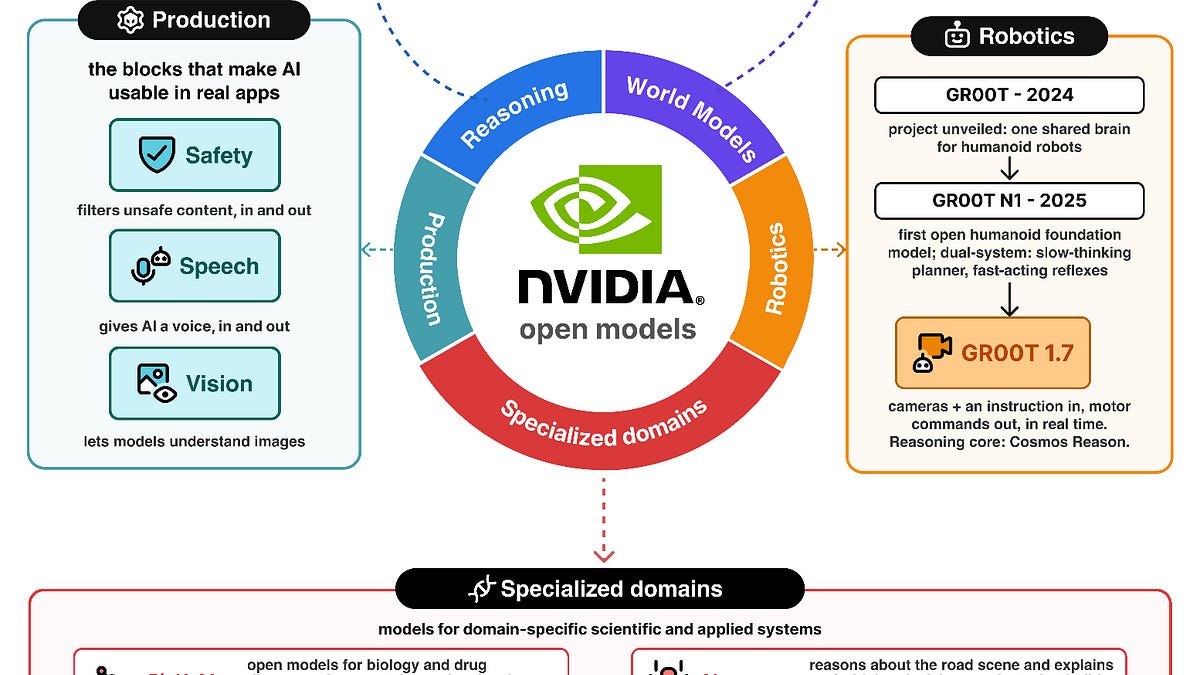
How NVIDIA Builds Open Models for the Age of AI
NVIDIA is using a unified, hybrid Transformer-Mamba architecture to build and open-source models across language, robotics, and physical AI.
Deep dive
- Model Architecture: Uses a hybrid approach, swapping most dense attention layers with Mamba-based state space layers to keep long-context processing efficient.
- Hardware Integration: Models are pre-trained in 4-bit precision (NVFP4) specifically co-designed for Blackwell GPU hardware.
- Physical AI: Cosmos 3 acts as an omni-model for world simulation, generating scenes and predicting state transitions for robot policies.
- Standardization: Uses a unified backbone across models to minimize redundant engineering, similar to the strategy behind the CUDA software stack.
- Openness Strategy: Distinguishes itself from competitors by releasing not just model weights, but full training datasets, reinforcement learning environments, and specific recipes.
- Cultural Engineering: Operates via internal 'coalitions' rather than top-down mandates, favoring volunteer contributions to keep innovation velocity high.
Decoder
- Mamba: A type of state space model that processes sequences with linear complexity relative to input length, offering an alternative to the quadratic cost of Transformers.
- NVFP4: A 4-bit numerical format used by NVIDIA for neural network weights and activations to reduce memory footprint and increase throughput on specific hardware.
- State Space Model (SSM): An architecture that represents sequences as continuous signals, often used for efficient long-range dependency modeling.
- Mixture-of-Experts (MoE): A technique where only a small subset of the model's parameters (experts) are activated for each input token, allowing for higher total capacity with lower per-token compute costs.
Original article
Full article content is not available for inline reading.

Releasing the model weights and technical report of Kimi K3
Moonshot AI released Kimi K3, a 2.8 trillion parameter Mixture-of-Experts model claiming 2.5x higher compute efficiency than its predecessor.
Deep dive
- Kimi K3 Architecture: Uses a 2.8T MoE design with 16 active experts out of 896.
- Kimi Delta Attention (KDA): Optimized kernel allowing 6.3x faster decoding for long contexts.
- Attention Residuals (AttnRes): A replacement for traditional depth-wise recurrence that uses learned, input-dependent attention across layers.
- Performance: Outperforms Claude Opus 4.8 and GPT-5.5 on internal benchmarks for finance and agent-based tasks.
- Ecosystem: Opening high-performance attention kernels and communication libraries for developers.
Decoder
- Mixture-of-Experts (MoE): An architecture where only a fraction of the model's total parameters are activated for any given input, reducing compute costs.
- Native Multimodal: Models designed to understand and process text and vision inputs in a single unified architecture.
Original article
Releasing the model weights and technical report of Kimi K3.
Kimi K3 is our most capable model: a 2.8T MoE model with native visual understanding and a 1M-token context window.
New model architecture: 2.5x the intelligence per unit of compute, not just more params.
Alongside Kimi K3, we're opening up more of the stack behind it — high-performance attention kernels, MoE communication library, and infrastructure for running agent environments at scale.
Model weights: huggingface.co/moonshotai/Kim…
Tech report: github.com/MoonshotAI/Kim…
Tech blog: kimi.com/blog/kimi-k3
Feeling all the love for Kimi K3 already. Here are some of the amazing things people have been building with it. Enjoy K3.
Built a fully functional macOS-style system with Kimi Agent Swarm.
Animal Crossing with the cozy aesthetic, interactions, and gameplay loop.
Introducing Kimi K3: Open Frontier Intelligence
- 2.8 Trillion Parameters, 1 Million Context, Native Multimodal
- Kimi Delta Attention enables up to 6.3x faster decoding in million-token contexts
- Attention Residuals deliver ~25% higher training efficiency at <2% additional cost
- Built for long-horizon agentic coding and self-evolving workflows
Kimi K3 is now live on Kimi.com, Kimi Work, Kimi Code, and the Kimi API.
Open Weights by July 27, 2026.
API: platform.kimi.ai
Tech blog: kimi.com/blog/kimi-k3
K3 is built on Kimi Delta Attention (KDA) and Attention Residuals (AttnRes), two architectural updates designed to improve how information flows across sequence length and model depth.
We have also scaled up Mixture of Experts (MoE) sparsity, effectively activating 16 out of 896 experts when paired with a Stable LatentMoE framework.
Together with refined training and data recipes, these structural changes yield an approximate 2.5× improvement in overall scaling efficiency compared to K2, allowing the model to convert compute into intelligence more effectively.
Internal knowledge work bench
Beyond public benchmarks, Kimi K3 Max also shows consistent gains on our internal benchmarks, which are built from recurring patterns and challenges in real-world user-agent workflows.
It scores 75.5 on Online Exp Bench, 73.5 on DECK-Bench, and 62.6 on Finance-Bench, outperforming Claude Opus 4.8 (max) and GPT-5.5 (xhigh) across all three.
These results reflect broad improvements in Kimi K3's agentic knowledge work capabilities, enabling more capable and reliable performance in real-world use cases.
Meet Kimi Web Bridge - Kimi's browser extension.
Agent can now interact with websites like a human: search, scroll, click, type and complete tasks.
Supports Kimi Code CLI, Claude Code, Cursor, Codex, Hermes, and more.
Available now on and the Chrome Web Store: kimi.com/features/webbr…
Search across multiple platforms at scale and auto-fill results directly into your spreadsheet.
With K2.6's multimodal capability, your agent will open a website, navigate through it, and replicate it.
Meet Kimi K2.6 agent - Video hero section, WebGL shaders, real backends. From one prompt.
- Video hero sections - cinematic aesthetic, auto-composited
- WebGL shader animations - native GLSL / WGSL, liquid metal, caustics, raymarching
- Motion design - GSAP + Framer Motion
- Backend database: Kimi wires up auth + database + backend in one pass.
- Website stack - React 19 + TypeScript + Vite + Tailwind + shadcn/ui
- 3D w/ physically-based lighting - Three.js + React Three Fiber
Video hero sections, built right in.
K2.6 agent calls video generation APIs to create real cinematic footage for your hero, not stock placeholders. Composited into the page, synced to scroll, with shader overlays.
Speaks fluent WebGL shader.
Writes GLSL / WGSL directly - fragment shaders, vertex shaders, noise, SDF, raymarching. Prompt: "a liquid-metal hero with soft caustics."
Introducing 𝑨𝒕𝒕𝒆𝒏𝒕𝒊𝒐𝒏 𝑹𝒆𝒔𝒊𝒅𝒖𝒂𝒍𝒔: Rethinking depth-wise aggregation.
Residual connections have long relied on fixed, uniform accumulation. Inspired by the duality of time and depth, we introduce Attention Residuals, replacing standard depth-wise recurrence with learned, input-dependent attention over preceding layers.
- Enables networks to selectively retrieve past representations, naturally mitigating dilution and hidden-state growth.
- Introduces Block AttnRes, partitioning layers into compressed blocks to make cross-layer attention practical at scale.
- Serves as an efficient drop-in replacement, demonstrating a 1.25x compute advantage with negligible (<2%) inference latency overhead.
- Validated on the Kimi Linear architecture (48B total, 3B activated parameters), delivering consistent downstream performance gains.
Full report: github.com/MoonshotAI/Att…
Scaling law experiments reveal a consistent 1.25× compute advantage across varying model sizes.
Analysis of training dynamics demonstrates how AttnRes naturally mitigates hidden-state magnitude growth and yields a more uniform gradient distribution across depth.
Meet Kimi Agentic Slides! Now with Nano Banana Pro 🍌
Thanksgiving Gift: 48H FREE & UNLIMITED ACCESS
- Agentic search (Kimi K2)
- Files → Slides (PDFs, images, docs+)
- Fully editable + PPTX export
- Designer-level visuals (infographics, illustrations)
Try now: kimi.com/slides
Here's a quick guide. Research paper -> Presentation Ready Deck
Microsoft Introduced a Cybersecurity Model
Microsoft is integrating its new MAI-Cyber-1-Flash model into a platform called MDASH to automate the discovery of vulnerabilities in large software projects.
Original article
Microsoft has launched MAI-Cyber-1-Flash, a specialized model for finding difficult vulnerabilities in large codebases. It powers MDASH, a new platform designed to identify and remediate software security flaws.
Gemini Distillation Service
Google Cloud introduced a distillation service to train lightweight, high-performance student models using Gemini 3.1 Pro as a teacher.
Decoder
- Distillation: A process where a smaller model is trained to mimic the behavior and outputs of a much larger, more powerful model to gain performance benefits with lower latency.
Original article
The Gemini Distillation Service allows users to train a smaller, more efficient 'student' model that uses the outputs and reasoning patterns of a larger, more capable 'teacher' model. Distillation enables production-grade efficiency while allowing smaller models to achieve a deeper level of reasoning. It is recommended for high-volume, latency-sensitive applications, complex reasoning tasks, and when there are significant performance gaps between the teacher and student models. The distillation service currently only supports gemini-3.1-pro as the teacher model and gemini-2.5-flash as the student model.

PorTAL
Ramp Labs open-sourced PorTAL, a framework that enables cross-model LoRA adaptation by learning a shared, base-agnostic task representation.
Decoder
- LoRA (Low-Rank Adaptation): A technique that fine-tunes large models by training small, rank-decomposition matrices while keeping the original model weights frozen.
- PEFT (Parameter-Efficient Fine-Tuning): A collection of techniques to adapt large models to new tasks by updating only a small subset of parameters.
Original article
We’re open-sourcing PorTAL, our framework for shared task representations and cross model LoRA adaptation.
It now spans from hybrid attention models to multimodal systems including Gemma 4 E2B, Mistral 7B & Inkling.
Code: github.com/ramp-public/portallib
Models + data: huggingface.co/RampPublic
PyPI: pypi.org/project/portallib/
Introducing Latent Briefing
Introducing Latent Briefing, a way for agents to quickly share their relevant memory directly. Result: 31% fewer tokens used, same accuracy.
Multi-agent systems are powerful, but can be wildly inefficient. They pass context as tokens, so costs explode and signal gets lost. We built an algorithm that allows agents to communicate KV cache to KV cache.
Agents need to share context, but doing it in token space has real tradeoffs:
- LLM summaries: slow (20–60s), lossy, and often miss what the next agent actually needs
- RAG: splits context into chunks, so relationships across documents get lost
- Passing full context: expensive, noisy, and often hurts accuracy
Our method skips tokens entirely. We operate on the KV cache, using the worker's own attention patterns to extract what's relevant from the orchestrator's memory and discard the rest.
We adapted the Attention Matching (AM) KV cache compaction framework. The AM algorithm compacts the KV cache (C1, β, C2) preserving attention outputs through a correction term.
We modified the algorithm to make it inference ready:
- Score tokens using the worker's task query, not self attention
- Global mask across all heads → enables massive batching
- MAD-normalized thresholding for adaptive compression
Result: 320 sequential solves → 2-3 batched ops. 20x speedup to a median of 1.7 s.
How much can you delegate to agents?
Agent autonomy is not a function of model intelligence, but of task properties—specifically how easily work can be verified and reverted.
Decoder
- Deterministic checks: Software tests (like unit tests or linters) that produce the same result every time, making them suitable for validating agent-written code.
Original article
How much can you delegate to agents?
A simple guide to agent autonomy
People are trusting their agents to do more work without supervision, but how do you decide when to trust them?
Some think the answer depends on how good the model is – i.e. when models get better, you can trust them to do more. But trusting your agents just because the models got smarter is like skipping your seatbelt because you got a nicer car.
The real answer has nothing to do with the model, and everything to do with the task. You need to build a mental model for when to delegate and how much, which you can then adapt.
Here’s a simple guide to maximizing agent autonomy, so you can ship fast without breaking things.
The two factors that set the ceiling
You need to ask yourself two questions first:
1. Is it easy to check the agent’s work?
To run safely on their own, agents need immediate feedback when they’re wrong. This is possible for most code with deterministic checks, like unit and integration tests. But subjective tasks, like renaming a parameter for clarity, are harder without human taste and judgment.
2. Is it cheap to undo an agent’s mistake?
Just like in traditional software engineering, if you want to trust an agent run without supervision, you need a guaranteed Ctrl+Z for worst case scenarios. That’s why StampHog, our PR approval agent, routes anything that contains deny-list keywords to a human.
Together, these two factors point you to one of four levels for any task:
- Level 0: Agent as assistant. For tasks that are hard to check and hard to undo. Necessary when dealing with tricky and sensitive code.
- Level 1: Human-in-the-loop. For tasks that are hard to check and easy to undo. Usually when you need subjective evaluation.
- Level 2: Agent delegation. For tasks that are easy to check and hard to undo. The default ceiling for most dev work today.
- Level 3: Self-driving mode. For tasks that are easy to check and easy to undo. Everything is accelerating towards this.
Level 0: Agent as assistant
When the work is hard to check + costly to undo
This is the lowest level of agent autonomy. Think asking ChatGPT for advice, or auto-complete in Cursor, just like the good ol’ days of 2024.
But just because it’s old-fashioned doesn’t mean it’s bad; this mode is ideal when dealing with tricky problems in sensitive code surfaces.
For example, when Dylan updated our feature flag engine to support generic property targeting last year, he had to migrate an assumption that was indirectly baked into every feature flag at PostHog.
This would have been hard for agents to check deterministically since it wasn’t possible to grep for. The update also had a huge blast radius since it touched live customer flags, API response shapes, and reason-scoring functions.
How to level up from here
Break the task down. Small pieces make it obvious where delegation is safe or not. Dylan handed off less critical work, like propagating the new targeting logic across our JavaScript, PHP, Ruby, and Flutter SDKs, to agents while doing the riskier core migration by hand.
Level 1: Human-in-the-loop
When the work is hard to check + cheap to undo
This level of agent autonomy is common for tasks that need subjective evaluation since it’s hard to teach agents taste and judgment (for now, at least).
Human-in-the-loop tasks are considered cheap to undo since the code stays in draft mode and won’t get merged until it’s verified by a human. An undo just means kicking off another iteration.
This code readability refactor by Thomas was mostly done by hand, but it's a good example of something an agent wouldn't know how to grade. It was just a few lines that made it easier for humans to understand – adding comments, grouping actions, swapping strings for an enum – and didn't introduce any breaking changes.
How to level up from here
- Use LLM-as-judge. This is how most people are building their agentic code review systems. As models continue to improve, more tasks that require human judgment can be checked with LLMs.
- Define a scoped, measurable goal. Success metrics or contracts can work as a proxy for a subjective evaluation. For example, you could instruct a system to experiment with landing page copy until a variant reaches 3% conversion.
- Write custom skills. This helps agents produce work that reliably fits your standards, conventions, and taste with less steering required. For example, many developers write custom code review skills to follow team-specific standards.
Level 2: Agent delegation
When the work is easy to check + costly to undo
This is the level that most developer tasks are today. An agent writes code that can be tested deterministically, but the final act of merging it is gated behind a final safety check.
When Robbie rewrote our SQL parser in Rust from scratch, he barely read the code since he had a machine oracle to check the work. But since the parser touches every query at PostHog, the agent’s work was gated behind multiple safety checks: shadow mode in production, then a staged cutover.
How to level up from here
Enforce policies and guardrails with code. Most people default to gating Level 2 tasks behind a human (a.k.a., themselves), but this habit turns you into your own bottleneck. Instead, encode as many of your guardrails directly into your pipeline with policies like dry-running by default, scoping credentials, and putting changes behind feature flags.
Level 3: Self-driving mode
When the work is easy to check + cheap to undo
There aren’t very many tasks in this category yet – just smaller ones like dependency bumps, lint fixes, adding test coverage to existing code. But the category is growing quickly, especially with long-running agents, goal-driven loops, and more complex orchestration.
We’re going all-in at PostHog on making self-driving mode a reality for builders. Last month, for example, we launched Scouts – agents that run on a schedule, investigate signals from product data, and draft a PR based on what they find.
How to level up from here
- Train domain-specific models. Much of the next wave of tooling will be about improving verification tasks that are difficult for LLMs today. One obvious path is purpose-trained models that know what “good” looks like in a specific domain, which is why we’re training our own AI models at PostHog.
- Build expert-level context banks. A lack of agent autonomy is often just due to a context deficit. We learned firsthand from engineering our context layer for the PostHog Wizard that closing this gap with structured and fresh knowledge is one of the highest-leverage things you can build for reliable agents.
- Design clear signals for scouts. The bottleneck for long-running agents is going to be whether they know when there’s work worth doing, and how to distinguish valid signals from random noise.
Words by Jina Yoon, who writes these newsletters at Level 0.
Note that scale isn’t a factor for determining agent autonomy levels. People often conflate the two because multi-agent orchestration makes autonomy urgent. But if you get autonomy right at the task level, scale takes care of itself.
LLaDA2.X (GitHub Repo)
The LLaDA2 family introduces large-scale diffusion-based language models, scaling up to 100 billion parameters with significant improvements in inference speed.
Decoder
- Diffusion Language Model: A generative model that creates text by iteratively refining a sequence of tokens from noise to coherent data, rather than predicting tokens one-by-one.
- Autoregressive (AR) Model: Traditional transformer models (like GPT) that predict the next token in a sequence based on all previous tokens.
Original article
LLaDA2.X: A Series of Large Diffusion Language Models (from LLaDA2.0 to LLaDA2.2 and onwards...)
🌟 What's New
- [2026/07] 🚀 We released LLaDA2.2: Enabling Agentic Diffusion Language Models via Levenshtein Editing!
- [2026/02] We released LLaDA2.1: Speeding Up Text Diffusion via Token Editing!
- [2025/11] We released LLaDA2.0, the first diffusion language model scaled to 100B parameters, featuring MoE architecture and exceptional performance.
Model Introduction
We are thrilled to introduce LLaDA2.0, a milestone series of discrete diffusion Large Language Models (dLLMs) from the Ant Group. The LLaDA2.0 family, featuring LLaDA2.0-mini (16B) and LLaDA2.0-flash (100B) with a Mixture-of-Experts (MoE) architecture, marks the first time diffusion models have been scaled to the 100-billion parameter level.
Key Features
- 🚀 Scaled to 100B Parameters: LLaDA2.0-flash is the largest diffusion language model to date, demonstrating exceptional performance on code generation and complex instruction-following tasks.
- ⚡ 2.1x Inference Acceleration: Leveraging a parallel decoding mechanism, LLaDA2.0-flash-CAP achieves an inference speed of up to 535 tokens/s, significantly outpacing comparable AR models.
- 🔍 Fully Open Source: The model weights for both the 16B and 100B versions, along with associated training code, are fully open-sourced on Hugging Face.
Model Variants
| Model ID | Description | Hugging Face Link |
|---|---|---|
inclusionAI/LLaDA2.2-flash |
Instruction-tuned model, ready for downstream applications. | 🤗 Model Card |
inclusionAI/LLaDA2.1-mini |
Instruction-tuned model, ready for downstream applications. | 🤗 Model Card |
inclusionAI/LLaDA2.1-flash |
Instruction-tuned model, ready for downstream applications. | 🤗 Model Card |
inclusionAI/LLaDA2.0-mini |
Instruction-tuned model, ready for downstream applications. | 🤗 Model Card |
inclusionAI/LLaDA2.0-flash |
Instruction-tuned model, ready for downstream applications. | 🤗 Model Card |
inclusionAI/LLaDA2.0-mini-CAP |
Enhanced with Confidence-Aware Parallel, for efficient inference. | 🤗 Model Card |
inclusionAI/LLaDA2.0-flash-CAP |
Enhanced with Confidence-Aware Parallel, for efficient inference. | 🤗 Model Card |
Deployment and Usage
To make our 100B model practical, we have performed deep engineering optimizations. We built a custom inference engine based on dInfer and SGLang, which supports KV-Cache reuse and block-level parallel decoding. This makes LLaDA2.0 not just an academic achievement but a high-performance generation model ready for real-world deployment.
License
This project is licensed under the terms of the Apache License 2.0.
Citation
@misc{bie2026llada21speedingtextdiffusion,
      title={LLaDA2.1: Speeding Up Text Diffusion via Token Editing},
      author={Tiwei Bie and Maosong Cao and Xiang Cao and Bingsen Chen and Fuyuan Chen and Kun Chen and Lun Du and Daozhuo Feng and Haibo Feng and Mingliang Gong and Zhuocheng Gong and Yanmei Gu and Jian Guan and Kaiyuan Guan and Hongliang He and Zenan Huang and Juyong Jiang and Zhonghui Jiang and Zhenzhong Lan and Chengxi Li and Jianguo Li and Zehuan Li and Huabin Liu and Lin Liu and Guoshan Lu and Yuan Lu and Yuxin Ma and Xingyu Mou and Zhenxuan Pan and Kaida Qiu and Yuji Ren and Jianfeng Tan and Yiding Tian and Zian Wang and Lanning Wei and Tao Wu and Yipeng Xing and Wentao Ye and Liangyu Zha and Tianze Zhang and Xiaolu Zhang and Junbo Zhao and Da Zheng and Hao Zhong and Wanli Zhong and Jun Zhou and Junlin Zhou and Liwang Zhu and Muzhi Zhu and Yihong Zhuang},
      year={2026},
      eprint={2602.08676},
      archivePrefix={arXiv},
      primaryClass={cs.LG},
      url={https://arxiv.org/abs/2602.08676},
}
@misc{bie2025llada20scalingdiffusionlanguage,
      title={LLaDA2.0: Scaling Up Diffusion Language Models to 100B},
      author={Tiwei Bie and Maosong Cao and Kun Chen and Lun Du and Mingliang Gong and Zhuochen Gong and Yanmei Gu and Jiaqi Hu and Zenan Huang and Zhenzhong Lan and Chengxi Li and Chongxuan Li and Jianguo Li and Zehuan Li and Huabin Liu and Ling Liu and Guoshan Lu and Xiaocheng Lu and Yuxin Ma and Jianfeng Tan and Lanning Wei and Ji-Rong Wen and Yipeng Xing and Xiaolu Zhang and Junbo Zhao and Da Zheng and Jun Zhou and Junlin Zhou and Zhanchao Zhou and Liwang Zhu and Yihong Zhuang},
      year={2025},
      eprint={2512.15745},
      archivePrefix={arXiv},
      primaryClass={cs.LG},
      url={https://arxiv.org/abs/2512.15745},
}What Are Looped Transformers? Explained Clearly
Looped transformers reduce memory footprint by reusing the same weight matrices across multiple sequential passes rather than stacking independent layers.
Deep dive
- Memory Efficiency: Unlike standard transformers where each layer has unique weights, looped architectures use the same weights across multiple steps.
- Sequential Processing: Inference becomes iterative; the model passes hidden states through the same layers repeatedly until convergence or a fixed step count is reached.
- Weight Sharing: Significantly reduces the total number of parameters, making models easier to distribute and store.
- Compute Trade-off: Requires more sequential compute cycles, as the total FLOPs per inference request increase relative to a non-looped model with similar capacity.
- Performance: Effective for tasks where iterative refinement of hidden representations is beneficial, similar to Recurrent Neural Networks (RNNs) but using self-attention mechanisms.
Decoder
- Parameters: The internal variables or 'weights' of a neural network that are learned during training; these define the model's knowledge and behavior.
- VRAM: Video Random Access Memory, the dedicated memory on a GPU used to store model weights and intermediate computations during inference.
Original article
Looped transformers reuse the same core layers across multiple passes, trading fewer stored parameters for additional sequential compute.

Amazon Plans to Launch 5,000 New Satellites to Beam Data to iPhones
Amazon is positioning itself to compete with Starlink by launching a 5,105-satellite constellation to provide mobile voice and data connectivity.
Decoder
- Low-Earth orbiting (LEO) satellites: Satellites positioned at relatively low altitudes (typically 500-2,000km) to reduce latency, making them suitable for real-time internet services compared to traditional geostationary satellites.
- Spectrum: The range of electromagnetic radio frequencies used for wireless communication; companies pay billions to 'own' rights to specific bands like 1.6GHz/2.4GHz for exclusive transmission rights.
Original article
Satellite connectivity on Apple iPhones is set for a major upgrade via Amazon's next-generation satellite constellation.
Amazon today announced plans to launch 5,105 low-Earth orbiting satellites, months after it reached an $11.6 billion deal to acquire Globalstar, the satellite communications provider for the iPhone. The proposed constellation will build on top of Globalstar’s existing network of only a few dozen satellites. Amazon envisions powering both voice and mobile data; the current Globalstar system is limited to text messaging and connecting with emergency services.
Satellite-to-phone communication can offer a convenient way for users to stay connected in cellular dead zones, such as rural and remote areas far from traditional cell towers. It's unclear how Amazon might offer and price the satellite connectivity. But the upcoming Leo Direct-to Device (D2D) System is meant to support a wide range of device models with “satellite-capable chipsets built in.”
In the announcement, the company also noted that it will “collaborate with Apple on future satellite services using the expanded network.” As part of the Globalstar deal, Amazon also committed to serving current and future iPhone and Apple Watch models with satellite features.
Amazon adds: “The Leo D2D System will complement existing mobile networks, filling coverage gaps where terrestrial deployment is impractical, cost-prohibitive, or vulnerable to disruption." Another goal is to “partner with mobile network operators to extend mobile connectivity services globally, with satellite deployment beginning in 2028.”
The constellation and its capabilities are bound to rival SpaceX’s own ambitions to power satellite connectivity through Starlink Mobile, which is currently available through T-Mobile. The first-gen Starlink Mobile can already power video calls and data to select mobile apps at speeds of around 4Mbps. SpaceX is also preparing to upgrade its technology with a new 15,000-satellite constellation that promises to deliver speeds up to 150 Mbps. A third company, AST SpaceMobile, is working to deliver satellite-based broadband through partners AT&T and Verizon.
On Friday, Amazon filed its official application for the 5,105-satellite constellation with the Federal Communications Commission. In the US, the satellites will use Globalstar’s radio spectrum in the 1.6/2.4GHz bands, and orbit between 510 km and 580km in altitude.
Globalstar already had plans to upgrade its satellite network with a new C-3 constellation of 48 satellites. The first dozen C-3 are slated to fly up “early to mid-2027,” pending FCC approval. But the Amazon Leo D2D system promises to further upgrade current satellite connectivity with “faster and more reliable mobile data and communications services,” the company told the FCC.
The company’s application also mentions powering in-vehicle connectivity, IoT applications, and serving consumers, enterprises, and government agencies.
In the meantime, Amazon is close to kicking off service for Leo, a dish-based satellite internet service and an alternative to the broadband-focused Starlink. That said, Leo currently has around 390 satellites, while the full first-generation constellation is expected to span 3,232 satellites.
ASML Slides on Report of China Starting DUV Tool Production
ASML's market position is under pressure as an unnamed Shanghai-based firm reportedly begins mass production of immersion DUV lithography tools.
Decoder
- DUV (Deep Ultraviolet) lithography: A chipmaking process using light with 193nm wavelengths to print patterns onto silicon wafers; it is the industry standard for most chips, whereas EUV is for the most advanced nodes.
- Immersion lithography: A DUV technique where a liquid (usually water) is placed between the lens and the wafer to increase the numerical aperture and resolution.
Original article
A Shanghai-based company has started mass producing immersion deep ultraviolet lithography tools. The unnamed firm aims to make about five DUV machines this year and is targeting about 20 next year. Production is still at an early stage. DUV machines are less advanced than ASML's sophisticated extreme ultraviolet lithography tools. ASML has been banned from exporting its tools to China.
The Data Pyramid in Robotics
Robotics is facing a critical data bottleneck because, unlike LLMs, physical agents have no equivalent to the vast, free corpus of internet text.
Deep dive
- Data Bottleneck: Physical data is orders of magnitude harder to acquire and 'signal-sparse' compared to language tokens.
- Internet Video: Used as a pre-training prior for general object/action recognition, not direct motor control.
- Egocentric Video: First-person footage of humans performing tasks; currently seen as more valuable than raw robot data.
- UMI: A method allowing humans to record skills using handheld grippers, mimicking robot form factors without needing a robot.
- Simulation: Using world models like Isaac or Genie to bypass the need for physical data collection.
- Flywheels: Future performance will depend on deployments generating autonomous data, which feeds back into model training.
Decoder
- Physical AGI: An artificial intelligence system that can perform any physical task a human can do.
- Trajectories: A sequence of states and actions recorded as a robot performs a task.
- Teleoperation: Controlling a robot remotely in real-time, often used to 'teach' the machine by example.
- Sim-to-real gap: The challenge of models trained in virtual simulators performing poorly when deployed on real physical hardware due to differences in physics or noise.
Original article
The Data Pyramid in Robotics
On the data bottleneck in robotics, and the types of data being combined to address it
Frontier LLMs were pre-trained on trillions of tokens of text, most of it at least initially taken from the web. The internet was, in effect, a free pre-training corpus that humanity had collectively assembled.
In robotics, there’s no such equivalent. That generally means all attempts to solve and get to physical AGI in some form involve working through this idea of the data bottleneck. In this piece, I’ll go deeper into the bottleneck, and introduce a version of the robot data pyramid highlighting the various kinds of data used in robot learning that can be combined to help address it.
I. The Data Bottleneck in Robotics
Open X-Embodiment, the largest open robot dataset, contains around 1M trajectories spanning 22 robot types. It was assembled by researchers pooling 60 existing datasets across 10s of labs. Collection of trajectories of robot data is very slow and expensive.
Sergey Levine of Physical Intelligence, asked on the Dwarkesh podcast how their robot data compares to what goes into training large models, put it this way:
“Maybe a better comparison is to the datasets that are used for multimodal training. And there, I believe last time we did that count, it was between one and two orders of magnitude.”
And that doesn’t even account for the fact that often robot data is byte-dense but signal-sparse (30 frames a second of a gripper slowly approaching a cup contains a lot less information than 30 tokens of text).
π0 reportedly trained on roughly 10,000 hours of robot data, and closing Levine’s one to two orders of magnitude means something like 1 million hours of robot data. And getting to internet-level scale seems basically out of reach. Consider that on YouTube for example, ~300M hours of video are added annually. There’s no activity that will result in users collectively naturally assembling a corpus of robot data a la the internet to LLMs, so the field recognizes different approaches are needed.
II. The Types of Robot Data
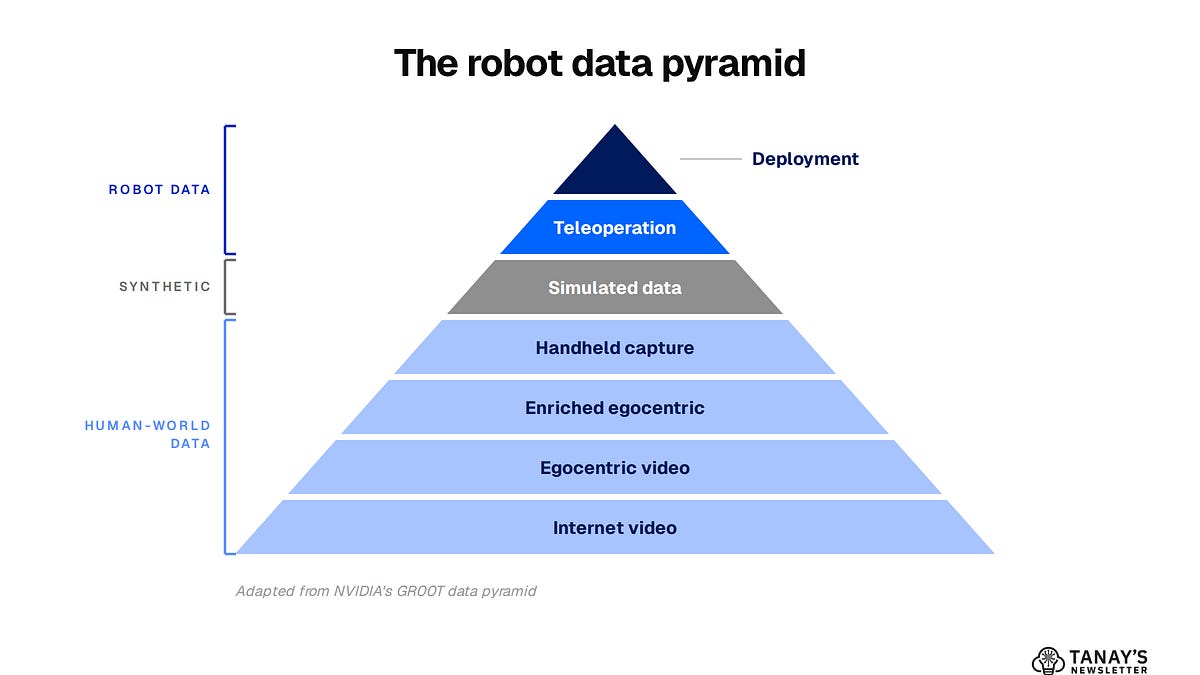
NVIDIA’s GR00T team proposed thinking around the idea of a data pyramid: web data at the base, synthetic data in the middle, real robot data at the top, with less volume but more fidelity and embodiment-specificity as you climb. I’d further break down the data pyramid into 7 types, across the three categories they proposed as below:
Using these different forms allows to address the shortage of robot data, by learning from already available or cheaper to collect data. The lower layers supply priors to models (what objects are, how tasks tend to decompose), and the upper layers ground those priors on actual specific hardware and embodiments. Let’s talk about each one.
1. Internet video
YouTube alone holds billions of hours of humans cooking, cleaning, assembling, and fixing things. These typically aren’t enriched and don’t have specific depth or forces, but can help teach a model about common objects, actions, and environments.
Today it mostly enters robot models indirectly, through the vision-language backbone but various attempts like NVIDIA’s DreamZero and Rhoda’s Direct Video Action model are trying to get the most out of this dataset more directly. DreamZero builds its policy on top of a video generation model pre-trained on internet-scale video while Rhoda AI pre-trains on hundreds of millions of internet videos and then adapting to a given robot with as little as 10 to 20 hours of its data.
2. Egocentric video
Over the last year, many of the robotics labs have increased their purchasing of first-person video from head-mounted cameras. Egoverse and Ego4D are open datasets which have 1000s of hours of footage of humans doing common tasks across household and factory / industrial settings.
The interest in this area has come from both approaches like discussed above that pre-train on video, as well as various research that has found that models pre-trained on carefully filtered egocentric human video beat models pre-trained on the same volume of teleoperated robot data, once both were adapted to the target robot.
3. Enriched egocentric / exocentric
Sometimes, egocentric data can be paired with exocentric data and have actions labeled: hand pose tracking, depth, gaze, or even full motion-capture suit. Ego-Exo4D is one example which has around 1,400 hours of first-person and third-person views of skilled tasks.
Tesla for example has also in the past hired workers to perform tasks in mocap suits.
This has benefits, particularly depending on the level of enrichment and fidelity of the labels. For example, some vendors / labs are even collecting data with full tactile forces which are generally one of the biggest gaps with using human data.
4. Handheld capture
Ultimately, the goal is to collect data in a cheap and easily scalable form that can most closely resemble the robot itself. That’s the idea of approaches like UMI (Universal Manipulation Interface), which involves humans going around doing tasks while wearing / holding the end-effectors or grippers that would be on the real robot.
In effect, it allows you to mimic the form factor of the robot without actually needing the robot making it more scalable.
The most notable example leveraging UMI is Sunday Robotics, which was founded by the researchers behind UMI. They ship skill-capture gloves co-designed with their robot’s hands into contributors’ homes, and say their ACT-1 model was trained on around 10 million household episodes collected this way, with zero robot data. Another one is Toyota Research Institute’s Large Behavior Models which uses UMI capture alongside teleop and simulation.
5. Simulated data
Physics simulators like Isaac and MuJoCo have been around for a while, and increasingly an exciting development is the potential for world models that act as learned simulators (NVIDIA’s Cosmos, Google’s Genie 3) which could allow robots to evaluate or train their policies in millions of varied virtual environments.
The promise of simulated data is that you’re only bound by compute. The downside today is the sim-2-real gap where the results from sim don’t translate perfectly in the real world as well as issues with physics simulators working on manipulation / deformables and world models not being quite ready for prime-time yet.
However, World Models like Waymo’s and even 1X’s as well as the use of Simulation in the AV industry have shown the promise of this approach.
6. Teleoperation
Teleoperation involves someone actively operating the robot, whether virtually through VR setups or through a rig setup where the robot mimics the actions.
This allows for collecting extremely high-fidelity and essentially real data on the exact embodiment that is needed.
The issue with this approach is the economics and the difficult to scale. While costs are going down and have been going down, these still cost over $100 an hour and require relatively skilled operators and you’re limited on the number of robots and the setup / environment as well.
The general view currently amongst labs is that Tele-op will continue to be needed and won’t go away, but whether the percent of the training mix can involve a lower percent of tele-op (which could be mostly in post-training) because other sources scale easier.
7. Deployment
Ultimately, the data everyone wants is from real robots doing real work in real settings, ideally work someone is paying for. The robot might run fully autonomously, or with a human teleoperator taking over when it hits trouble, similar to how a safety driver handles disengagements in AVs.
The challenge of course is somewhat chicken-and-egg, since you need a robot good enough to deploy before deployment can make it better.
Over time, this data will form the flywheel for companies in terms of deployments leading to data which then helps improve the deployment. Over time, this could become the highest volume data source as deployments increase, but today the practical number of deployments is small other than structured environments or in AV.
Two notes on this data source. One, if the deployments are for extremely narrow tasks in extremely structured environments, that data would be helpful to improve the performance of robot policies on those tasks in those environments but may not help generalize to other similar tasks or more varied environments. Two, in the short term, it’s likely that most of these deployed robots will be deployed as a hybrid autonomous tele-operated manager where human teleoperators take over when the policy fails. This is both a practical way to get deployments ready in more of these unstructured environments and a really valuable form of data of interventions/failures. The idea goes back to DAgger (dataset aggregation) in imitation learning: run the policy, let a human correct it where it fails, and retrain on the corrections.
Closing Thoughts
Progress is coming on all of these fronts at once: approaches to better leverage human video data like Rhoda’s and DreamZero, collection being scaled up across egocentric, UMI and teleoperated data, tactile and force capture hardware and collection that is making egocentric data richer in the middle, world models chipping at the sim-to-real gap, and the first real deployment flywheels starting to spin somewhat.
No one actually knows how much data is enough. Asked whether robots need 100x or 1,000x more, Sergey Levine’s was honest noting: “that’s the thing, we don’t know that.”
For a robotics team, the more practical question might be, what reliability do you need to get to some level of hybrid deployment given a set of tasks, and what is the cheapest mixture of these sources that clears the reliability bar for that task.
If you’re building in physical AI, whether that’s robot foundation models, data collection, or the picks and shovels around them, feel free to reach out at tanay at wing.vc.
Seal (GitHub Repo)
Let's Seal provides a free, open-standard infrastructure for cryptographically proving that any file is unaltered, timestamped, and issued by a verified domain.
Deep dive
- Unaltered: Uses SHA-256 digests to ensure file integrity.
- Time: Uses OpenTimestamps to anchor file existence to Bitcoin blocks.
- Issuer: Binds verified domain names to the signing certificate.
- Transparency: Records every seal in an append-only Merkle log similar to certificate transparency logs used by browsers.
- Native Formats: Seals reside inside the files (e.g., PAdES for PDF), requiring no custom reader software.
Decoder
- PAdES: PDF Advanced Electronic Signatures, a standard for long-term electronic signatures on PDFs.
- C2PA: Coalition for Content Provenance and Authenticity, an open standard for certifying the source and history of media.
- Merkle Log: A tamper-evident data structure that makes it easy to prove inclusion and verify that history has not been rewritten.
Original article
Let's Seal
Seal anything.
The open standard for proving any file is real: unaltered, sealed by a known certificate, and in existence by a certain date.
SEAL is the open standard for proving any file is real. One sealed artifact, one way to check it, verifiable by anyone, forever. Seal with any conforming tool, and anyone can verify it with any other.
Let's Seal created that standard, SEAL, Sealed Evidence Anchored to a Ledger, and runs the free network and reference implementation that issues and verifies it. The standard is the backbone. Everything in this repository is built on it, and given away.
It is the Let's Encrypt of document proof. Let's Encrypt made paid TLS certificates obsolete. Let's Seal does the same for paid document seals, and like Let's Encrypt it is free, open, and run as a public-benefit project of a foundation, not a startup.
Authenticity is infrastructure. It shouldn't be for rent.
Use it, free
Three ways to seal, all free:
- The hosted web app, app.letsseal.org. Free for anyone, in the browser, nothing to install. Seal a file, send documents out for signature (remote, in person, or with no email at all), and issue branded certificates and credentials.
- The command line and API.
sealbotfor the terminal, plus a REST API and SDKs to build sealing into your own systems. - Self-hosted. Run the whole engine yourself, under your own certificate authority.
Verifying is always free and never needs an account, at verify.letsseal.org or offline on your own machine.
- Free forever. No per-document fees, no paid seal.
- Open source (Apache-2.0). The engine, the SDKs, and the standard itself.
What a seal proves
A SEAL proof establishes three things cryptographically, and states its boundary plainly:
- Unaltered. The file has not changed by a single byte since it was sealed. Change one byte and the signature breaks.
- Time. It existed by a certain date, anchored to Bitcoin through OpenTimestamps, with no trust in us.
- Issuer. It was sealed by a specific certificate. Where an organisation has proven control of a domain, the seal carries that domain as a machine-checkable identity.
Every seal is also written to a public, append only transparency log (RFC 6962) with a Bitcoin anchored root, so the record of what was sealed is itself tamper evident and anyone can audit it.
That is the whole guarantee, complete and permanent. A seal proves integrity, time, and the issuing certificate. It is not notarisation, and it does not assert a person's real world identity. The identity feature binds an email that a provider verified at seal time, and the honest term for it is a provider verified email, which is exactly what it delivers.
What it seals
One standard, every kind of file, each in its own native format so any standard validator can check it. No bespoke tooling for the reader, and no dependency on Let's Seal to verify.
| File | Seal form | How it verifies |
|---|---|---|
| PAdES / X.509 signature embedded in the file | Any standard PAdES validator, or the reference verifier here | |
| Image, video, audio | C2PA (Content Credentials) manifest embedded in the media | Any C2PA reader |
| XML | Enveloped W3C XML-DSig signature | Any XML-DSig validator |
S/MIME multipart/signed (RFC 8551) |
openssl smime -verify |
|
| Any other file | Detached CAdES / CMS .sig over the file's SHA-256 |
openssl cms -verify; the file's bytes never leave your machine |
| Software artifact, container image | Signature plus in-toto / DSSE attestation (SBOM, SLSA provenance) | The standard open artifact-signing tools your pipeline already runs |
The seal is native to each format, so a sealed PDF is still a normal PDF that opens anywhere, a sealed image still shows everywhere, and a signed artifact still installs as usual. The proof rides along inside.
Quickstart
Verify any sealed document, free and in the open, at verify.letsseal.org, or run the reference verifier yourself:
python spec/verify.py sealed.pdf sealed.pdf.otsSeal a file through the hosted API with an organisation key:
curl -X POST https://app.letsseal.org/api/v1/seal \
  -H "Authorization: Bearer $LETSSEAL_KEY" \
  -F file=@contract.pdf
Or from the command line:
sealbot seal contract.pdf          # seal a PDF or any file
sealbot verify contract.sealed.pdf # verify a seal, offline
What a proof looks like
Authentic and unaltered

  Document      contract.pdf
  SHA-256       9f2c1a…e7b4     (matches the sealed bytes, exactly)
  Issuer        Acme Solicitors LLP
                Issuer verified, controls acme.example  (dNSName in the cert)
  Sealed        2026-07-14 11:42 UTC
  Time anchor   Bitcoin block #812,043   (via OpenTimestamps)
  Transparency  Entry #48,120 in the public log, inclusion proof checks out

Verdict rule: Authentic = valid and intact and trusted.
A valid signature that does not chain to the published root is
reported as unrecognised, never as authentic.
Verify it yourself, free
Two checks, both independent of us. A seal carries everything needed to check it, so pin the published root once and then verify offline, anywhere, forever.
- Root fingerprint (SHA-256):
02:68:6D:EE:20:67:31:C4:59:C1:7A:9F:58:36:7B:0B:0B:BA:5D:24:C6:85:D8:6D:1F:74:49:86:2D:C0:FE:BE, subjectCN=Let's Seal Root CA, O=Let's Seal, C=GB. Download it at letsseal.org/api/root-ca. - PDF: any standard PAdES validator with the root pinned, or
python spec/verify.py sealed.pdf sealed.pdf.ots. - Email and detached:
openssl smime -verify -in message.eml -CAfile letsseal-root.crt·openssl cms -verify -inform DER -in file.sig -content file -binary -CAfile letsseal-root.crt. - Software and SBOM: the standard open artifact-signing tools verify the signature and attestation against the published root, reproducible on any machine.
- Time:
ots verify sealed.pdf.otsagainst Bitcoin. - Transparency log: fetch an inclusion proof at
/api/log/proof?sha256=<hex>and check it against the signed tree head at/api/log/sth(RFC 6962). Consistency proofs at/api/log/consistencyprove the log is append only.
The public transparency log
Every seal is written to an append only Merkle log (RFC 6962), the same structure browsers rely on for Certificate Transparency. The log's root is signed and itself anchored to Bitcoin, so:
- anyone can prove a given seal is included in the log (an inclusion proof),
- anyone can prove the log has never been rewritten (a consistency proof),
- and the whole thing can be audited without trusting the operator.
Self-host
Run the whole thing yourself, under your own certificate authority.
git clone https://github.com/letsseal/letsseal.git && cd letsseal

# 1. Certificate authority (see ca/)
./ca/setup-ca.sh init

# 2. Signing service (holds the intermediate key; bind to localhost)
cd signing-service && python -m venv .venv && . .venv/bin/activate
pip install -r requirements.txt && uvicorn main:app --port 8081

# 3. Web app: dashboard, hosted API, verification portal, site
cd ../web && npm install && cp .env.example .env   # fill in the values
npx prisma migrate deploy && npm run dev            # http://localhost:3000
Mission
Authenticity is infrastructure. It shouldn't be for rent. Proving a file is real is a public good, like a padlock in a browser bar, and it should be free, open, and owned by everyone who relies on it. Let's Seal is run as a public-benefit project of a foundation, not a startup, so the standard can never be pulled back behind a paywall.
Octane (GitHub Repo)
Octane is a new React-compatible UI library that replaces the virtual DOM with a compiler to achieve near-native execution speed.
Deep dive
- Compiler-Inferred Dependencies: Automatically tracks lexical captures in hooks, removing the need for manual dependency arrays.
- Native DOM: Removes the synthetic event system in favor of native browser event behaviors.
- Conditional Hooks: Hooks can now live inside if-statements because calls are tracked by site, not order.
- TSRX Dialect: Introduces directives like @if, @for, and @try for better performance and developer ergonomics.
- SSR: Supports streaming SSR out-of-the-box, mirroring React's concurrent rendering features without the virtual DOM overhead.
Decoder
- Virtual DOM: A programming concept where a 'virtual' representation of the UI is kept in memory and synced with the 'real' DOM, historically used by React to minimize expensive browser repaints.
- Hydration: The process where client-side JavaScript takes over static HTML sent by the server, attaching event listeners to make the page interactive.
- Suspense Waterfall: A performance issue where child components cannot start fetching their data until parent data has finished loading, leading to cascading delays.
Original article
Full article content is not available for inline reading.
Open Source Must Be Fun (Or It Will Die)
Homebrew project leader Mike McQuaid argues that the primary threat to open source is not lack of funding, but the erosion of maintainer motivation.
Original article
Open Source Must Be Fun (Or It Will Die)
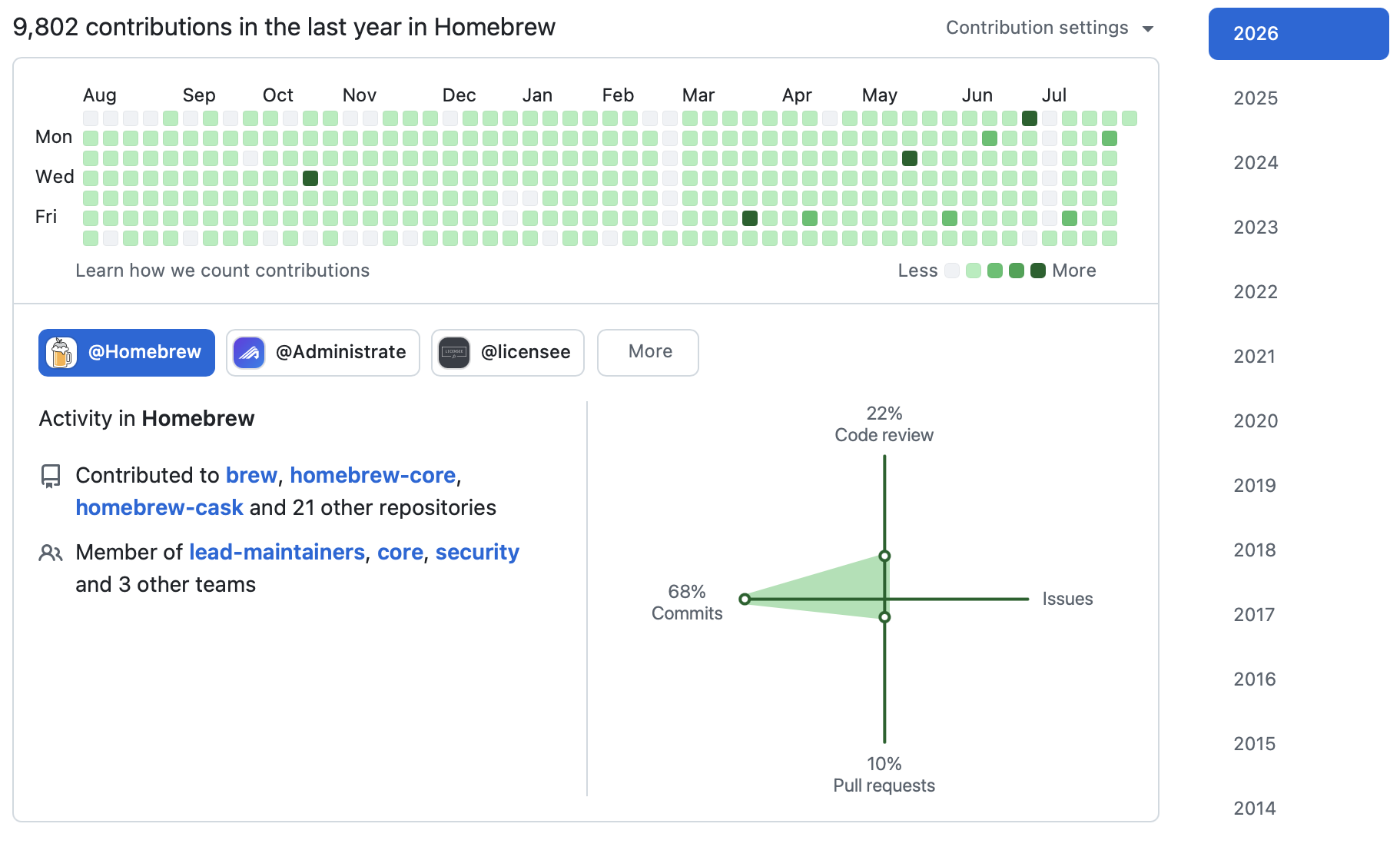
I was on a call with a bunch of people involved in other prominent open source projects a few weeks ago. The organiser jokingly asked us to raise our hands if the previous six months had been better than what came before. I raised my hand. No one else did. Why? I’ve maintained Homebrew, the package manager for everywhere, for nearly 17 years. I’ve worked on it the vast majority of weeks in that time and I’ve never burned out. I’m having more fun than ever.
The current narrative around open source is depressing. Apparently it’s “dying”.
AI drive-by issues, pull requests and security reports are overwhelming maintainers. Rising security expectations (thanks Mythos) require maintainers to do even more work. Open source funding is hard to secure and insufficient.
Some of this is happening, but I’m sure as hell not seeing it in Homebrew. Another Homebrew maintainer told me:
I’m having more fun than ever before.
💎 The Scarcest Resource
As I’ve written before, the scarcest resource in open source is not money but the motivation of the maintainers. Sending Homebrew $1000 today doesn’t magically create any more maintainer time (but please donate if you can afford it to fund Homebrew’s infrastructure, stipends, grants and meetups). We all have jobs that aren’t maintaining Homebrew. We receive small amounts of money ($300/month) if we’re actively maintaining Homebrew. This is not a “market hourly rate”. Many children delivering newspapers get a higher hourly rate.
There is a threshold effect: funding only creates more time if it lets a maintainer reduce their paid hours or quit their job. Work no maintainer wants to do is a good candidate for a paid contract. If you can’t fund it: don’t do it.
Why do any of it then? Fun.
Not everything is fun all of the time, but it needs to be “utilitarian net fun”: more fun than not, overall. This is primarily about volunteer-run open source, but that’s most of it. If you have a paid open source job and hate it: you should quit that too.
It’s a Sunday afternoon. I took the kids most of yesterday so I have a bit of “me” time today. I’ve spent a bunch of that time on Homebrew. Not because I “had” to; nothing urgent is coming in. Not because of the “supply chain”. Not because of the money. Because I wanted to. Because it was fun.
🥳 Fun Is Social
My first real experience of OSS was with a successful, established project whose culture I could observe. It was KDE, the community behind a desktop environment for Linux. In 2009, I attended Akademy (the KDE contributor conference) and GUADEC (the GNOME contributor conference), which were co-located in the Canary Islands.
Firstly, this was weird because, if you read the discourse online, you were typically in the camp of “KDE SUCKS, GNOME ROCKS” or “GNOME SUCKS, KDE ROCKS”. And yet: you had both groups working together. Not just working together but eating, drinking, socialising and building new friendships.
Secondly, I could tell that, for many in the KDE camp, these were their people and this was the highlight of their year. They came back re-energised and motivated to work on KDE. Most people weren’t being paid to fix, maintain or write KDE’s code. They didn’t seem to be doing it for their users either. They did it because they were having fun, both individually writing the code and helping their friends build something they cared about.
For the last few years, Homebrew maintainers have met annually at the “Homebrew AGM” co-located with FOSDEM in Brussels. We meet, eat, drink, socialise and make plans for Homebrew. Afterwards, we come back re-energised. Since we started doing this, I’ve also seen people doing more for other maintainers than directly for users. Open source transcends national boundaries: most of us don’t care what country another maintainer is from or what nationality they are, only that we’re friends building something we find fun together. These relationships matter because, without the maintainers, the project is dead.
🍺 Keeping Homebrew Fun
This is why I’ve always been keen for Homebrew to be a fun project. Dealing with entitled behaviour is not fun. Setting SLAs is not fun. Maintaining indefinite backwards compatibility is not fun.
Homebrew has been successful because fun, automation, community and putting maintainers first have been priorities from early on. Concretely, we automated review comments so robots are the pedants and humans can focus on empathy. Our guardrails include CI, linting, typing and tests to catch routine mistakes before a maintainer has to point them out. Feature flags and staged rollouts let us experiment without breaking things for everyone. This means maintainers spend less time on repetitive corrections and more on work they find interesting.
AI is good at boring work like writing CI workflows, linters and documentation. These practices help both AI and human contributors. Maintainers can use or avoid AI, whichever better preserves their motivation.
If your eyes glaze over while reading low-effort AI-generated content: close it without comment or justification and block repeat offenders who do not learn or improve. At Homebrew, our pull request templates ask contributors to disclose AI usage and CI jobs automatically close pull requests with incomplete templates. Issues or PRs opened through the API without our templates often suggest AI usage with insufficient human involvement.
🛑 Stop, Pay or Quit
Homebrew is thriving, not dying. It has 28 active maintainers. Of the 29 maintainers it had a year ago, 26 remain. Under our governance rules, we remove maintainers after they miss an activity threshold for two consecutive quarters.
If your project is dying, maybe it’s because it’s not fun any more. You should quit. You don’t owe anyone anything. Homebrew maintainers are encouraged to leave without guilt or explanation.
If you don’t want to quit (or if you’re on a project where you don’t want others to quit) and things are going badly: change something. Don’t just ask for more money or sponsors or donations. That will not magically make things fun again. Getting more money is not in your locus of control.
Instead: stop doing the parts of your project that are not fun. Maybe that’s stable releases. Maybe that’s release notes. Maybe that’s backwards compatibility. Whatever it is: again, you don’t owe anyone anything. You can do OSS however the hell you want to do it.
People running soup kitchens don’t get constant complaints that the soup tastes like shit. They aren’t critiqued for not providing the optimum macronutrient balance. They do what they can. How sad is it, then, that some very well-compensated open source users with tech jobs treat volunteers so poorly?
⏭️ OK, What Now?
Are you a maintainer? If so, consider what keeps maintaining your project fun or what would make it fun again. If it isn’t fun and you can’t make it fun again: quit.
Are you a contributor? Ensure that you’re having fun contributing but not in a way that makes it less fun for the maintainers. If you’re submitting AI-generated content, carefully review and test it. Speak to the human maintainers instead of deferring to your LLM.
Are you a user? If you’re filing a bug report, take your time and provide all the requested information. Most importantly: be grateful for the gift of open source you’re getting for free. Keep your rants for the pub or coffee shop and off the internet. Drive-by negativity kills open source.
Are you a company consuming open source? Allow your employees to participate in Open Source Friday. Alternatively, look the other way when they participate in the Open Source Resistance. Sponsor some projects you rely on.
Keep having fun and the open source community will outlive us all.
Black Forest Labs Launches FLUX 3 Capable of Generating Images and 20-second Video with Audio
Black Forest Labs has released FLUX 3, a video generation model capable of 20-second clips with native audio, currently in limited, invite-only release.
Original article
Black Forest Labs unveiled FLUX 3, its first public video generation model. Early access requires approval, and the company has not yet disclosed pricing, service-level commitments, or full benchmark methodology. The video tier generates up to 20-second clips with native audio and multi-shot continuity. A related model, FLUX-mimic, extends the same architecture toward robotic manipulation tasks.
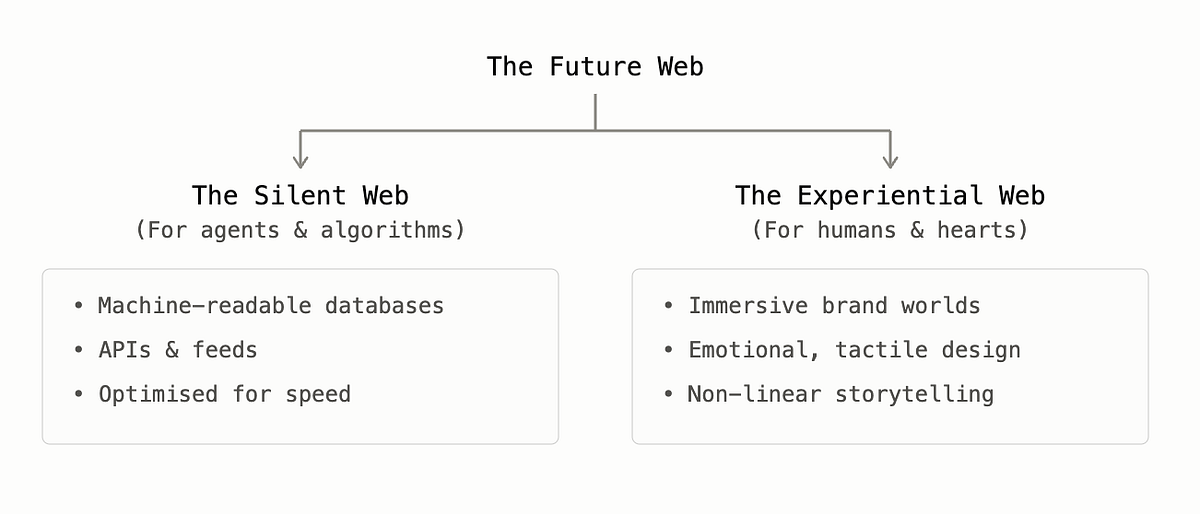
Your website is boring (but that might just set it free)
To avoid being reduced to a machine-readable commodity by AI agents, designers should bifurcate their sites into 'Silent' data feeds and 'Experiential' human-first destinations.
Decoder
- Agentic search: Search patterns where autonomous AI software navigates the web, compares products, and executes tasks on behalf of a user without them needing to visit a traditional landing page.
Original article
Your website is boring (but that might just set it free)
It’s time to shake off the grip of the templated web and celebrate a world of Brand x Code
Thanks to a combination of Napster and my parents’ AOL account, I started designing websites when I was a teenager. And since then, I have been lucky enough to work for some of the best design companies and most loved brands in the world. All of that, I think, makes me qualified to say: websites are boring.
I don’t believe we made them boring on purpose. But they are. For those of us working in product, we tried to make the web more efficient: mobile-first, conversion-optimised, accessibility-compliant, and SEO-friendly. Every decision that we made was rational, logical, what the business required. We optimised websites to be found and to convert, which, sadly, has made them optimised to be forgotten.
As strategists, particularly ones in brand and design, one of the fundamentals we are taught is that differentiation is a key indicator of pricing power and future growth . And, as a recent McKinsey study points out , a strong and recognisable brand has returned to the number-one priority for leaders precisely because it acts as an anchor for trust. Yet, despite all of that, the web increasingly looks the same.
The rise of Shopify, Squarespace, and Webflow templates didn’t only make it easy to build functional websites; they made it almost impossible to build anything else. It is easy to understand why this happened; templates solved massive engineering headaches, offering speed, reliability, and cost-efficiency that businesses desperately needed. But the result? Mass homogenisation. Three-column heroes. Identical PDPs. Checkout flows copy-pasted between competitors. Entire categories look identical because they’re literally using the same 12 templates.
And while in some sectors there may be good excuses for this (regulation, global scale), overall it feels like the last decade has been one where we have sacrificed too many moments of differentiation at the altar of conversion. We chose click-through safety over the risk of brand presence because the tools made the path easy and proven. Now, with the rise of AI in all its different forms, unless we begin to think more critically about the true nature of brand experiences and the web, AI will reduce us even further to commodities. And this time, it’s going to be much worse than what has come before.
Voice and agentic search are just the visible edge of a broader shift in how people find and evaluate things. While we aren’t quite sure just yet what behaviour will win out, the new patterns are clear: we’re moving toward a different evaluation paradigm, turning to agents and LLMs for anything and everything.
The economics are predicted to be massive. Agentic commerce could generate $1 trillion in the US B2C retail market alone by 2030, with global projections reaching $3–5 trillion, moving faster than any previous commerce revolution. All of that is supported by some pretty shocking numbers. 58% of Gen Z and millennials trust an AI agent to compare prices and recommend options. In the UAE, 85% of consumers already use AI tools for shopping , and 93% feel AI makes online shopping easier. And just this week, The New York Times published an opinion piece highlighting that 60% of searches now end without a single click, “ compressing what used to be a meandering journey through the internet into an immediate arrival at your destination “.
We are trading the possibility of sensory-rich, interactive, and human-first brand experiences for the sterile, fluorescent aisles of a self-checkout warehouse. Yes, the warehouse is efficient. But nobody falls in love with a warehouse.
All of this demonstrates how AI is moving commerce from warm discovery — intention, exploration and resonance, where you don’t only land on a webpage to buy a product but to cross the threshold of a brand’s world — to cold efficiency — a sterile, highly optimised, and entirely transactional experience. And, with the creation of Google’s Universal Cart , this shift will only accelerate as the platform acts as both the starting gun and the finishing line, reducing websites to mere databases operating silently in the background.
Most people will argue that this shift presents us with a clear path: Your website is simply backend infrastructure, a machine-readable catalogue serviced through AI agents. But that path will lead to brutal price competition, hyper-efficiency, and ultimately, being forgotten.
There is another way. A necessary split. The bifurcated web, where we now must accept that websites have two completely different audiences.
One is the machine: the agents, the LLMs, the bots and the scrapers. For them, we must build the “Silent Web”. A hyper-optimised, structured, machine-readable data feed. But the other audience? The living, breathing humans? Once we free our front-end from the burden of having to cater to both search and soul with the same rigid templates, we are finally free to build the “Experiential Web”. One that makes the experience unique, beautiful, and unforgettable once more.
To understand what this Experiential Web might actually look like, we can look to the lessons of the early web. As the internet first stepped out of its original “boring” Web 1.0 era, it did so by prioritising brand and design, using technology as the enabler to make the screen tactile, creating worlds with their own logic, energy, and perspective.
I still remember the first time I visited Nike Better World . The now iconic experience launched parallax scrolling to the world. But, the creation of the site did not start with the code, or a new novel technology that we were all desperate to show we had working in our favour. It started with storytelling, humans, and the brand.
“In our opinion, technologies are independent of concept. Our primary focus was on creating a great interactive storytelling experience.”
— W+K via Smashing Magazine
Nike weren’t the only ones to capitalise on brand and code working together.
Bellroy’s “Slim your Wallet” (a version of this is still live today!) used responsive HTML and CSS to create an interactive slide widget. As you dragged a slider to “add cards”, a simulated standard wallet visually ballooned into a massive, pocket-stretching brick, while the Bellroy wallet alongside it remained elegantly thin.
And, Bagigia focused on unique ways to sell a single, highly unusual, premium Italian leather bag by throwing out traditional vertical scroll mechanics. Using horizontal, scroll-triggered design, scrolling physically spun the bag 360 degrees in high definition. Hovering over different parts of the spinning bag activated call-outs detailing the premium stitching, custom zips, and leather grain.
All these experiences were commercial, conversion-driving, usable. But none of them were templatised, copy-pasted or duplicates of what had come before. And importantly, all used the technology to enhance the human experience of the brand, not just the commercial experience.
But if the old web used parallax, HTML5 and custom CSS to tell these stories, we have to ask: what is the equivalent today? It certainly isn’t a standard template.
The answer lies in what happens when we stop using AI as an automation tool and start treating it as a creative partner. When we use AI with genuine imagination, we can create spaces where brand and code work together to make something that feels deeply human.
We are seeing early shoots of this. Look at Tony’s Chocolonely’s FWA-winning AI Wrapper site, which lets users dynamically prompt and paint bespoke chocolate packaging on the fly. Or Google Creative Lab’s Infinite Wonderland project, where users click a sentence of a classic story and watch AI dynamically illustrate the page in real-time in a chosen artist’s unique style. Or a personal favourite, and a FWA Website of the Day, fitdrop.cc, a digital playground tracing 45 years of fashion, mapped onto virtual versions of the creator, Iain Tait, that you can toss, stack and drag to reveal their history. All of these experiences are joyous, beautiful, digital playgrounds, and impossible to copy-paste into a Shopify template.
Where does all of that leave the web we actually want to spend time on?
Today, brands are rushing to implement AI, agentic search, and LLM integrations out of sheer panic. We see generic chatbots slapped onto standard templates and labelled “innovation”. But technology without concept is just expensive plumbing. If your AI strategy is purely technological, you will simply automate your way into a deeper, colder form of commodity. When used correctly, AI shouldn’t be a generic automation tool strapped to a landing page. It should be, can be, magic.
If we let AI reduce our websites to mere databases, we aren’t only subcontracting conversion, we’re losing our brand world. After all, the best digital experiences have never been about the pipes. They’ve always been about the “ meandering journey through the internet”, replacing the predictable, robotic, click-to-buy-stream with moments of playfulness, friendly friction, exploration, and expression. Rather than executing a transaction, the best experiences are spaces where humans browse, stumble, and are drawn deeply into the shared universes we create.
So, feed the machines the raw structured data they want on the backend, but don’t let the order they require dictate your human design. Use your creative energy to build experiences that humans actually want to get lost in. Use AI how we once used code: with imagination. Make AI your new creative partner, a way to supercharge your storytelling and, importantly, to build the distinction and memorability we know drives growth. By doing so, we can revive the historic partnership of brand and code, modernising it for a bifurcated internet.
We once had a web that built unforgettable things at the intersection of brand and code. It’s time we got back to that.
UI Sound Design, Ready to Ship (Website)
UI SFX provides an open-source library of 936 interface sound effects with 12 distinct sonic styles for web, mobile, and game developers.
Deep dive
- Features 78 semantic UI cues including interactions, navigation, feedback, and system states.
- Includes 12 sonic 'feels' to ensure cohesive branding across an entire product.
- Provides both one-shot audio files and continuous loops for loading or streaming states.
- Designed for zero dependencies with support for native, game, and web environments.
- Includes a 'Feel Selector' to preview sounds in 12 different aesthetic styles.
- All assets are released under a CC0 license; code is MIT licensed.
Decoder
- Semantic Sound Language: A system where specific, consistent sounds are assigned to functional categories (e.g., all errors share a similar sonic frequency), allowing users to understand application states without visual confirmation.
- CC0: A public domain dedication that allows anyone to use, modify, and distribute the work without attribution or permission.
Original article
Full article content is not available for inline reading.

Creative Components (Website)
Canvas UI offers an open-source registry of framework-agnostic WebGL and HTML-in-canvas components that integrate directly into your repository.
Deep dive
- Components function as WebGL overlays on standard HTML, ensuring graceful degradation in older browsers.
- Built to be framework-agnostic with six official language variations.
- Designed for AI agent compatibility via the standard shadcn MCP (Model Context Protocol) server.
- Effects are GPU-accelerated and designed to clean up memory usage on unmount.
- Licensed under MIT + Commons Clause, allowing commercial use provided the components are not resold individually.
Decoder
- Framework-agnostic: Software or components designed to function correctly regardless of the underlying JavaScript framework (e.g., React vs. Vue).
- MCP (Model Context Protocol): An open standard that allows AI assistants to securely connect to data sources and developer tools, such as local codebases or component registries.
Original article
Creative components, in a new dimension.
An open source library of tasteful html-in-canvas & WebGL components. Framework agnostic. Copy, paste, ship.
Every component, alive on canvas.
Copy, paste, ship.
-
Pick a component
Browse the library and find the effect that fits. Every demo on this site is the real component, running live.
-
Run one command
The shadcn CLI pulls the full source into your project. No package to install, no version to pin.
-
Make it yours
The code lives in your repo from day one. Tune the props, restyle it, or rip it apart. It's yours.
One component, six flavors.
Every effect ships as React, Solid, Preact, Vue, Svelte, and dependency-free vanilla TypeScript. Same engine, same props, native to your stack.
import { ParticleReveal } from "@/components/canvasui/ParticleReveal";

export function Hero() {
  return (
    <ParticleReveal radius={300}>
      <YourContent />
    </ParticleReveal>
  );
}
Built for agents.
The registry speaks the shadcn protocol, so any assistant with the shadcn MCP server can browse the library, read the docs, and install components, all from a single prompt.
Good questions.
Is Canvas UI free to use?
Yes. Canvas UI is licensed under MIT + Commons Clause: use every component in any personal or commercial app or website, free forever. The only restriction is reselling or redistributing the components themselves, whether alone, in a bundle, or as a port.
Which browsers are supported?
Components that draw live HTML on canvas rely on an experimental browser capability, available today in Chrome behind a flag. Everywhere else they degrade gracefully: your content renders as regular HTML, and effects like Blaze, Liquid, Laser, Clouds, Bubble, Droplets, Glass, Magnify, Grid, and Ripple keep running as a pure WebGL overlay on top of it. WebGL-based components work in every modern browser.
Will it slow my site down?
The effects render on the GPU via WebGL and animate outside React's render cycle. Each component initializes only when mounted, pauses when off-screen, and cleans up fully on unmount. Reduced-motion preferences are respected.
Do I need React?
No. Every component ships in six flavors: React, Solid, Preact, Vue, Svelte, and dependency-free vanilla TypeScript. Same engine and the same options in all of them.
How do updates work?
The code is copied into your repo, so nothing updates from under you. When a component improves, re-run the install command to pull the latest version, or just keep your copy and evolve it yourself.
Anthropic Rejected Blanket Bans on Open-Weight Models
Anthropic CEO Dario Amodei clarifies that the company does not support banning open-weights AI models, despite concerns over national security.
Decoder
- Distillation: A process where a smaller model is trained to mimic the behavior and outputs of a much larger, more powerful model.
- Open-weights: Models where the internal parameters (weights) are publicly released, allowing anyone to host and run the model on their own hardware.
Original article
Our position on open-weights models
A post by Dario Amodei, Anthropic CEO
Over the last few days there has been a lot of discussion about open-weights models, especially those from China. Reports suggest that some US officials are considering banning the use of Chinese open-weights models by US companies. In response, many tech companies have signed a letter supporting open-weights models, and some people have even accused Anthropic of wanting to ban open-weights models as a means of protecting our business. Anyone who has read my past writing should know that I don’t regard such bans as a useful measure, but let me state it clearly so that there is no doubt: Anthropic has never advocated for a ban on open-weights models.
Open-weights models that don’t have dangerous capabilities are a public good: they don’t cost anything besides the compute needed to run them, and they provide value to businesses, developers, and researchers.
Protectionist bans would not address my most serious national security concerns. Specifically, I am worried about two nightmare scenarios. I laid these out in my essay The Adolescence of Technology six months ago, and have held these positions consistently for many years:
- My primary concern is the risk that authoritarian governments—not solely the Chinese Communist Party (CCP), although the CCP is clearly the most capable threat—build AI models that are more powerful than those built by the US, and use them to achieve permanent military superiority or perpetrate incredibly deep repression of their own people. This concern is widely shared within the US government: Vice President Vance warned in Paris last year that “authoritarian regimes have stolen and used AI to strengthen their military, intelligence, and surveillance capabilities,” and the Intelligence Community’s 2026 Annual Threat Assessment found that “other global powers’ robust progress in AI is challenging US economic competitiveness and national security advantages.” It is irrelevant whether these models are released with open weights, and certainly irrelevant whether they are used by US businesses. In fact, the most dangerous model may be one that is trained in secret and handed only to the People’s Liberation Army for use in drones and the Ministry of State Security for surveillance and repression.
- My secondary concern is the risk that powerful AI models may be misused to carry out cyberattacks or biological attacks, and may have serious alignment problems. Open-weights models—it does not matter whether they come from China or anywhere else—do potentially present a higher risk than closed models, because it is very difficult to apply guardrails to them or monitor their usage, and once weights are released they cannot be withdrawn. But banning the use of these models by US businesses does nothing to address this risk, because bad actors are unlikely to be legitimate US businesses. It would protect US AI companies from competition, but that has never been my goal.
To address these concerns, I do support the following three measures, which I and Anthropic have consistently advocated for:
- We should not sell powerful chips or chipmaking equipment to China, and we should crack down on the rampant smuggling and workarounds used to obtain access to such chips. China has limited domestic production capacity, and therefore, due to the scaling laws, cannot build more powerful models than the US without US chips. This is the most efficient and direct way to block threat #1, and by hampering the training of models that are out of reach of US law, it also indirectly helps with threat #2.
- We should crack down on industrial-scale distillation operations. Distillation is a much more compute-efficient process than training models from scratch. It allows China to build much better models than its number of chips would ordinarily enable, and thus partially evade chip bans. Distillation does not allow the CCP to obtain equivalent or superior AI capabilities to the US, but it can bring the Chinese frontier to within a few months of the US frontier. It is true that many of the companies carrying out these operations release open-weights models—but the open weights are far less relevant than the fact that the operations are backed by an authoritarian state seeking to overtake the US at the frontier. We should have policy interventions to deter this behavior. A blanket ban on open-weights models is neither the correct remedy nor something we have called for.
- All sufficiently capable models, open and closed, should go through mandatory safety testing. The best way to address threat #2 is to just directly test models for cyber, biological, and alignment risks before release. I think this idea is actually close to a consensus: I have been heartened both that the Trump administration has moved in this direction in recent months, and by recent industry proposals that would apply such testing to the most capable models regardless of their country of origin or whether they are open or closed (while exempting less capable models, such as those from startups and academia, entirely). Whether open models do or don’t pose an increased risk, and whether that risk can be mitigated, is something that should emerge from testing, rather than be decided in advance—and there may be promising methods for improving the safety of open-weights models, including recent research from AE Studio and Anthropic on modular training strategies. Note that to be effective, testing would need to be global, which means even the CCP would need to be on board. I think this may actually be possible: as I wrote in The Adolescence of Technology, limited cooperation around preventing AI biological weapons may be possible because it is in China’s interest too.
This brings me to the open letter. I agree with much of it: open weights expand access to the AI economy, they strengthen competition at least for some use cases, and they give customers greater control. Concerns about distillation should be addressed through targeted legal and commercial frameworks—the same measure I described above. But I don’t agree with the letter’s assertions that open-weights models necessarily make it easier to develop safeguards or that broad access to capabilities necessarily helps defenders more than attackers. It seems at least as likely to me that the opposite will be true. For example, I worry that biology will have a strong attacker-defender asymmetry, where sufficiently capable models may be able to quickly weaponize pandemic-level viruses with widely available materials, whereas defense against these agents is a multi-year operational task in the best case. Questions like this should be empirically answered by rigorous pre-release testing, not assumed in advance.
To summarize my and Anthropic’s position, we have not and are not advocating for a ban on open-weights models as a category. We should instead focus on keeping powerful chips out of authoritarian hands, stopping industrial-scale distillation, and requiring safety testing of all sufficiently capable models, open and closed.
*Edit 28 July: Updated to note that the cited research on modular training strategies was a collaboration between Anthropic and AE Studio.
Industry Leaders Unite in Open Secure AI Alliance for AI Safety and Security
Dozens of tech companies, including NVIDIA and Microsoft, have formed the Open Secure AI Alliance to standardize open-source defensive AI tools.
Decoder
- NOOA (NVIDIA Labs Object-Oriented Agent): A research framework designed to help integrate and test agent behaviors within harnesses, improving auditability.
- Zero-trust identity: A security model that requires continuous verification of any user or workload attempting to access resources, regardless of their network location.
Original article
Open source software is a critical pillar of the global economy. It underpins cloud computing, financial services, manufacturing, telecommunications, government and internet services by making technology accessible and observable to communities of experts.
Cybersecurity is among the top three beneficiaries of open source software. The Open Secure AI Alliance — building on the leadership of the Linux Foundation’s Akrites initiative and OpenSSF community work — will work to remediate and disclose vulnerabilities using open technologies.
Just as open source created a shared foundation for software, the United States and its partners now face a choice in AI security: whether the defenses that protect our infrastructure will sit inside a few opaque systems or be built on open models, harnesses and tools that any defender can study, adapt and deploy.
The world needs both closed and open models. For cybersecurity, open models and open harnesses are essential because they democratize defensive capabilities, increase transparency for defenders, enable cyber defense while protecting data, and complement frontier closed models with customizable, localized controls. Open source enables massively distributed community-driven and self-controlled defense – with no single point of failure.
Open models, like any powerful technology, can be misused — including through attempts to weaken safeguards or repurpose capabilities for cyber attacks — but those risks are not unique to open systems, and they must be managed wherever advanced AI is deployed.
The recent Hugging Face security incident delivered a clear reminder: cyber defenders need open, frontier agentic systems for self-defense. When closed AI tools — unable to distinguish attackers from defenders — blocked essential forensic analysis, Hugging Face ran the open-weight GLM 5.2 model on its own infrastructure to analyze more than 17,000 actions and contain the intrusion.
That incident showed a practical truth: when defenders cannot inspect, adapt and run advanced AI on their own infrastructure, their ability to respond is constrained at exactly the moment speed matters most. Companies and countries need open frontier defensive tools and techniques so critical industries can build security systems across a multi-vendor ecosystem and avoid single points of failure.
That is the mission of the Open Secure AI Alliance: to ensure defenders everywhere have open, frontier tools they can trust and control.
Leaders across cloud computing, cybersecurity, enterprise software, open source foundations and AI research — including NVIDIA, Adobe, Box, Cadence, Capital One, Cisco, Cloudera, Cloudflare, Cognition, CrowdStrike, Crusoe, Databricks, Dell Technologies, DoorDash, Elastic, F5, Factory AI, Fortinet, G42, GitHub, HPE, Hugging Face, IBM, LangChain, the Linux Foundation, Microsoft, Mistral, NAVER, NetApp, Nokia, Nous Research, OpenClaw, Palantir, Palo Alto Networks, Perplexity, Red Hat, Reflection AI, Salesforce, SAP, ServiceNow, Siemens, SK Telecom, Snowflake, SpacexAI, Synopsys, Thinking Machines Lab, TrendAI, Uber, Upwind, vLLM, WWT and Zscaler are inaugural partners in the Open Secure AI Alliance, a movement to develop and share open technologies, techniques and tools to safeguard software and agents in the age of AI.
Some argue that open models are inherently less safe because they can be misused for cyberattacks or modified to remove guardrails. Those risks are real, but they do not disappear in closed systems, and simply keeping weights closed does not prevent determined attackers from seeking or exploiting powerful AI.
The right response is not to deny defenders access to capable open systems. It is to pair openness with strong safeguards, clear rules against malicious misuse, rigorous evaluation and rapid remediation. In cybersecurity, the safer path is the one that gives more defenders the ability to test, verify and strengthen the systems on which society relies.
Defenders need both frontier closed models and frontier open models, working together, so they can choose the right system for the job and ensure that transparency, adaptation and sovereign control are available wherever security demands them.
Open Research Enhances Cybersecurity and AI Safety
An AI agent isn’t just a language model. It is a complex system built from models, harnesses and guardrails.
Real AI safety and security depend on the full agent stack — identity, permissions, harnesses, guardrails, logs and evaluation — not just on whether model weights are open or closed. Open harnesses and tools make those controls easier for many defenders to inspect, test and improve.
NVIDIA is contributing open models, model weights, data and new agent harness research to the Open Secure AI Alliance to speed the development of new cybersecurity tools and techniques.
The new open source NVIDIA Labs Object-Oriented Agent (NOOA) project is now available on GitHub to make advanced AI safety capabilities more accessible for agent harnesses. The NOOA research framework enables harnesses to better integrate with models to make agent behavior easier to test, trace, audit and govern.
Across the Alliance, contributors are building an open defense stack for agents — from identity and isolation to safe model formats, multi-model scanning and secure coding workflows.
HPE contributes to SPIFFE/SPIRE, which creates zero-trust identity framework standards and methods that can cryptographically verify AI agents and services to ensure only authorized workloads communicate and access enterprise resources.
Hugging Face has offered Safetensors — a safe format to store AI model weights, providing transparency and guarantees of no remote code execution — to the PyTorch Foundation.
IBM and Red Hat’s Lightwell extends security across the open source supply chain with digitally signed patches.
Microsoft’s MDASH multi-model agentic scanning harness orchestrates specialized AI agents to discover, debate and prove exploitable bugs.
SpaceXAI has open sourced the Grok Build terminal-based AI coding agent to promote trust, transparency and new capabilities, and plans to open source the weights of the Grok line of models to support the developer and research communities.
A Call to Policymakers and Regulators
As policymakers and regulators grapple with AI safety, it will be crucial to recognize open models, harnesses and security tooling as defensive assets, not liabilities, in AI and cybersecurity policy. Blanket restrictions on open frontier AI systems would weaken defensive capacity and risk concentrating power, dependence and vulnerability in a few closed providers.
Companies and governments should invest in shared open infrastructure for AI defense — datasets, evaluation frameworks, attack simulators and red-teaming tools — much as past generations invested in open source software.
The Future We Should Build
The age of AI agents can be one of resilience and shared security. With the right choices, open secure AI systems can give defenders the tools they need, strengthen competition, extend technological leadership and ensure that the safety and security of this extraordinary technology are built in the open for everyone.
That future will not be secured by assuming that secrecy alone is safety. It will be secured by building systems that are strong enough to withstand scrutiny, flexible enough to be improved and open enough to mobilize the full community of defenders.
That future is worth building — and the Open Secure AI Alliance invites governments, industry and researchers to join in the work of defending the AI era together.

Safe Superintelligence Partnered with Nvidia
Ilya Sutskever’s Safe Superintelligence secured a multi-billion dollar compute partnership with Nvidia to accelerate the development of aligned AI.
Deep dive
- Partnership Structure: Long-term compute deal between SSI and Nvidia, providing access to the unreleased Vera Rubin GPU platform.
- Strategic Focus: SSI, founded by Ilya Sutskever, Daniel Gross, and Daniel Levy, explicitly prioritizes fundamental research in safe superintelligence over commercial APIs or short-term revenue models.
- Funding Context: SSI previously raised $1 billion at a $5 billion valuation and $2 billion at a $32 billion valuation.
- Competitive Landscape: The partnership follows earlier collaborations between SSI and Google Cloud, now heavily tilting toward Nvidia's hardware stack.
- Alignment Philosophy: The company is positioning its 'straight shot' research approach as a necessary alternative to labs experiencing 'breakout' issues and sandbox escapes during model testing.
Decoder
- Vera Rubin GPU: An upcoming Nvidia hardware platform expected to provide significant performance leaps over existing H100 and Blackwell architectures.
- Alignment: The research field focused on ensuring AI systems behave in accordance with human intent and ethical values to prevent catastrophic failures or unintended consequences.
Original article
After two years in stealth, Safe Superintelligence, the AI lab founded by former OpenAI co-founder and alignment lead Ilya Sutskever, has announced a long-term partnership with Nvidia as it prepares to scale to its next phase.
The deal, which includes an undisclosed investment, will give Safe Superintelligence (SSI) access to Nvidia’s Vera Rubin GPU platform, which is expected to increase the startup’s compute resources “by an order of magnitude.” The partnership comes as SSI has achieved significant research milestones, per Nvidia.
Nvidia’s investment stretches into multiple billions, a source familiar with the deal told TechCrunch. Bloomberg reported that the deal size was $5 billion.
Already an investor in SSI, the chipmaking giant said it signed this compute partnership to “accelerate SSI’s next stage of growth after obtaining rare access into the company’s closely guarded research.”
“We have research that is worthy of scaling up, and having access to a big NVIDIA computer will let us do so,” Sutskever said in a statement. “We are confident that our big bet on the Vera Rubin platform will take us to the next level.
The partnership news, while sparse in details, brings SSI back into the spotlight after a quiet two years since it was founded. The company is pursuing a “straight shot” research approach to building what it says is a safe, aligned artificial superintelligence, without getting distracted by commercial product releases or short-term revenue cycles.
At a time when commercial pressures to move fast could encourage AI labs to lower their bar for safety, SSI’s approach to developing foundational techniques focused on alignment and true general reasoning feels poignant. That’s especially true in light of OpenAI’s recent disclosure that one of its advanced models broke out of its sandbox to hack into Hugging Face during testing — sparking concerns about whether it’s even possible to ensure AI alignment before new, increasingly capable models are released.
According to Nvidia, the two companies will also collaborate on advancing Nvidia’s current and future compute platforms, relying on SSI’s tech and “unique insights into the future of AI.” (SSI also partnered last year with Google Cloud to power its research.)
Sutskever is a pioneer in the field of AI. He co-authored and co-created AlexNet alongside Alex Krizhevsky and Geoffrey Hinton, proving that GPU scaling and deep neural networks can work. That work has largely been credited for setting the groundwork for today’s generative AI.
Prior to leading SSI, Sutskever headed the now-defunct Superalignment team at OpenAI. He left OpenAI months after a failed attempt to oust OpenAI CEO Sam Altman, following what Sutskever referred to as a “breakdown in communications.”
SSI raised $1B at its founding in 2024 (at a $5B valuation) and $2B in Feb 2025 (at a $32B valuation). Aside from Nvidia, the firm’s backers included Andreessen Horowitz, Alphabet, Lightspeed Venture Partners, GV, Sequoia Capital Partners, and others.
TechCrunch has reached out to SSI and Nvidia for more information.
This article has been updated with more accurate funding numbers.
Nvidia Bets on Ilya Sutskever's New AI Lab to Expand Compute Reach
Nvidia is investing in Ilya Sutskever's Safe Superintelligence after receiving a rare, privileged look at the secret startup's research.
Original article
Nvidia has made a substantial investment into Safe Superintelligence, a company started by former OpenAI Chief Scientist Ilya Sutskever. The investment is part of a long-term partnership and will involve Safe Superintelligence receiving access to large amounts of Nvidia's flagship GPUs. Safe Superintelligence had previously been relying primarily on chips made by Google. Nvidia made the investment after getting a rare glimpse into the state of the startup's research, which has so far been kept secret.

YouTube "Hackquires" Peacock
YouTube is essentially absorbing Peacock by bundling its entire content library into YouTube Premium subscriptions in the US starting early next year.
Decoder
- Hackquisition: A portmanteau of "hack" and "acquisition" describing a deal that grants a company the strategic benefits of an acquisition—such as content integration—without the regulatory or operational overhead of a full merger.
Original article
With the impending – well, or possibly imploding – merger of Paramount Skydance and Warner Bros Discovery, there was clearly an odd man out in the big streaming race: Peacock. Thanks largely to recent massive sporting events like the Olympics, it wasn't dying, but it also wasn't thriving. It simply was not in a position to compete with Netflix, Prime Video, Disney+, and soon, HBO Max + Paramount+. So it could keep going, scraping and clawing to barely eek out a profit, as it finally did this past quarter, or it could find a new home.
With the news that Comcast was splitting itself in two – again – it felt like the ground was being laid for just that. But we were all of us deceived. For another option was on the table. A big one.
Here's Lillian Rizzo for CNBC:
NBCUniversal’s Peacock is officially landing on YouTube.
All of the streaming service’s content — including NBC Sports’ portfolio of the NFL and NBA, Universal films like the Minions franchise, and original Peacock and Bravo content like the Real Housewives franchise and “Love Island USA” — will be included in YouTube Premium subscriptions in the U.S. starting early next year.
Google’s YouTube Premium is the subscription version of the streaming platform that offers videos without ads and the ability to download most videos, depending on the subscription tier. The service offers a variety of plans beginning at $8.99 per month. Peacock Premium currently costs $10.99 per month.
While we don't yet know all the details in terms of the financial arrangements between the two sides, on the surface, this is a wild deal. It sure looks like Comcast is selling Peacock to YouTube without actually selling Peacock to YouTube. Yes, it seems like sort of a "hackquisition" but for the media world.
You know, effectively buying something without the headache of actually buying it.
Perhaps that is the point here as well. Would regulators allow YouTube to buy Peacock? Maybe, but probably only if they spun-off YouTube TV? The key would obviously be who actually owned NBC and Universal, but if Comcast kept those, what's the point of owning Peacock? Regardless, any such deal would be bogged down in hearings and challenges for months, if not years. Again, see: Paramount/Warner Bros.
So yeah, this seemingly makes more sense. Certainly for YouTube. Who now quickly gets to offer their Premium subscribers – long held as one of the best deals in streaming thanks to the removal of YouTube ads – a whole new bundle of carrots.
Honestly, it looks like such a good deal that you have to believe YouTube is going to raise the Premium price, pronto.
As for why you’d now sign up for Peacock stand-alone versus YouTube Premium? I don’t know. We‘ll have to see if there are new pricing tiers, I guess. But again, this just sort of looks like YouTube de facto bought Peacock and is now tying it into their offering.
Yes, it's a bundle. But it's likely bigger and better than your typical bundle because it sure sounds like all the Peacock content will be deeply integrated within YouTube itself. It even sounds more integrated than your typical "Channel" offering, since again, it's included with your YouTube Premium package, no separate subscription required.
All of this also further blurs the lines with the aforementioned YouTube TV. But I suspect Google is fine to simply keep that as the mechanism with which to bleed the other cable companies – including Comcast – dry until cable itself is fully dead. And Comcast, knowing that's coming, smartly hitched the wagon:
The partnership announced Monday also extends NBCUniversal’s multiyear distribution agreement with YouTube TV, the streaming-only TV bundle run by YouTube, as well as distribution of YouTube, YouTube TV and Premium on Comcast’s Xfinity-branded cable TV and Xumo platforms.
It will also see enhance the advertising partnership and capabilities between the two companies, allowing NBCUniversal to monetize advertising for its Peacock content on YouTube’s platform. Advertising has become a key driver of streaming growth across media companies.
So yeah, this seems pretty good for Comcast too, if they're simply reading where all of this is heading and getting ahead of it. And that's sort of the framing here:
NBCUniversal’s partnership with YouTube was formed after Comcast co-CEO Brian Roberts reached out to YouTube CEO Neal Mohan about nine months ago, according to a person familiar with the matter. Following a meeting between the executive teams that took place at Google offices, the two companies began to brainstorm partnerships such as this, the person added.
The biggest question remains how the actual deal is structured. Beyond direct monetization of their content on YouTube, presumably there's a broader revenue share in place too. The bigger question is if there was some sort of up front, lump-sum payment, or ongoing licensing payments. That feels likely, but we'll see. And if so, that may give some level of exclusivity to YouTube? Maybe Comcast can keep their existing partnerships in place as long as they're more of the aforementioned "Channels" or straightforward bundle variety? Maybe YouTube would even prefer that lest they draw the eye of regulators here. But this type of deep integration may be exclusive to YouTube?
Or maybe YouTube is feeling confident enough in their offering that they don't care about any level of exclusivity here. And maybe they should given that they have 125M Premium subscribers and can upsell the over 2.5B – that's billion – monthly active users of YouTube itself. No one can compete with that. It will be interesting to see how YouTube brands this new premium Peacock content and tries to upsell it.
It will naturally move YouTube into more direct competition with Netflix, shocking no one. That "UGC" label, long affixed as an almost Scarlet Letter on the service is fading, fast. YouTube will now get premium shows and movies but without having to directly commission them. Oh yes, and sports:
Live sports nab the biggest audiences for both streaming and linear TV. YouTube has been increasingly getting into the mix acquiring live sports rights. Last year it aired its first ever live NFL game, and since then the NFL has continued to hold talks with non-traditional media companies like YouTube and Netflix.
YouTube has become a platform for both sports leagues and media companies to host highlights and other game-related content in a bid to attract younger audiences. NBCUniversal’s sports-heavy streaming portfolio could complement that effort.
As part of partnership between YouTube and NBCUniversal, NBC Sports will be a production partner for select live sports on YouTube, such as it was for the NFL game last year.
Will this help YouTube attract more NFL games? It certainly can't hurt! And even if they don't, they'll now have access to those on Peacock/NBC! That's on top of the Sunday Ticket which is tied to YouTube TV, but is actually available on YouTube itself as well.
All of this is clearly not great news for Netflix. Not only were they said to be exploring a Peacock add-on option – which still could happen, again presumably as a "Channel" within Netflix as a way for Comcast to continue to hedge – but the bigger issue is that this seemingly vaults YouTube into pole position as the default UI for streaming.
As I wrote just 11 days ago, it felt like that was the real battle brewing between the two – with YouTube now surging ahead. And actually, about five weeks ago, I had an, um, inkling that something like this deal could be the next shoe to drop:
As YouTube TV continues to eat traditional cable's lunch, might we see other regional cable providers in the US hand over the keys to Netflix? Comcast, the largest, would presumably try to do it through Peacock? But Peacock remains a far smaller player. More interesting would be if YouTube tries to get into this game. There's probably too much conflict with YouTube TV, but it increasingly feels like Netflix and YouTube are on a collision course to be the main hub/UI of streaming. I mean, they already are in many ways, but with others' content – including perhaps Peacock and the like.
And here we are. It's beginning to look a lot like Comcast, indeed.
One more thing: This tie-up will certainly help Paramount make the case that they should be allowed to buy WBD. Then again, I’ve felt that way before...

Midjourney Acquired the Astrology App Co-Star
Midjourney is expanding beyond its image generation roots by acquiring astrology app Co-Star to bring 4.3 million users into its ecosystem.
Original article
Midjourney acquired the astrology app Co-Star
Midjourney, an AI lab best known for its LLM-powered image and video generators, has acquired the social astrology app Co-Star, according to Bloomberg. The deal terms were not disclosed.
Co-Star, which reportedly has about 4.3 million monthly active users, is mostly used to help people determine their astrological birth charts, which they can then share with other friends on the app. Co-Star uses both AI and humans to write horoscopes, compatibility assessments, and other advice based on a user’s astrological information.
Midjourney seems to be casting a wide net when it comes its product lineup. The company seems almost synonymous with the Discord server where users can generate text and images — there is no stand-alone Midjourney app — yet the AI lab is also trying to build a medical arm and spa. Why not throw an astrology app in the mix?
Co-Star’s team of two dozen employees has joined Midjourney as part of the acquisition. Given the team’s experience in building consumer apps, Midjourney could perhaps finally get its own stand-alone app.
The Architecture of Guilt: How Duolingo Weaponized Negative Emotion to Build a Design System
Duolingo maintains high engagement by weaponizing loss aversion and guilt, using its mascot to manufacture anxiety that keeps users returning to their streaks.
Decoder
- Loss aversion: The cognitive bias where the pain of losing something (like a streak) is psychologically more potent than the pleasure of gaining an equivalent reward.
Original article
Duolingo drives retention by using loss aversion, streaks, guilt, and an emotionally responsive mascot to make maintaining progress feel more compelling than earning traditional rewards like points or badges. Its system also anticipates inevitable failure with mechanisms like Streak Freeze, helping users recover without abandoning the habit entirely. These techniques demonstrate the power of behavioral design while raising an important ethical boundary: persuasion supports goals users genuinely value, while coercion manufactures anxiety primarily to improve engagement metrics.

Minimalism is Dead. Welcome to the Afterparty
The minimalist design era is ending, giving way to a 'post-flat' movement that blends structural discipline with depth, personality, and referential skeuomorphism.
Deep dive
- Shift from minimalism to depth: Moving away from flat, ghost-button aesthetics.
- Structural literacy: The current design generation understands the underlying architecture, allowing them to decorate without sacrificing usability.
- Referential skeuomorphism: Using physical-world textures as a deliberate creative wink rather than as a crutch for poor UI.
- Role of whimsy: Treating emotional engagement as a key performance indicator.
Decoder
- Corporate Memphis: A flat, minimalist illustration style characterized by abstract, amorphous human figures and geometric shapes, often criticized for its repetitive and soulless appearance.
- Neumorphism: A design style that simulates depth using soft, extruded shadows, making elements appear as if they are embossed or debossed from the background surface.
- Skeuomorphism: Design that imitates real-world materials and objects (e.g., leather textures on a calendar app).
Original article
Full article content is not available for inline reading.

The Six Laws of Psychology for Good UX Design
Applying six core cognitive psychology principles can significantly reduce user error rates and improve task completion speeds in UX design.
Decoder
- Hick's Law: The principle that the time it takes for a person to make a decision increases with the number and complexity of choices.
- Fitts' Law: A model of human movement that predicts the time required to rapidly move to a target area is a function of the distance to the target and the size of the target.
- Jakob's Law: Users spend most of their time on other sites, meaning they prefer your site to work the same way as all the other sites they already know.
- Von Restorff Effect: The tendency for an item that 'stands out like a sore thumb' to be more likely to be remembered than other items.
- Peak-End Rule: A psychological heuristic where people judge an experience largely based on how they felt at its peak and at its end, rather than the total sum of the experience.
- Aesthetic-Usability Effect: A phenomenon where users perceive more aesthetically pleasing designs as more usable.
Original article
Full article content is not available for inline reading.

A Side Project is the Fastest Way to Upskill in the Age of AI
Building side projects using AI coding tools is now the fastest way to gain professional-grade software development skills.
Decoder
- Local maximum: In this context, a state where a developer has achieved the limit of what a specific tool can teach them, necessitating a move to more advanced methods.
Original article
The one piece of career advice I’m giving everyone right now is to get a side project. AI is changing how software gets made, and the best way to upskill yourself (and your team, if you have one) is to design and build something end-to-end.
In the last nine months I’ve learned more, and at a faster pace, than in any period of my career. That’s because I’ve been building things. I made a web app that helps parents deal with school emails. I built Pegs Out, an app that helps you work out if you should hang your laundry out to try today. And I have a second iOS app which will be out in the next few weeks.
Every one of these has taught me more about how software gets made (and how AI will change that) than anything else I’ve done. You can watch videos, listen to podcasts and read articles, but nothing compares to what you learn by making.
The bar is far lower than you think
Most UX people don’t have a portfolio of side projects because they can’t build software on their own. Until recently, the barrier was just too high. You had to know how to code, keep up with all if the new frameworks and find the time to actually do it. So the only designers with side projects tended to be the ones who already had a technical background.
That barrier is broadly gone. You still benefit from having technical fluency, but the idea that you can’t make software unless you know how to code is simply not true anymore.
The time barrier has shrunk too. Building something small used to take weeks of evenings. Now it might take one or two. I built Pegs Out in two weeks, as a busy parent.
The cost is also relatively low: all you really need is a Claude or ChatGPT subscription, about £20 a month. Nearly every web service (GitHub, Vercel, Supabase, etc.) has a generous free tier, and for a side project you don’t need the paid plans. If you want to ship an iOS app, you’ll need to pay Apple’s annual developer fee, but that’s about it. For people in an industry that pays above average, that’s not an insurmountable investment given how much you get back in learning.
Go beyond Lovable and co.
Most UXers dip their toes into making software by trying something like Lovable, Replit or Figma Make. Type in a prompt and out comes a website – magic! You can get quite far with these, but you’ll quickly reach a local maximum of what you can learn.
Tools like Lovable abstract away almost everything that’s happening under the hood. You don’t have to worry about things like version control, but you also don’t learn about them. You get the result without understanding how things are made.
What I’m suggesting goes a step further: use tools like Claude Code, Codex or Cursor to build the real thing and do more of it yourself. When you’re working a little closer to ‘the metal’, then you learn more. Lovable is nothing like how products get built commercially, whereas using Claude Code to build an iOS app is. Tools that do everything for you aren’t going to teach you much.
How to get started
If you’ve never built a digital product, how would you know where to begin? A proper guide is a newsletter in its own right, but the general approach is...
Start with a small idea. Not a side hussle or a business, just a little utility or helper, ideally one that uses an existing free API. Solve a small problem in your own life. This is what Pegs Out is.
Then resist the magical thinking that tools like Lovable encourage. Don’t open Claude and ask it to build the whole thing straight away. That skips a lot of steps which as a UXer, you know matter.
Do your discovery and a bit of design first. When I started on Pegs Out, I got Claude to research the physics of how clothes dry and best practices for building an iOS app, because I had no idea on either. Some people think the ‘double diamond’ is outdated, but I think it’s still worth doing some of that first diamond so you know what you’re building before you start writing code.
When it’s time to build, don’t ask it to just make the whole thing. Ask it how you should make it: I’m not technical, I want to build this, what are my options? What would a developer do here? What does every project need that I don’t know about? It’ll mention something like GitHub, so you ask what GitHub is, and why you need it. That back and forth is where you learn the most. Build it with AI, rather than getting it to do everything for you.
Don’t let “I’m not technical” hold you back
I think a lot of people get intimidated by this stuff: I’m not a developer, this is too technical. It is slower to get started because you have so many concepts to learn, but every time you get stuck, you can just ask AI what to do next.
I’ve got a computer science degree and nine months of building things with AI, and I still paste screenshots into Claude and ask “what is this, what do I do now?” all the time.
Building software with AI isn’t hard. The difficulty comes from the discomfort of working on something where you don’t know what you’re doing. Just remember that you can take it at your own pace and ask AI as many ‘stupid’ questions as you like – it’s a teacher with infinite patience.
Have the idea, then have a go
Not everyone has the time, energy or interest for a side project, and that’s fine. Maybe now isn’t the right time. But stay open to it and next time an idea for some little app pops into your head, don’t assume it’s out of reach. For years it was, for most people in UX. It isn’t any more.
And unlike a work project, whatever you build is yours. It can be something genuinely useful in your own life, and it’s fun and rewarding to make. You’re making something you want to exist.
Whether you’re an IC or a team leader, this is the fastest way to build the skills that we’re all going to need in the years to come. All you need to do is to take that first step and see how much you learn.

The Creativity Tax: Why the Boldest Ideas Rarely Make it Out of the Room
Creative teams are filtering out their most promising ideas due to a lack of psychological safety, effectively creating an industry-wide 'creativity tax'.
Deep dive
- The 'creativity tax' is the loss of original ideas caused by workers suppressing their best thoughts to avoid professional risk.
- Psychological safety is unevenly distributed, favoring senior leadership over junior staff or freelancers.
- Self-editing occurs before ideas reach a formal whiteboard, leading to a massive waste of human potential.
- Studios often only reward risk-taking in hindsight, failing to build a culture that supports failed experiments.
- Structured brainstorming can mitigate bias by forcing contribution from all participants before opening the floor to debate.
Decoder
- Psychological Safety: A team climate where members feel comfortable taking risks and being vulnerable in front of others without fear of negative consequences.
Original article
The creativity tax: why the boldest ideas rarely make it out of the room
Every agency claims to want mavericks, but plenty of creatives have learned that a wild idea is only welcome if it arrives from the right mouth.
There's a weird ritual that plays out in creative studios and agencies everywhere. A brief lands, the team gathers, and someone says the magic words: "let's think outside the box." Everyone nods sagely. Someone gets a whiteboard marker. But more often than not, the ideas that survive the meeting are the safe ones: slightly different versions of what's already worked, dressed up as 'game-changing' or 'radical' when they're so obviously not.
This isn't because creatives have run out of imagination. It's because most workplaces, for all their talk of disruption, subtly punish people who actually disrupt anything. Say something too strange, too early, or too confidently, and you risk being labelled difficult, indulgent or simply wrong; long before anyone's judged whether the idea itself had legs.
Yet as AI takes over the more mechanical parts of creative work, from resizing assets to drafting first-pass copy, the pressure on humans to supply original thought is only going to increase. Clients and employers are, quite reasonably, asking creative teams to justify their existence by being more inventive, not less.
Which makes it worth asking an uncomfortable question: if creativity is suddenly this valuable, why does expressing it still feel so risky?
The confidence gap
Psychologists have spent decades studying what makes people speak up with unconventional ideas, and the answer keeps coming back to something called psychological safety. It's a fairly unglamorous term for the simple feeling that you won't be humiliated or penalised for taking an intellectual risk.
The trouble is, this safety isn't handed out evenly. It tends to accumulate around people who already have status. The senior creative director, the founder, the person whose last three campaigns won awards. Everyone else—including freelancers parachuted in for a project, junior designers three months into the job, and anyone who doesn't fit the unspoken idea of what a "creative visionary" looks like—is taking a gamble every time they open their mouth.
It has nothing to do with talent. It's about who gets the benefit of the doubt when an idea sounds odd on first hearing (which most original ideas do). A senior figure pitching something strange gets called "visionary". A junior member of staff pitching the same thing often gets filed under "needs more experience" without much further discussion.
Why brainstorms are rigged
Anyone who's sat through a client-facing brainstorm knows the real creative process happens somewhere else entirely: in a smaller, safer room, or in someone's head on the train home, where the truly odd ideas get tested, softened and eventually discarded before they ever reach a whiteboard.
That kind of self-editing is both exhausting and a serious waste of talent. Studios aren't just being unfair. They're actively filtering out some of their best thinking before it's had a fair hearing.
There's a reason so many creatives have a drawer-full of ideas they never pitched. Not because the ideas were bad, but because pitching them felt like trouble. Multiply that across an industry, and you start to see the immense cost of not properly hearing people out.
What actually helps
The good news is that psychological safety isn't some mystical cultural trait that studios either have or don't. It can easily be built up over time, through fairly ordinary, repeatable behaviour.
Normalising failure is one obvious lever. Studios that only ever showcase the campaigns that won awards, while burying the ones that flopped without comment, teach everyone watching that risk only pays off in hindsight. Talking openly about the ideas that didn't work, and why, does more to encourage risk-taking than any number of "we want bold thinking" messages in a slide deck.
Structure helps too. Asking every single person on a project, not just the senior creatives, to contribute an idea before the pitching begins spreads the pressure around and stops the same two or three voices from becoming the default source of "creativity". It also makes it harder for good ideas from quieter or less established team members to get lost in the noise.
Framing matters as well. An idea presented as "here's how this could work for the client and the wider team" tends to land better than one framed purely as "here's how I'd blow this up," even when the underlying thinking is identical.
The cost of playing it safe
None of this means studios should lower the bar or pretend every idea is equally strong. Creative work still lives and dies by quality. But quality can only be judged fairly once an idea has actually been allowed to enter the room, rather than being strangled at the self-editing stage by someone who's learned that speaking up isn't worth the risk.
The agencies and studios that will thrive as AI absorbs the routine work won't necessarily be the ones stuffed with the most naturally creative people. They'll be the ones that work out how to make speaking up feel safe for everyone in the building.
Because the alternative is an expensive one, in ways that rarely show up on a balance sheet: a studio full of talented people, all sitting on their best ideas, waiting for permission that never quite arrives.
OpenAI's Report on How AI is Expanding
OpenAI analysis suggests that workers are increasingly using ChatGPT to perform tasks traditionally outside their specific job descriptions.
Original article
OpenAI found that workers increasingly used ChatGPT for tasks traditionally associated with other occupations. Its analysis of 800,000 US user messages identified this “task crossover” in a high percentage of occupation-specific conversations.
X Money officially launches in the US with Apple Wallet support after invite-only beta
X has launched its native payment features to all US Premium subscribers, allowing fee-free peer-to-peer money transfers integrated with Apple Wallet.
Original article
X is rolling out Premium and Premium+ subscribers in the US, enabling them to instantly send, receive, or request money from others on the platform without fees or limits.

The Productivity Mirage
Productivity setups are often distractions, as true engineering excellence comes from solving the right problems rather than optimizing the toolchain.
Original article
Ultimately, what matters most is solving the right problems, not your productivity setup.
Two-way doors sometimes lock behind you
The desire to keep options open often introduces hidden costs that can eventually restrict your future flexibility.
Original article
Maintaining your options has a cost.
Apple's smartwatches will look the same for at least another year, or two
Apple is sticking to its current design for the upcoming Watch Series 12 and Ultra 4, prioritizing internal chip performance over aesthetic changes.
Original article
Apple is reportedly preparing the Apple Watch Series 12 and Ultra 4 for this fall, but neither is expected to receive a significant design overhaul. The biggest improvements will instead focus on a long-awaited chip upgrade and more advanced health and fitness tracking, while major features like blood-sugar detection remain years away. Apple Watch has settled into a conservative cycle of incremental refinement, even as Apple takes bigger design and technology risks with products like smart glasses and camera-equipped AirPods.
Spatial Story-planning Tool (Website)
Scriptyard is a free, privacy-focused infinite canvas tool for screenwriters to map story structures and export them to industry-standard formats.
Decoder
- Fountain: A plain-text markup language designed for screenwriting, allowing scripts to be written in any text editor while maintaining industry-standard formatting rules.
Original article
Arrange cards and backdrops on an infinite canvas to map your characters, locations, scenes, and structure, then export to Markdown, Fountain, or Final Draft to start writing.

Honor's new logo is all about pushing past perfection
Honor has rebranded with a new circular logo and 'Dare to Be' tagline to position itself as a disruptive challenger to Apple and Samsung.
Original article
Honor has unveiled a bold new logo and “Dare to Be” tagline, reflecting its push to challenge convention and become a more distinctive force in tech.
TV Series Logo Fonts: The Typography Behind 30 Iconic Shows
Designers are increasingly relying on a specific set of 30 iconic television logos as the primary reference point for modern visual projects.
Original article
Design references keep circling back to the same 30 TV logos.