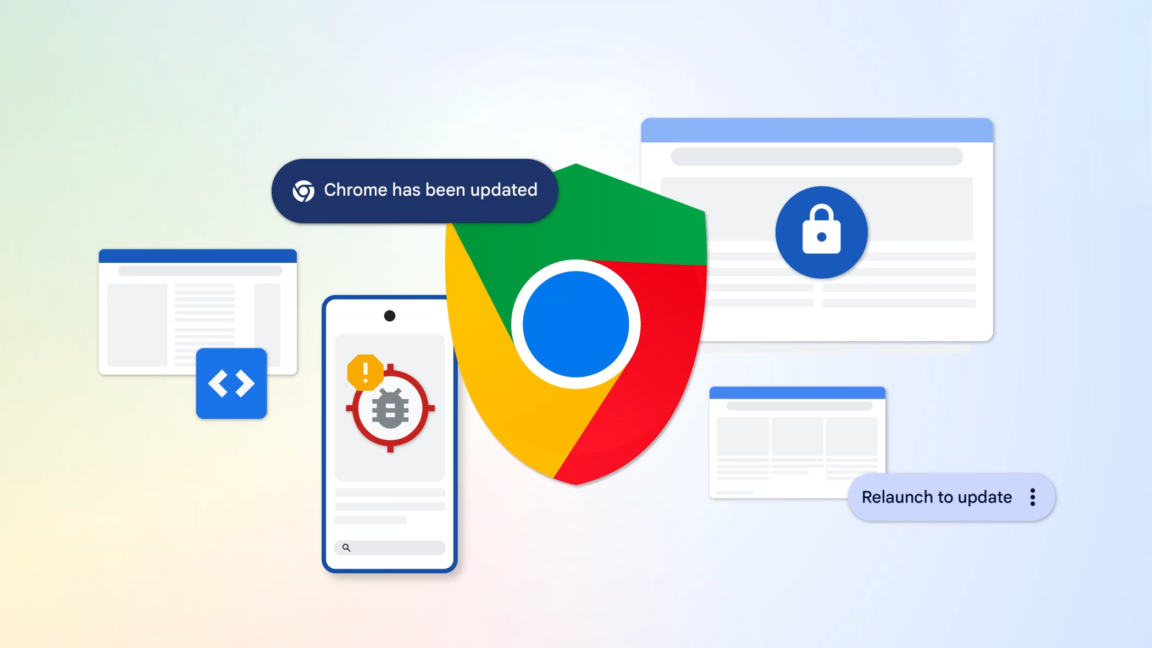
Chrome may get faster updates with no restart required
Google is piloting a system to update Chrome twice a week, using 'dynamic patching' to eliminate the need for browser restarts.
Deep dive
- Google observed a massive surge in bug fixes, with 1,072 patches in two versions compared to the previous 23 combined.
- AI tools are identifying vulnerabilities at unprecedented speeds, necessitating more frequent releases.
- The current two-week release cadence may shift to a twice-per-week cycle.
- A 'zero window restart' feature for macOS leverages existing application background processes to apply updates without a full application quit.
- 'Dynamic patching' is being researched to enable background updates that require no user intervention or restart.
Decoder
- Dynamic patching: A technique to apply code updates or security patches to a running application without restarting the entire process or losing current state.
- Zero window restart: A deployment method where an application updates itself in the background by utilizing the OS-level behavior of keeping processes alive even when the visible UI is closed.
Original article
With Chrome, Google pioneered the rapid release model for browser security. Now, Google says updates may need to change in the face of AI security analysis. According to the company, the number of bug fixes in Chrome releases has skyrocketed in recent months because AI is detecting so many flaws. We could be looking at more frequent updates soon, but Google is also working on ways to get those updates rolled out without bothering you as much.
Google has released two major Chrome milestone builds recently—Chrome 149 in early June and Chrome 150 just a few weeks later. These two updates had a total of 1,072 bug fixes, which is more than the previous 23 releases combined. Such is the impact of giant cybersecurity AI models that can probe software for vulnerabilities at light speed. Some of these vulnerabilities were serious, too, with one bug hiding in the Chrome codebase for 13 years. If it had been exploited, an attacker could have bypassed the Chrome sandbox to make the browser access local files.
With the vastly higher rate of vulnerability identification, Google is worried bad actors will also be able to identify software flaws faster. Its goal is to ensure your Chrome install is always up to date or as close to it as possible. The first step toward that is the two-week update cycle the company announced earlier in 2026, but it’s now piloting a system that would update Chrome twice per week. This would get patches out the door faster, ensuring that browsers are ready for the threat of AI-fueled attacks.
However, not everyone updates Chrome as soon as new versions are available. While Chrome will download and stage updates promptly, it relies on users to restart their browsers to complete installation. Google is looking at several ways to streamline that process.
In Chrome 150, Google implemented a new update mechanism that takes advantage of the way macOS handles applications. Apps typically continue to run in the background even if their foreground windows are closed. If you close Chrome 150 on macOS without quitting, Chrome can take advantage of that state to update the browser install with what Google calls a “zero window restart.” When you next open a Chrome window, you’ll see the update has been taken care of.
Google is also working on a technique it calls “dynamic patching.” The intent is to improve Chrome’s security model to allow for patches to be installed automatically without a browser restart. Google says it’s still “investing” in dynamic patching, but it hopes to have more to share on this in the future.
So, looking ahead, you should see more frequent Chrome updates, and they could be installed more smoothly on macOS. If dynamic patching works out, there will be even more updates you never notice.
Fresh dev news, AI-digested daily. Never miss a trend at devoured.fyi