DEVOURED
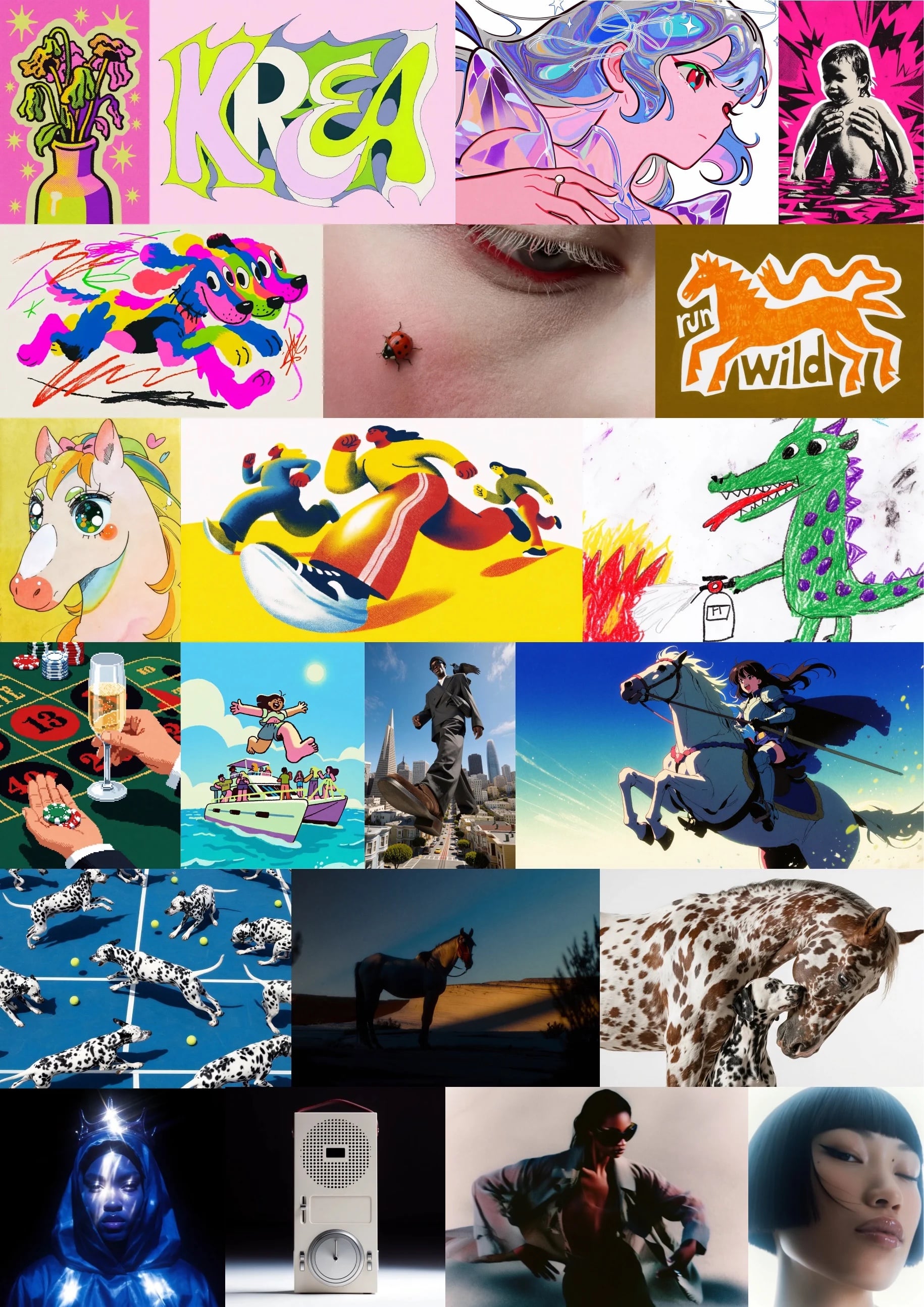
Krea 2 Technical Report
Krea 2 avoids the 'default aesthetic' trap by using a custom, multi-stage training pipeline and strict pretraining data curation to prioritize creative exploration.
What: The Krea 2 foundation model series, developed by Sangwu Lee and a large research team, uses a multi-stage training pipeline (pretraining, SFT, PO, and RL) to improve stylistic control. It features a custom prompt expander and a style-reference system, prioritizing aesthetic diversity over synthetic data.
Why it matters: This signals a trend away from massive, homogenous 'average' models toward specialized architectures that allow users to steer generation beyond the current 'photorealistic default'.
Deep dive
- Krea 2 uses a diffusion transformer (DiT) with gated sigmoid attention and grouped-query attention.
- It abandons synthetic training data to prevent bias propagation and quality ceilings.
- Data curation relies on hierarchical k-means clustering via FAISS and VLM-based filtering.
- The team implemented a 'krablet' PostgreSQL-based warehousing system for massive metadata handling.
- Multi-stage resolution scaling (256px to 1024px) was used to stabilize core capabilities.
- Training uses a multi-reward RL approach to discourage reward hacking and improve structural correctness.
- Fault tolerance was handled via aggressive checkpointing to the Weka file system.
Decoder
- DiT (Diffusion Transformer): A generative model architecture that uses transformer blocks to process diffusion-based latent spaces.
- Muon: A recent optimizer designed to scale training efficiency by performing lower-rank updates on weight matrices.
- Reward hacking: When a model learns to exploit the scoring mechanism in reinforcement learning to achieve a high score without performing the intended task correctly.
Original article
Full article content is not available for inline reading.
Explore all 56 articles in today's digest
Fresh dev news, AI-digested daily. Never miss a trend at devoured.fyi