DEVOURED
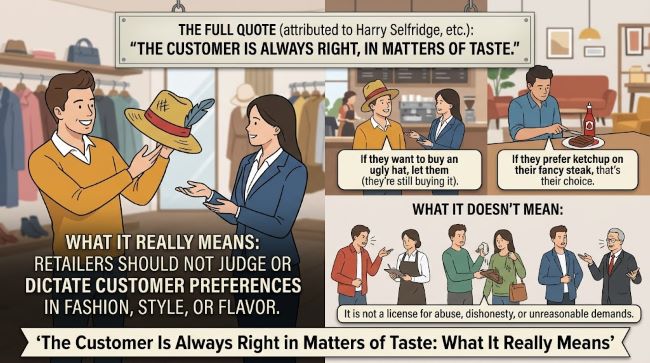
The Customer is Always Right in Matters of Taste: What it Really Means
The classic business adage 'the customer is always right' is frequently misapplied, missing its vital qualifier: 'in matters of taste.'
What: The phrase, originally attributed to retailers like Harry Gordon Selfridge, only applies to subjective consumer preferences and does not excuse factual errors, safety risks, illegal requests, or staff abuse.
Why it matters: Misinterpreting this principle as an absolute can lead to toxic work environments and poor business strategy by conflating customer whims with objective requirements.
Deep dive
- The phrase is a tool for preventing paternalistic merchant attitudes, not a mandate to accept every customer demand.
- It applies to domains like interior design, food modifications, and fashion where there is no 'correct' answer.
- It does not apply to safety protocols, legal compliance, or factual assertions (e.g., a customer claiming a product does something it doesn't).
- Businesses should draw a firm line: accommodate subjective preferences while enforcing standards for safety and staff treatment.
Original article
The phrase "the customer is always right" is widely misquoted – its original form includes a crucial qualifier: "in matters of taste." Attributed to Harry Gordon Selfridge and other early 20th-century retailers, it was meant to counter paternalistic merchants who imposed their preferences over customers' subjective choices. The principle applies to taste-based decisions in retail, food, and creative services, but not to factual disputes, safety, legal compliance, or staff mistreatment – where other standards must hold.
Explore all 71 articles in today's digest
Fresh dev news, AI-digested daily. Never miss a trend at devoured.fyi