DEVOURED
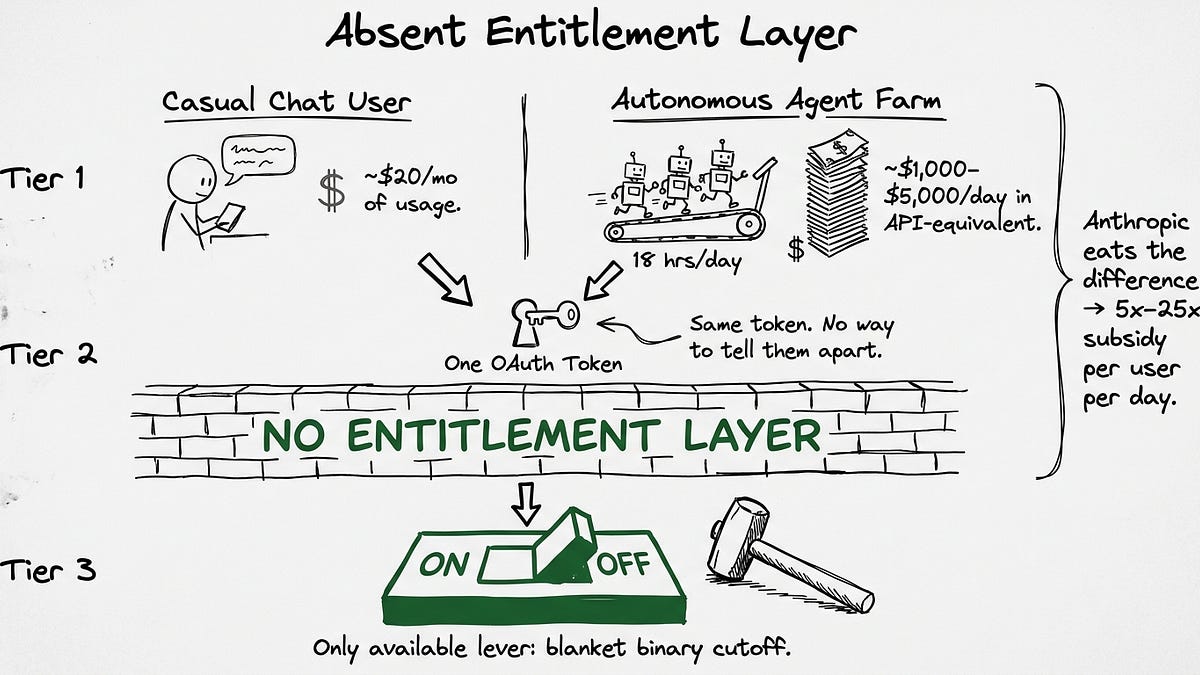
Anthropic's head of growth admitted Max was designed for heavy chat usage but autonomous agents burning $1,000-$5,000/day on $200 plans forced five emergency pricing changes from three AI giants in three weeks.
What: April 2026 saw a cascade of panicked pricing changes: Anthropic cut third-party agent harnesses from Claude subscriptions with <24hr notice after single OpenClaw agents burned $1,000-$5,000/day on $200/month plans (5-25x subsidy), GitHub froze all new Copilot Pro signups after weekly costs doubled, Anthropic briefly removed Claude Code from Pro, and OpenAI doubled GPT-5.5 API prices to $5/$30 per million tokens. Amol Avasare (Anthropic's head of growth) explained the root cause: entitlement logic hardcoded inline with inference code means every pricing change requires a deploy, turning customers into beta testers. Joe Binder (GitHub VP) wrote it's now common for a handful of requests to exceed the entire plan price.
Why it matters: The entire AI industry deferred financial engineering until unit economics broke in production at scale. OpenAI created a Financial Engineering function led by Sara Conlon, Anthropic hired Shanmugasundaram Alagumuthu from Turo to lead billing platform after inference costs surged 23% beyond projections. Both are rebuilding monetization as separate infrastructure because flat-rate pricing cannot survive agentic workloads with non-deterministic costs. The companies that survive IPO will be those that separated pricing logic before their margin crisis went public.
Takeaway: If you own billing or metering code for an AI product, architect your monetization layer as a separate service from inference today—make plans data instead of code, before the next tokenizer change or usage pattern shift forces a panicked deploy.
Deep dive
- Five major pricing announcements from Anthropic, OpenAI, and GitHub between April 4-23, 2026 all pointed to the same structural problem: subscription plans designed for chat cannot support autonomous agentic workloads
- The OpenClaw cutoff revealed brutal economics: a single third-party agent running one day burns $1,000-$5,000 in API-equivalent costs on a $200/month Max subscription, creating a 5x to 25x subsidy per user per day
- Technical reason for the subsidy: first-party tools like Claude Code maximize prompt cache hit rates (cached tokens cost 10% of standard rate), while third-party harnesses trigger full reprocessing at full price on the same token volume
- Anthropic gave <24hr notice on the OpenClaw cutoff (Friday evening for Saturday noon Pacific), offered refunds through April 17, then launched Claude Managed Agents four days later competing directly with OpenClaw
- GitHub's April 20 freeze was the most candid admission of broken unit economics: VP Joe Binder wrote "it's now common for a handful of requests to incur costs that exceed the plan price" and weekly Copilot costs doubled since start of year
- GitHub removed Opus models from Pro plan and applied a 7.5x premium multiplier to Opus 4.7 (up from 3x for 4.6) even though Anthropic's API price is identical—justified by Opus 4.7's new tokenizer producing up to 35% more tokens for the same input
- The tokenizer inflation is a silent meter change causing downstream tools with hardcoded multipliers to overcharge users—GitHub users reported phantom model billing for models they never selected (Sonnet 4.5, Haiku 4.5, Gemini 3 Flash) all at the wrong 7.5x rate
- The April 21 Claude Code Pro "test" updated the public pricing page for everyone while Anthropic claimed it affected "~2% of new prosumer signups"—Sam Altman replied "ok boomer" to Avasare's explanation thread
- The entire industry is converging on per-token pricing: OpenAI moved Codex to per-token billing April 2, Anthropic restructured enterprise contracts to $20/seat plus API rates plus mandatory monthly commitment (volume discounts gone), and OpenAI doubled GPT-5.5 API prices on April 23
- Root cause is architectural: when entitlement checks ("can this Pro user invoke Claude Code") live inside the request handler, every business decision becomes a code deploy, every pricing experiment risks billing side effects, and customers become beta testers
- The pattern that doesn't break: monetization as a separate layer where plans are data, not code—new plans become configuration, grandfathering becomes a query, tokenizer changes are isolated to meters, and pricing experiments run in a UI not a deploy
- OpenAI created a Financial Engineering function led by Sara Conlon (pods for Pricing & Packaging, Infrastructure, Financial Automation, Payments) and Anthropic hired Shanmugasundaram Alagumuthu from Turo in June 2025 to lead Billing Platform
- The volatility is structural because AI providers don't yet have stable unit economics—they're figuring it out in public with customers absorbing the variance, and Anthropic's inference costs surged 23% beyond internal projections pushing gross margin to ~40%
- Customer reality from Ramp CEO Eric Glyman: AI spend grew 13x in 12 months across Ramp's customer base, nobody knows how to budget for it, and the core question is whether companies extracting maximum token spend have incentive to help customers use AI efficiently
- Next article promises deep dive into GitHub issue #41930 where community engineers reverse-engineered Claude Code using Ghidra and MITM proxy, documenting cache invalidation bugs, sentinel string replacement issues, and how $200 of credits can vanish because of words typed in previous prompts
Decoder
- Prompt cache: LLM optimization that reuses previously processed tokens at 10% of standard cost; first-party tools maximize cache hits, third-party harnesses trigger full reprocessing, creating 5-25x cost difference
- Entitlement logic: Code determining what features a subscription unlocks; when embedded in inference code rather than separate monetization layer, every pricing change needs a code deploy
- Tokenizer inflation: Newer tokenizers producing more tokens for identical input (Opus 4.7: +35%), silently raising costs even when per-token rate stays constant
Original article
The design of subscription plans is being challenged by evolving product capabilities and usage patterns.
Explore all 73 articles in today's digest
Fresh dev news, AI-digested daily. Never miss a trend at devoured.fyi