DEVOURED
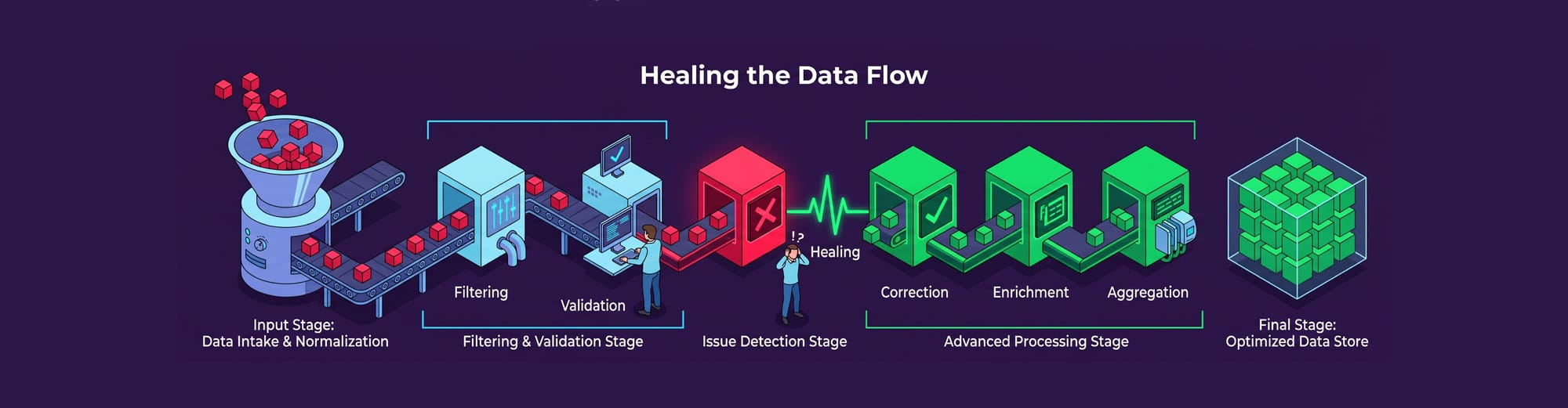
Halodoc built six targeted self-healing layers for data pipeline failures—CDC auto-restart, memory scaling, lock cleanup—dropping recovery time from 45+ minutes to under 5 and weekly alerts from 5 to 1.
What: Dana Rabba and Halodoc's data engineering team built six self-healing layers for their data platform: CDC auto-restart with checkpoint rewind, source-to-lake consistency validation, size-aware mini-batching to handle backlogs, progressive Spark memory scaling on retries (+25%/+40%/+60%), warehouse lock cleanup using query watermarks, and BFS-based dependency backfills that execute layer-by-layer. Each layer alerts before acting.
Why it matters: This represents a shift from generic retry logic to failure-mode-specific recovery. Most data platform incidents are predictable, automatable interruptions rather than novel problems requiring human diagnosis—the key insight is that each failure type needs its own recovery logic, because a single system cannot safely handle CDC checkpoint math, memory-aware batching, progressive scaling, and dependency traversal simultaneously.
Takeaway: If you run data pipelines with predictable failures (CDC restarts, Spark OOM, lock contention), start by building one targeted auto-recovery layer for your most frequent failure mode, with transparent alerting, before attempting a generalized solution.
Deep dive
- Problem statement: Data pipelines at scale fail predictably (CDC tasks, memory exhaustion, lock contention, dependency cascades), but manual recovery was taking 45+ minutes per incident and burning engineering hours on firefighting rather than building.
- Design principle: Alert first, validate eligibility, recover safely, measure impact—every automated action sends a notification before executing, creating an audit trail regardless of outcome.
- Layer 1 - CDC Auto-Recovery: Detects failed CDC tasks on a schedule, validates eligibility (incremental tasks only, known error patterns), calculates safe restart checkpoint by rewinding from last committed position with configurable buffer (e.g., 24 hours), favoring data completeness over duplicate risk since downstream systems handle idempotency better than gaps.
- Layer 2 - Source-vs-Lake Consistency: Periodically compares unique identifiers (not just row counts) between source RDS and silver layer within stable time windows, alerts on mismatch, recovers upstream (bronze-to-silver) before downstream (reporting tables) to prevent propagating bad data.
- Layer 3 - Mini-Batch Processing: Calculates cumulative file size from bronze layer using window functions, assigns batch IDs when threshold reached (e.g., 2GB), processes sequentially with explicit memory release between batches, checkpoints progress so interrupted runs can resume—turned a 15GB backlog from guaranteed OOM into 8 sequential 2GB batches.
- Layer 4 - Smart Memory Scaling: Intercepts Airflow retries via on_retry_callback, queries runtime metrics to confirm OOM (vs. spot interruption or script error), progressively scales executor memory relative to right-sized baseline: 1st retry +25%, 2nd +40%, 3rd+ +60%, alerts team to signal when permanent config increase is needed.
- Layer 5 - Warehouse Lock Management: Embeds structured comment watermarks (e.g.,
-- ETL_INCREMENTAL__schema__table --) in every warehouse query, scans running-queries view before execution to detect duplicates caused by Airflow heartbeat loss, cancels orphaned sessions before proceeding, uses distinct watermarks for incremental vs. backfill to allow safe concurrency. - Layer 6 - Cascading Dependency Recovery: Uses breadth-first search to traverse configuration tables and build complete dependency tree, executes layer-by-layer with parallel runs within each layer and gates between layers, supports backfill mode (new runs) and clear mode (rerun failures), places tables at maximum depth to ensure correct ordering when multiple paths exist—dropped backfill setup from 4-8 hours to <15 minutes.
- Results: CDC recovery <5 min (from 45+), warehouse locks near-zero (from daily), on-call alerts 1/week (from 5), manual memory interventions weekly (from daily), backfill setup <15 min (from 4-8 hours).
- Key insight: Each failure mode deserves its own recovery logic—a single generic retry system cannot safely handle CDC checkpoint calculation, memory-aware batching, progressive scaling, watermark deduplication, and dependency traversal simultaneously; separating concerns made each mechanism simpler and safer.
- Current limitations: Driver-side OOM still requires manual investigation (only executor-side is auto-detected); future work includes predictive scaling using historical trends, adaptive batch sizing, and cross-layer orchestration when failures are causally linked.
- Recommendation: Start with your most recurring failure, build one focused mechanism, alert transparently even when auto-fixing, measure reduction in manual interventions, iterate to next layer once stable—don't attempt a generic solution first.
Decoder
- CDC (Change Data Capture): System that streams row-level database changes to a data lake by reading transaction logs, enabling near-real-time replication without polling; common in data engineering but breaks when logs rotate.
- Bronze/Silver layers: Data lake architecture where bronze = raw ingested data, silver = cleaned/transformed data; popularized by Databricks' medallion architecture; failures in one layer cascade to the next.
- Watermark (in this context): Structured comment embedded in queries to identify ownership and detect duplicates; distinct from streaming watermarks used for event-time processing.
- Heartbeat loss: Airflow marks tasks failed when losing periodic health-check connection, even if underlying warehouse query still runs, causing lock contention when retry attempts concurrent write.
Original article
Build targeted self-healing layers for recurring pipeline failures: CDC auto-restarts with safe checkpoint rewind, source-vs-lake consistency checks, size-aware mini-batching, Spark retry memory scaling, warehouse lock cleanup using query watermarks, and dependency-aware backfills. The design pattern is: alert first, validate eligibility, recover safely, measure impact. Results included CDC recovery dropping from 45+ min to <5 min and backfill setup from 4-8 h to <15 min.
Explore all 73 articles in today's digest
Fresh dev news, AI-digested daily. Never miss a trend at devoured.fyi