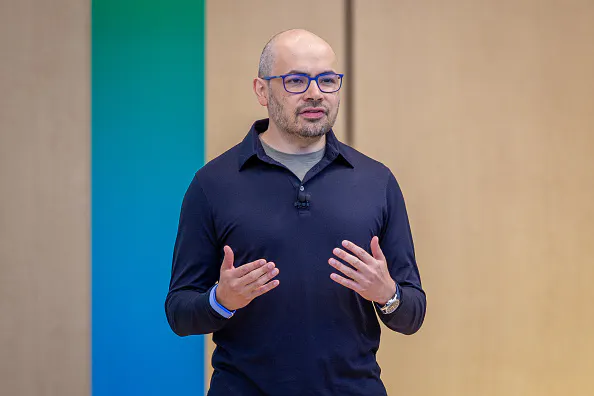
Google DeepMind's Hassabis: AGI is 3 to 4 years away
Google DeepMind CEO Demis Hassabis has revised his AGI prediction, now stating it could be achieved as early as 2029-2030, a significant acceleration from his previous 2030-2035 estimate.
Decoder
- Artificial General Intelligence (AGI): A hypothetical type of AI that can understand, learn, and apply intelligence across a wide range of tasks at a human-like level, rather than being specialized for a single task.
Original article
Google DeepMind’s Hassabis: AGI is 3 to 4 years away
Google DeepMind CEO and Nobel Prize winner Demis Hassabis shortened his prediction for when the era of AGI would be upon us.
Last year, we gathered up the many predictions we were hearing from tech leaders about when we should expect artificial general intelligence to arrive.
There was no shortage of opinions then, and the range of predictions was pretty wide.
Recently, Google DeepMind CEO Demis Hassabis revised his prediction, shortening the time frame significantly. Last June, Hassabis predicted that AGI may be achieved between 2030 and 2035. Last week, the window was narrowed to 2029-30.
During the Google I/O conference, Hassabis said, “When we look back at this time, I think we all realize that we were standing in the foothills of the singularity. It will be a profound moment for humanity.”
After the keynote, Axios’ Ina Fried spoke with Hassabis, and he said that with the acceleration of agents, we may also be faster to achieve AGI: “We can see agents really happening now and imagine what they will be in another year, and how useful they’ll be.” He reportedly predicted we would have AGI by 2029 or 2030.
We also noted a newer AGI prediction from former OpenAI cofounder Ilya Sutskever (now the CEO of Safe Superintelligence Inc.). Way back in 2017, before ChatGPT came out, Sutskever predicted we would’ve already had AGI by 2019 or 2021. But last November, at the dawn of the agentic AI boom, Sutskever made a much wider estimate: as soon as 2030 or up to 2045.
Nvidia CEO Jensen Huang kind of made a new prediction back in March while on Lex Fridman’s podcast. He said we had already achieved AGI, but then heddged a bit. “I think it’s now. I think we’ve achieved AGI.”
We’ll keep this tracker updated. Seen one that we’ve missed? Send them our way: keegan@sherwoodmedia.com!
Anthropic raises $65 billion at a $965 billion valuation, releases a more “honest” Claude Opus 4.8
Anthropic’s monster $965 billion valuation puts it firmly ahead of OpenAI’s $850 billion valuation as the rivals head toward expected IPOs later this year.
Report: Microsoft tries to get back in the AI coding game with new model
Microsoft wants to fight its way back into the AI coding field by releasing a new model next week at its annual Microsoft Build developer conference, The Information reports.
The company is expected to announce a new family of models as Microsoft AI CEO Mustafa Suleyman seeks to shore up the company’s own AI offerings and gradually wean it off OpenAI’s technology over the remainder of their $13 billion partnership.
Microsoft was initially well positioned to meet software developers with AI-enhanced tools. It owns GitHub, the most popular platform for hosting and sharing code, and GitHub’s Copilot AI-powered coding tool was released months before OpenAI’s ChatGPT debuted in 2022.
But it fumbled one of the biggest first-mover advantages in history as Anthropic’s Claude Code, OpenAI’s Codex, and Cursor rolled out coding tools that developers loved.
Microsoft to Release New Coding Model Next Week in Comeback Attempt
Microsoft was initially well positioned to meet software developers with AI-enhanced tools. It owns GitHub, the most popular platform for hosting and sharing code, and GitHub’s Copilot AI-powered coding tool was released months before OpenAI’s ChatGPT debuted in 2022.
But it fumbled one of the biggest first-mover advantages in history as Anthropic’s Claude Code, OpenAI’s Codex, and Cursor rolled out coding tools that developers loved.
Waymo to launch free robotaxi rides in its new Ojai vans
The new vehicles are less expensive — which is important for the service to really scale.
Report: Tesla’s Robotaxi trainers don’t think it’s ready for prime time
If you listen to Tesla CEO Elon Musk, you might think rapid expansion of the company’s Robotaxi service is right around the corner. If you listen to the people tasked with reviewing the footage and training its AI, that future is a long way off.
An in-depth report from Reuters that interviewed nine former “data labelers” and a former Tesla self-driving engineer paints a picture of highly massaged safety stats, vehicles failing to execute basic driving functions, and a behind-the-scenes reality where the supposedly “autonomous” tech relies heavily on the exact kind of localized, labor-intensive mapping and training Musk has publicly mocked. The skepticism runs so deep that one former insider told reporters they wouldn’t ride in a Robotaxi “if you f---ing paid me.”
Currently, the service is operating about 30 unsupervised vehicles across three Texas cities — a much more circumscribed execution than Musk had initially planned. The problem, for Tesla, is that the success of its Robotaxi business is now integral to the company’s value proposition.
Why Tesla’s AI trainers don’t trust its self-driving tech – or its safety stats
An in-depth report from Reuters that interviewed nine former “data labelers” and a former Tesla self-driving engineer paints a picture of highly massaged safety stats, vehicles failing to execute basic driving functions, and a behind-the-scenes reality where the supposedly “autonomous” tech relies heavily on the exact kind of localized, labor-intensive mapping and training Musk has publicly mocked. The skepticism runs so deep that one former insider told reporters they wouldn’t ride in a Robotaxi “if you f---ing paid me.”
Currently, the service is operating about 30 unsupervised vehicles across three Texas cities — a much more circumscribed execution than Musk had initially planned. The problem, for Tesla, is that the success of its Robotaxi business is now integral to the company’s value proposition.
Recent pushes into subscriptions, enterprise, and floating a cloud business suggest it’s serious about new revenue sources.
Fresh dev news, AI-digested daily. Never miss a trend at devoured.fyi