Watts in Store for 2027: The AI Ceiling
The US AI compute capacity will hit a hard ceiling of 81 gigawatts by 2027 as rising demand and power shortages double GPU rental prices.
Deep dive
- 2027 capacity projections suggest a massive buildout, but 10-15 GW of that may fail to come online due to grid limitations.
- GPU rental rates have jumped from $3/hour to $13/hour in six months due to demand outstripping supply.
- Inference now accounts for 40% of compute workloads; this share will likely rise as foundation model labs prioritize revenue over training.
- Chinese models like Qwen demonstrate that architectural innovation can rival much larger models, offering a path to performance despite limited compute.
- Software-level 'harnesses' can reduce the cost of resolved tasks by over 70% by optimizing model interaction.
Decoder
- Harness: A layer of software surrounding an AI model that automates orchestration, error correction, and task routing to improve reliability and reduce costs.
- Inference: The stage where a trained AI model processes input to generate output, as opposed to the training phase where it learns.
- Latency: The time delay between sending a request and receiving a response from a model.
Original article
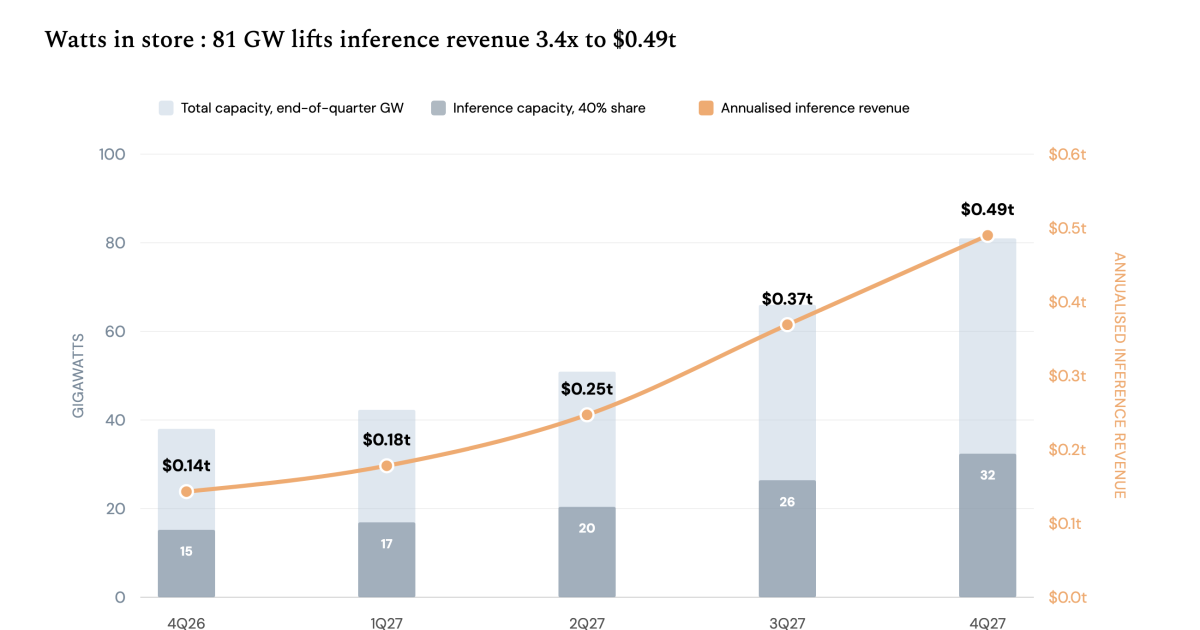
In short : US AI capacity grows from 38gw today to an 81gw ceiling in 2027. Because 40% of compute serves inference & new Blackwell & Rubin racks lift blended monetization from $9.4b to $15.1b per inference gigawatt, theoretical US inference revenue rises 3.4x from $0.14t to $0.49t.
The ceiling for AI in 2027 is about 80gw : doubling all the compute built in the history of the country in twelve months.
Yet even at this historic pace, the hourly cost of GPUs has doubled in the last six months : short-term rental rates have jumped from $3 to $12-13 per hour, pushing Anthropic’s blended GPU-hour cost up 82% in just two quarters. Finished server racks are already sitting unpowered in staging warehouses because data centers lack the energized utility power to turn them on.
When supply doubles & prices still double, demand is fundamentally outrunning physical reality. There will consistently be an active ceiling on energized compute, which will keep structural upward pressure on GPU prices per hour.
On last night’s All-In election livestream, Brad Gerstner framed that buildout in gigawatts :
“The consensus forecast is a total of 43 gigawatts coming online in 2027… the total gigawatts online at the end of ‘26, the cumulative in the United States, is about 38 … I think we could see at least 10 to 15 gigawatts of the expected build not come online.”
What does a ceiling like this mean for AI?
First, there’s a theoretical maximum amount of revenue we can generate from AI. A GPU can perform two types of tasks for AI : inference & training. Today, 40% of GPU hours are inference : AI sold to customers. The other 60% develops models.
Today’s 38gw fleet earns about $140b, while the 43gw to be added in 2027 will run on chips that are 3-5x more powerful & should deliver an annualized earnings capability of about $350b, for a total of nearly $500b.
As GPU prices continue to rise, foundation model companies may need to shift the fraction of GPU hours to inference from training. This might limit the pace of innovation at the frontier.
Second, latency becomes the release valve for too much demand. Internet access is priced in terms of bandwidth (gigabytes of files you can download) & speed (how quickly you can download it). AI may be priced the same way. We see this already with products focused on low-latency inference & those on long-horizon tasks.
Third, limitations in compute availability will encourage algorithmic innovation. Chinese models like DeepSeek, Qwen, & Kimi have demonstrated material architectural advantages that drive near-state-of-the-art performance on much smaller models & new architectures.
Fourth, the harness becomes critical to deliver state-of-the-art performance on limited GPU availability. Responsible for more than half of system performance, the software around the model can extract tremendous efficiency.
Fifth, the economics of vibe-coding face a reality check. When inference becomes more expensive, off-the-shelf software (with AI) can be less expensive than bespoke built & maintained internal software.
In 2027, AI’s constraint will be access to powered GPUs. As the prices for renting GPUs continues to increase faster than efficiency can fight, watts in store for 2027? Efficiency as the dominant motif up & down the stack.
Fresh dev news, AI-digested daily. Never miss a trend at devoured.fyi