DEVOURED
LiquidCodec: High-Fidelity Audio Tokenization Optimized for Speed
Liquid AI's new LiquidCodec enables faster, more efficient audio tokenization for on-device speech generation.
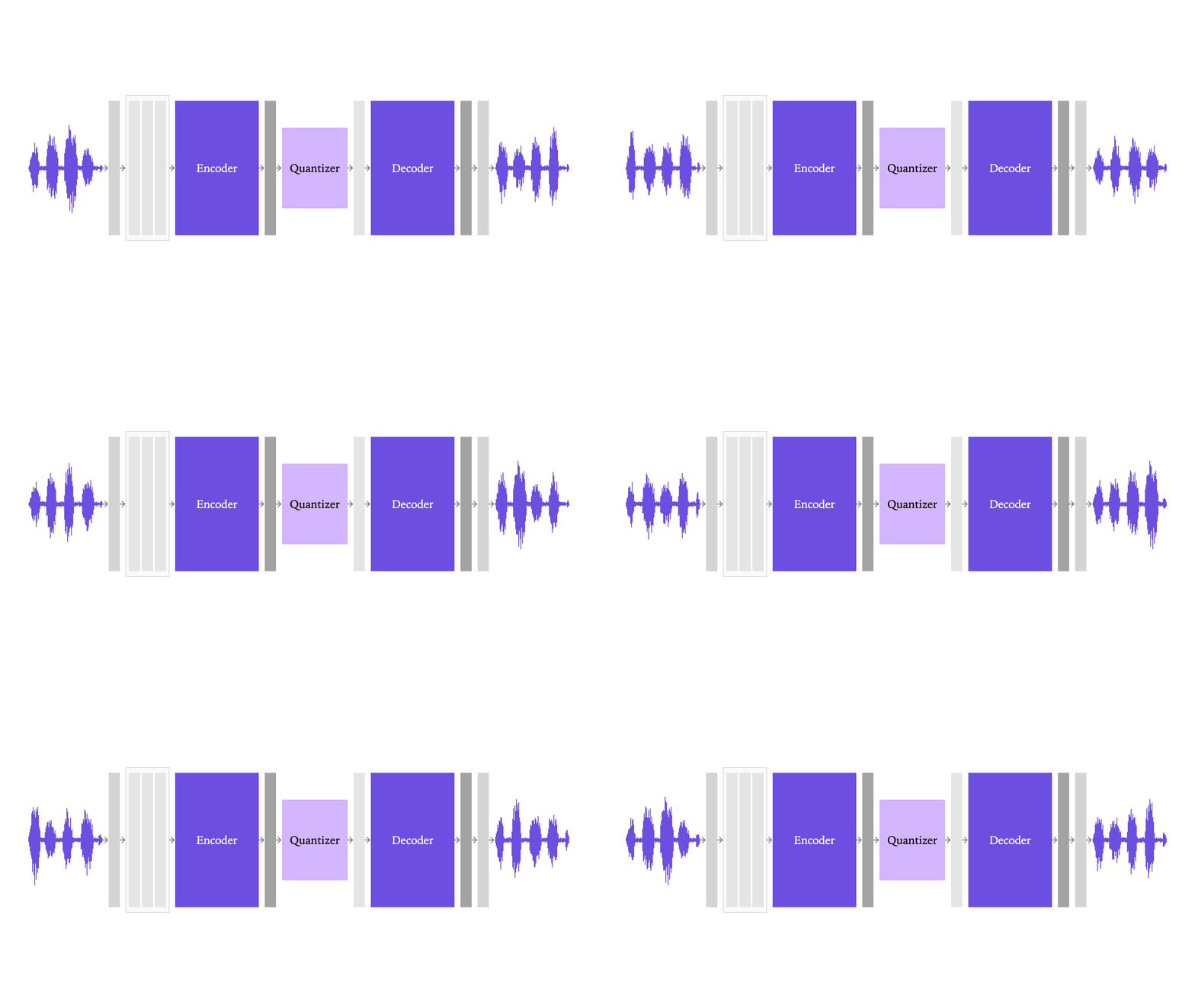
What: LiquidCodec uses a symmetric encoder/decoder architecture optimized for speed, matching existing high-fidelity codecs while outperforming them in decoding speed and token-to-waveform generation on-device.
Why it matters: It enables lightweight, low-latency conversational AI that can operate locally on mobile devices by replacing traditional, slower quantization methods.
Deep dive
- LiquidCodec uses GFSQ (Grouped Finite Scalar Quantization) to minimize dependencies between codebooks, enabling parallel prediction.
- Employs symmetric encoder and decoder architectures optimized for edge performance.
- Training utilized two stages: initial noisy data pretraining followed by fine-tuning on high-fidelity waveforms using adversarial critics.
- Achieves significant speedups (up to 87x real-time decoding on M4 Max).
- Available on Hugging Face for integration with existing transformers.
- Supports quantized GGUF builds for use in llama.cpp.
Decoder
- Codec: A tool that compresses audio into smaller data chunks (tokens) and decompresses them back into audio.
- RVQ (Residual Vector Quantization): A sequential method of quantizing data where each stage refines the error from the previous one.
- FSQ (Finite Scalar Quantization): A simpler quantization method that rounds vector dimensions to fixed values without sequential dependencies.
- ViSQOL: An objective metric for measuring perceived audio quality.
- RTF (Real-Time Factor): The ratio of time taken to process audio versus the length of the audio itself.
Original article
Full article content is not available for inline reading.
Explore all 57 articles in today's digest
Fresh dev news, AI-digested daily. Never miss a trend at devoured.fyi