AI, work from home, and the young-graduate job market
Data suggests work-from-home adoption, rather than AI exposure, is the primary factor behind the declining employment rates for recent college graduates.
Decoder
- Agglomeration effects: The benefits gained by firms and people being located near one another, such as knowledge spillovers, access to a larger labor pool, and reduced interaction costs.
Original article
AI, work from home, and the young-graduate job market
New college graduates are employed less than a few years ago. AI might be a factor, but there is growing evidence that work from home is playing a meaningful role.
Introduction
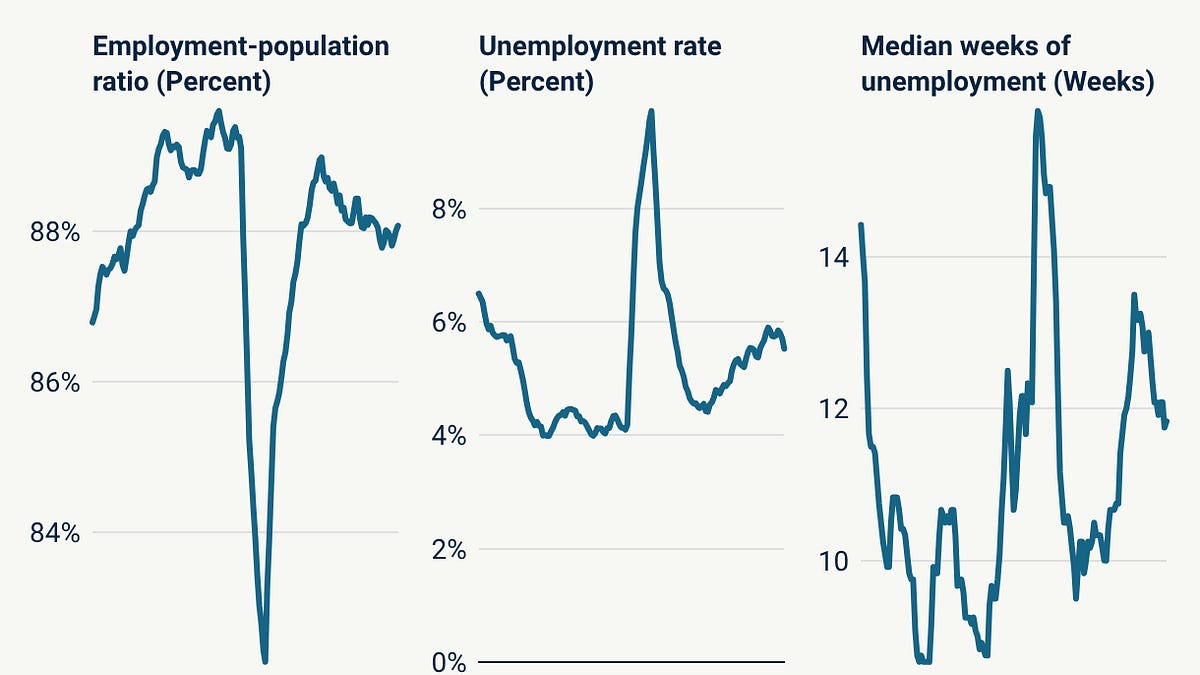
Young college graduates in the US are seeing a weakening labor market. Among workers age 22–26 holding a bachelor’s degree, their employment-population ratio was 88% in September 2026, a full percentage point below where it was three years earlier and nearly a point-and-a-half below its immediate pre-pandemic level. This group’s unemployment rate was close to 6% at the end of 2025—though appears to be cooling now—versus around 4% pre-pandemic. And those who are unemployed are spending more time looking for work as well: the typical unemployed young graduate has spent 12 weeks looking for work, a third higher than a few years ago.
These soggier job prospects for college grads have raised concerns that AI is reducing hiring and employment for young people just beginning their careers. As we discuss in the next section, while the evidence around AI’s employment effects is early and inconclusive, it is a hypothesis worth taking seriously. But a narrative that blames AI entirely for this slowdown has complications. First, as Ozimek and Goldschlag (2026) have shown, youth employment is also down since 2023 for young non-college-graduates, who are less likely to be in industries using AI and in jobs exposed to AI. In fact, young non-graduate employment rates have fallen slightly more since December 2019 than young graduate rates, while mid-career workers age 30-49 have fully recovered to pre-pandemic levels with little difference between those with and without a bachelor’s degree.
Second, AI is far from the only shock weighing on recent economic data. The modern era of AI began in late 2022, the same time other major economic shifts were also beginning to take shape. This makes it hard to disentangle the impact of any one factor. High inflation and the resulting higher interest rates likely pinched certain industries. Job switching surged in the pandemic during the “Great Resignation,” and then it swung to record lows thereafter as companies pulled back on hiring and firing, which could be disproportionately hurting new labor force entrants like recent grads. Immigration flows saw dramatic rises and falls too, changing job dynamics in uncertain ways.
Throughout this entire period, work from home (WFH) grew in adoption and cultural acceptance. WFH is a mixed bag when it comes to the labor market. There is increasing consensus that WFH helps the job prospects of disabled workers and older workers. That is a substantial benefit which ought not be dismissed. As we show in this piece, however, a trade-off is that WFH weakens the employment of young people: without the benefits of in-person learning and agglomeration effects, employers are likelier to hire older workers for jobs where WFH is now an expectation. Young workers themselves might also demand WFH jobs less than older workers.
Research so far around WFH and youth employment has been mixed
There is a growing economic literature on the effects of WFH. Bloom, Dahl, and Rooth (2026) find that remote work increased full-time employment among physically disabled Americans. Burn, Gentry, and Lahey (2026) use a related approach for the UK, and they find positive occupational full-time employment effects for disabled workers and workers ages 50–64.
At the same time, there are concerns about the effect on young workers. Emanuel, Harrington, and Pallais (2026) find that physical proximity to the office increases the job feedback received by software engineers, especially younger and less-experienced workers. Their national analysis also finds a relative increase in young graduates’ unemployment in remotable occupations. Lambert and Schindler (2026) find declines in junior hiring shares associated with WFH exposure after controlling for AI exposure.
Many AI studies also address the experiences of young workers. Alex Imas and Jacob Schaal have an excellent overview of the recent AI labor market research. Brynjolfsson, Chandar, and Chen (2026) find that young workers in AI-exposed occupations saw slower employment gains than older workers and workers in less AI-exposed occupations; their findings hold after controlling for a variety of potential confounding factors including WFH. Tucker (2026) finds a sharp decline in hiring of workers ages 22–24 in the most AI-exposed industries after ChatGPT’s release in late 2022. Orr, Tucker, and Warren (2026), using linked US Census Bureau records, find that graduates in the most AI-exposed tenth of college majors saw initial employment fall by about five percentage points and initial earnings by about 13% relative to less-exposed majors after late 2022.
But these findings are not universal. Fairlie and Wu (2026) find no unusual relative summer 2026 unemployment increase among non-enrolled college graduates age 22–25; they also find some positive teleworkability interactions. Kauhanen and Rouvinen (2026) find no systematic AI-related displacement or persistent wage differences by AI exposure among young workers in Finland through September 2025. Frank et al. (2026) find that the deterioration in US graduates’ entry into AI-exposed jobs begins before ChatGPT; graduates with more AI-exposed coursework have shorter job searches after its release and higher first-job pay when entering highly exposed occupations. And while Ando et al. (2026) find a negative relationship between AI exposure and labor demand through job openings, they also find no significant difference in this effect between junior and senior roles, and even a somewhat smaller negative effect among very junior (<1 year experience) openings.
Public data suggest a strong WFH effect on young college graduates, less so from AI
To explore whether WFH has been disproportionately weighing on recent college graduates, we use the Current Population Survey (CPS) to compare the growth in payroll employment-population ratios for recent grads to those of middle-career workers between 2023—when recent graduate full-time-equivalent (FTE) employment rates peaked—and the last 12 months. Our main measure of interest is the difference between the two groups’ ratios. Say an occupation’s young-grad payroll employment-population ratio falls 10%, while it falls 4% for middle-aged workers: the outcome we measure is a six percentage point relative decline for young grads. We track this spread for sets of broad and detailed occupations in each of the nine major Census Bureau divisions, and then we compare it to the WFH adoption rates in that occupational category also measured in the CPS.
We also test the possibility of AI weighing on young-grad employment by comparing our young-grad employment spread to two other metrics: the composite measure of occupational AI exposure in Gimbel, Kendall, and Kulsakdinun (2026), which combines several studies, and AI adoption by industry in the Census Bureau Business Trends and Outlook Survey (BTOS).
The detailed regression results are in the appendix, but we summarize the relationships we tested in the following figure. The left panel shows the relationship between the occupational WFH share (x-axis) and growth in our young-grad–mid-career employment spread (y-axis). The relationship is negative and statistically significant. Between 2023 and the last 12 months, for every extra 10 percentage points of WFH adoption, employment rates for young college grads grew between 3.9 to 6.6 percentage points more slowly than those for middle-aged workers.
As an accounting (not causal) exercise, we took these results and looked at how much of the 1.23-percentage-point decline in the young-grad FTE employment-population ratio between 2023 and 2026 could be explained by WFH. The answer was between 0.69 to 1.08 percentage points, explaining 56% to 88% of the total decline. When just looking at extensive-margin employment rate declines, WFH explains 97% to 153% of the total.
The middle panel replaces WFH adoption with AI exposure as a separate explanatory variable. As jobs become more exposed to AI, the effect on the new-grad employment spread is also negative but much shallower than with WFH and statistically indistinguishable from zero. When we include both WFH and AI exposure, the WFH effect remains statistically-significant while AI exposure remains insignificant. The same is true of industry AI adoption, shown in the right panel: industries that self-reported a higher likelihood of using AI in 2026 H1 actually saw, if anything, slightly faster young-grad employment growth relative to mid-career, though again, this effect is statistically insignificant.
Stripe data suggests young workers lost ground in regions where WFH proxy spend grew more
At Stripe, we do not have a direct line of sight into whether a person is working from home. What we can see, however, are proxies for WFH, such as spending on office supplies and furniture. As the following chart shows, the level of office supply, furniture, and electronics spending in the Stripe data relative to a state’s gross domestic product (GDP) is moderately correlated with WFH adoption rates.
Given this, we look at an even deeper geographical cut: how proxy WFH spend at the commuting-zone (CZ) level grew relative to each CZ’s GDP between 2023 and 2024. We then compare growth in proxy-WFH-spend-to-GDP to growth in 22- to 29-year-old employment-population ratios in the top 100 CZs by spend. We only look at spend at merchants present in both 2023 and 2024 to keep Stripe’s mix of business from being a factor.
The data shows that CZs where proxy WFH spend grew faster than the regional economy were likelier to see declines in employment of those ages 22–29 from 2023-24, with a moderate correlation. This does not establish a direct relationship between WFH and youth employment, but it is a surprising finding: one might have expected fast growth in office supply and electronics spend to be associated with the sort of healthy regional economy that’s more likely to employ more young workers.
Conclusion
Our analysis suggests that WFH is an important factor moving the needle on young-graduate employment. Telework adoption explains the decline in their employment better than AI exposure in our model using public data. And our own Stripe data suggests a negative relationship between regional spend on WFH proxies and growth in youth employment.
The takeaway of this analysis is not, however, that WFH explains everything around young-graduate employment while AI explains none. Our model is suggestive rather than truly causal. Moreover, AI exposure and teleworkability are highly correlated with each other, making it hard to distinguish definitively between the two factors, let alone the other factors we have not tested here, such as higher interest rates and past hiring surges. AI research, and indeed AI itself as a general-purpose technology, is still in its early stages, and even if overall employment stays high, AI could displace specific industries and occupations. Moreover, the full extent of AI effects on the labor market might not manifest themselves until the next recession, much like the effects of the internet did for travel agents. Such trade-offs between short-run narrow displacement and long-run aggregate augmentation would, in fact, be entirely consistent with the history of technological shocks. As we have emphasized before, researchers should keep an open mind at this early stage in AI’s deployment.
Methodological appendix
CPS analysis
Stripe’s analysis of the CPS compares the January to December 2023 period to the 12 months ending in September 2026. We exclude October from both periods since the CPS was not collected in October 2025 due to the US federal government shutdown, so each sample period has 11 months.
We look at employment growth between the two periods. Our two alternatives measure employment slightly differently: our preferred intensive-margin specification converts usual weekly hours in the primary job into full-time-equivalent terms by dividing by 40, and then it takes as a percent of the cohort population. Workers whose usual hours vary are assigned their actual hours. The other extensive-margin approach just looks at binary employment, with occupation assigned by primary job. In both cases, we limit to workers in payroll (i.e., non-self-employed) jobs in the CPS.
Our cohort of interest is “young college graduates,” 22- to 26-year-olds who:
- have exactly a bachelor’s degree;
- are not enrolled in school; and,
- did not report a disability.
The control group for comparison is non-disabled 30- to 49-year-olds of any educational attainment. The dependent variable of interest is percent growth in the employment-population measure for 22- to 26-year-olds minus that for 30- to 49-year-olds.
Work from home is measured as the share of all employment in an occupation-Census Bureau division’s cell that reports any telework in the CPS in the latter 2025-26 sample period.
The AI occupational exposure measure we use comes from Gimbel, Kendall, and Kulsakdinun (2026). The AI adoption measure we use is industry-based and comes from the US Census Bureau Business Trends and Outlook Survey, pooled over the periods spanning January to June 2026.
We adjust CPS survey weights for pre-2026 population controls. We also apply single-age compositional adjustments to fix the age demographics to November 2025-September 2026 proportions. Reported standard errors are robust.
Fresh dev news, AI-digested daily. Never miss a trend at devoured.fyi