DEVOURED
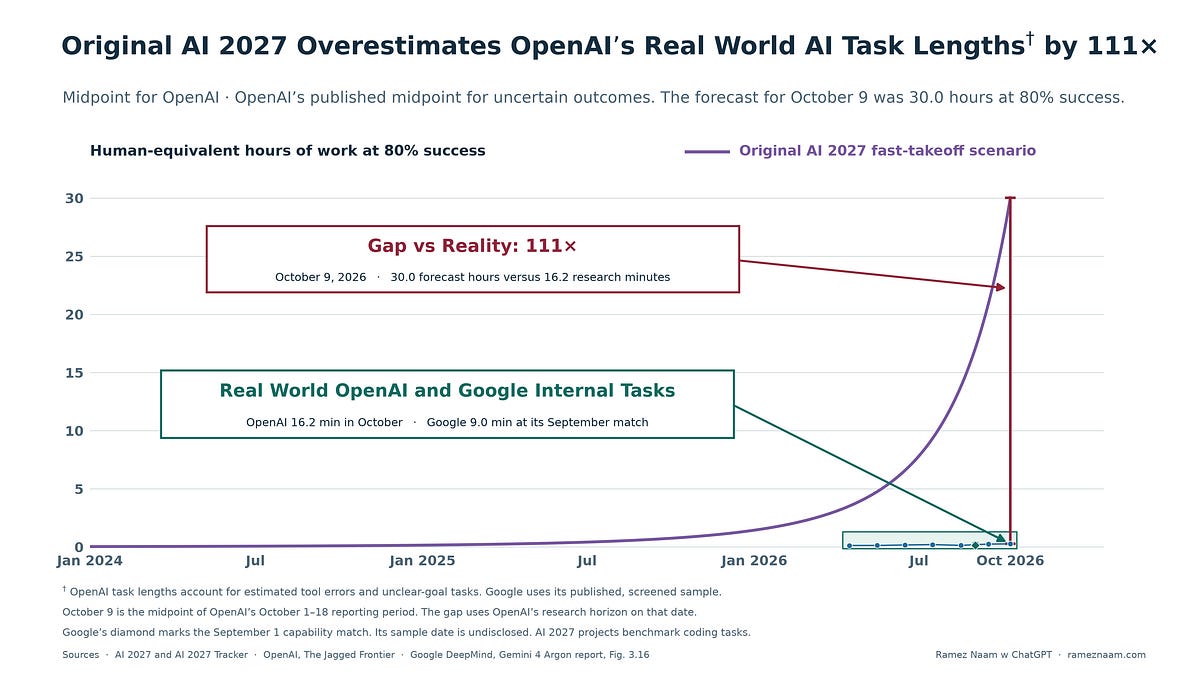
The Most Important Charts in AI are Wrong
Real-world data from OpenAI and Google shows AI models are far less capable at autonomous research than theoretical industry forecasts predict.
What: Ramez Naam analyzes internal usage logs showing AI agents at Google and OpenAI reach 80% success on tasks taking only 9 to 16 minutes of human work, respectively. This contrasts sharply with projections suggesting models should be capable of complex, months-long autonomous research by now.
Why it matters: This disparity suggests that AI is currently a helpful human-amplifier rather than an autonomous researcher, and that industry benchmarks are prone to selection bias toward "cut-and-dry" tasks.
Deep dive
- Forecasts like the "AI 2027" report overestimate real-world AI task-completion capabilities by over 100x.
- Real-world usage shows an exponential trend in AI task length, but at a much slower growth rate than theoretical benchmarks.
- Models lack high reliability (95%+ success) on long-form, complex tasks required for truly autonomous self-improvement.
- Experimentation pace per researcher is increasing, but not at a rate that triggers a self-sustaining recursive loop.
- The "reliability gap" means models require constant human steering for complex research goals.
- The current data gap highlights an urgent need for more transparency from industry leaders like Anthropic.
Decoder
- RSI (Recursive Self-Improvement): A hypothetical process where an AI system improves its own intelligence, leading to a rapid runaway effect.
- ECI (Epoch Capabilities Index): A benchmark metric aggregating model performance to estimate a general "IQ" for AI agents.
Original article
Full article content is not available for inline reading.
Explore all 68 articles in today's digest
Fresh dev news, AI-digested daily. Never miss a trend at devoured.fyi