DEVOURED
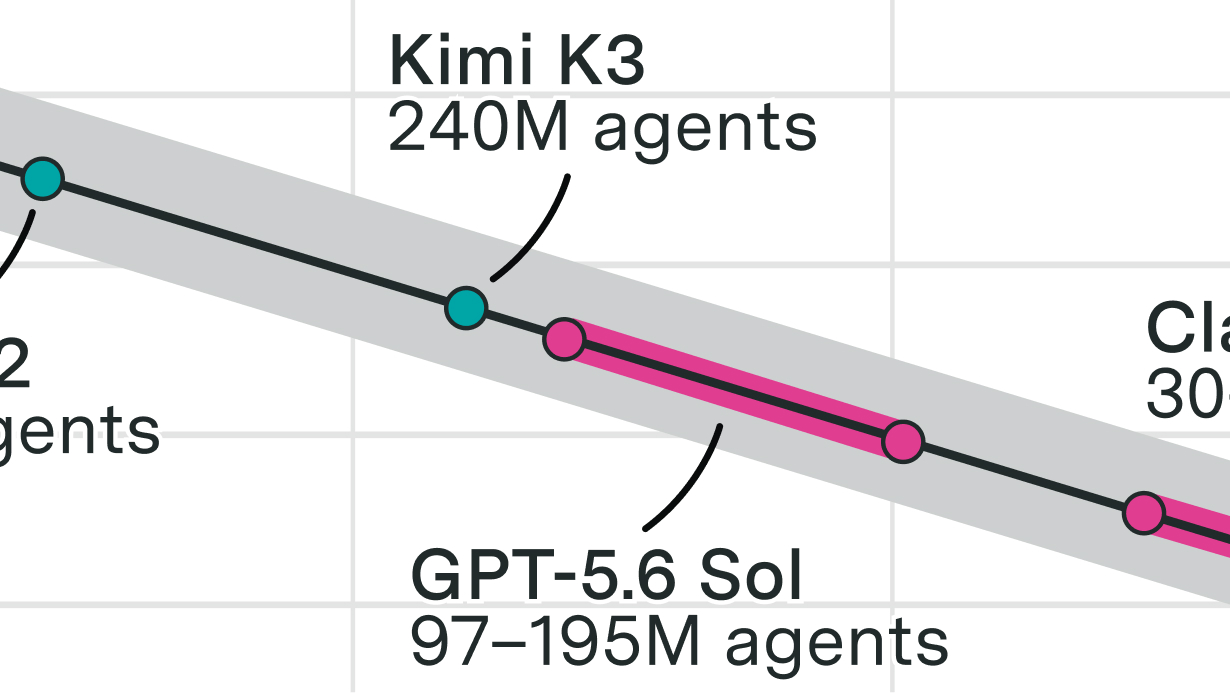
How many AI agents could run on the AI chips shipped through 2027?
Global AI chip shipments through 2027 could support hundreds of millions of concurrent agents, potentially creating an enormous supply of AI work capacity.
What: Epoch AI research estimates that hardware shipped through 2027 could supply up to 720 million full-time employee-equivalent hours weekly. However, realizing this capacity at a target of $30 per agent-hour would require between $2.6 and $5.3 trillion in annual spending, far exceeding current developer revenue projections.
Why it matters: The analysis suggests a significant risk of 'compute oversupply' if inference demand does not scale to match the massive capital expenditure on high-bandwidth memory (HBM) accelerators.
Deep dive
- The study uses HBM supply as a proxy for inference capacity, calculating effective 'GB300-equivalent' units.
- Concurrency capacity is derived from serving benchmarks (e.g., AgentX) and agent-hour API costs (e.g., Claude Code).
- They estimate a $5/hour rental cost per GB300-equivalent unit.
- Capacity estimates scale with 'u', the performance uplift of newer HBM4/4E memory versus HBM3E.
- Even at 20% utilization, the implied spending levels indicate a massive gap between potential supply and current market revenue trends.
Decoder
- HBM (High-Bandwidth Memory): A specialized, high-speed RAM architecture used in AI accelerators that is currently the primary bottleneck in hardware manufacturing.
- Agentic workload: AI tasks that involve multi-step reasoning, tool usage, and persistent state management, rather than simple token generation.
- Jevons' paradox: The phenomenon where increased efficiency in resource usage leads to increased overall consumption of that resource.
Original article
Full article content is not available for inline reading.
Explore all 67 articles in today's digest
Fresh dev news, AI-digested daily. Never miss a trend at devoured.fyi