DEVOURED
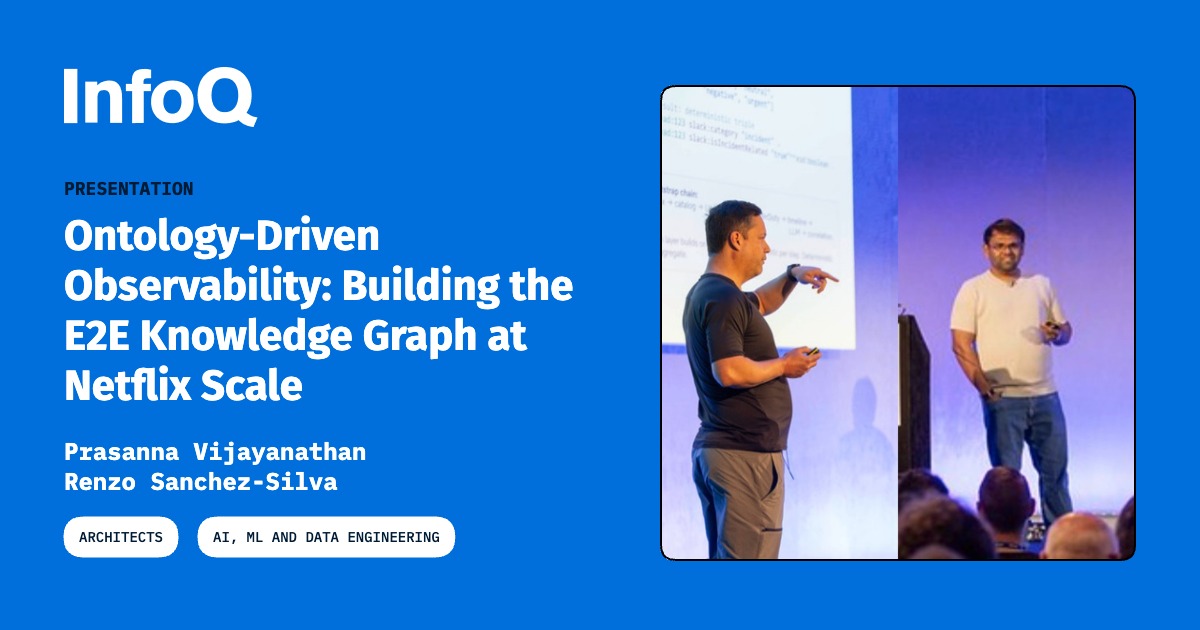
Ontology‐Driven Observability: Building the E2E Knowledge Graph at Netflix Scale (51 minute video)
Netflix is using an AI-driven operational ontology to unify fragmented observability data into a queryable knowledge graph for automated incident resolution.
What: Prasanna Vijayanathan and Renzo Sanchez-Silva describe a system that transforms messy logs, metrics, and incident Slack chatter into formal, machine-readable triples stored in a graph database, enabling proactive triage.
Why it matters: This demonstrates a shift from reactive monitoring to 'operational intelligence,' where the goal is to model the meaning and relationships within infrastructure rather than just collecting raw telemetry.
Deep dive
- Ontology-Driven: Uses W3C standards (RDF, OWL, SPARQL) to encode operational knowledge as a graph of subjects, predicates, and objects.
- Harvesting Pipeline: Uses LLMs to turn unstructured incident discussions in Slack into structured facts.
- Self-Improving: Implements an 'agentic loop' where AI fixes the very extraction scripts that power the pipeline.
- Knowledge Flywheel: Incident patterns learned from one event inform the system for future triage and remediation.
- QuipuDB: A custom graph database that holds the unified knowledge, enabling real-time querying across different microservice topologies.
Decoder
- Ontology: A formal specification of concepts and relationships within a domain; here, used to define how services, incidents, and telemetry interact.
- Triple: The fundamental unit of a knowledge graph (Subject-Predicate-Object), such as 'Service A - depends on - Service B'.
- MELT: Acronym for Metrics, Events, Logs, and Traces, the four pillars of observability.
Original article
Full article content is not available for inline reading.
Explore all 71 articles in today's digest
Fresh dev news, AI-digested daily. Never miss a trend at devoured.fyi