DEVOURED
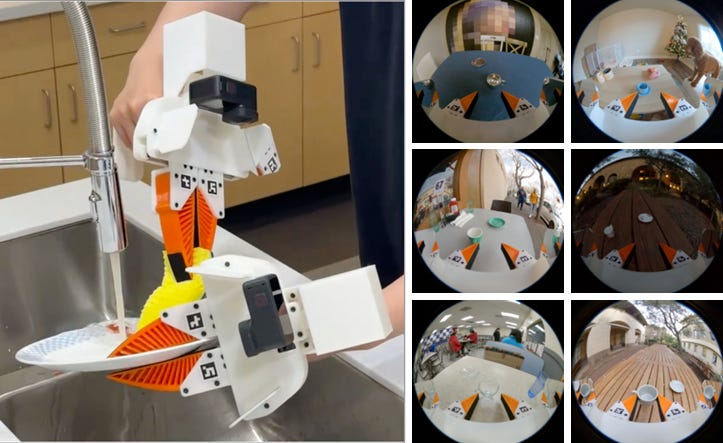
How to Train Your Robot
Robotics companies are racing to bridge a massive data gap by collecting millions of hours of human task demonstrations.
What: Firms like Physical Intelligence, Figure AI, and Dyna Robotics are using teleoperation and egocentric video to generate training data, aiming to replicate the scaling success seen in LLMs.
Why it matters: Robotics currently lacks an 'internet-scale' dataset equivalent to text; collecting real-world interaction data is expensive, physical, and highly non-uniform.
Deep dive
- Robot training relies on behavioral cloning and reinforcement learning, both data-hungry processes.
- Teleoperation is high-quality but difficult to scale due to hardware and labor costs.
- Simulation offers scale but suffers from the 'sim-to-real' gap, often requiring domain randomization.
- Human egocentric video (wearable cameras) is becoming a primary source for scaling.
- Estimates suggest current robot models have 1,000 to 5,000 times less data than LLM counterparts.
- Producing sufficient data may require $10B to $100B in investment.
Decoder
- Behavioral cloning: A form of imitation learning where a model is trained to mimic human-provided demonstrations of a task.
- Sim-to-real gap: The performance drop observed when a model trained in a simulated environment is deployed on physical hardware.
- Domain randomization: A technique where simulation parameters (like friction or lighting) are varied to help a model generalize to real-world environments.
- Egocentric video: First-person footage, typically captured via head-mounted cameras, showing a user performing a task with their hands.
Original article
Full article content is not available for inline reading.
Explore all 51 articles in today's digest
Fresh dev news, AI-digested daily. Never miss a trend at devoured.fyi