AI Agents for Creative Work (Website)
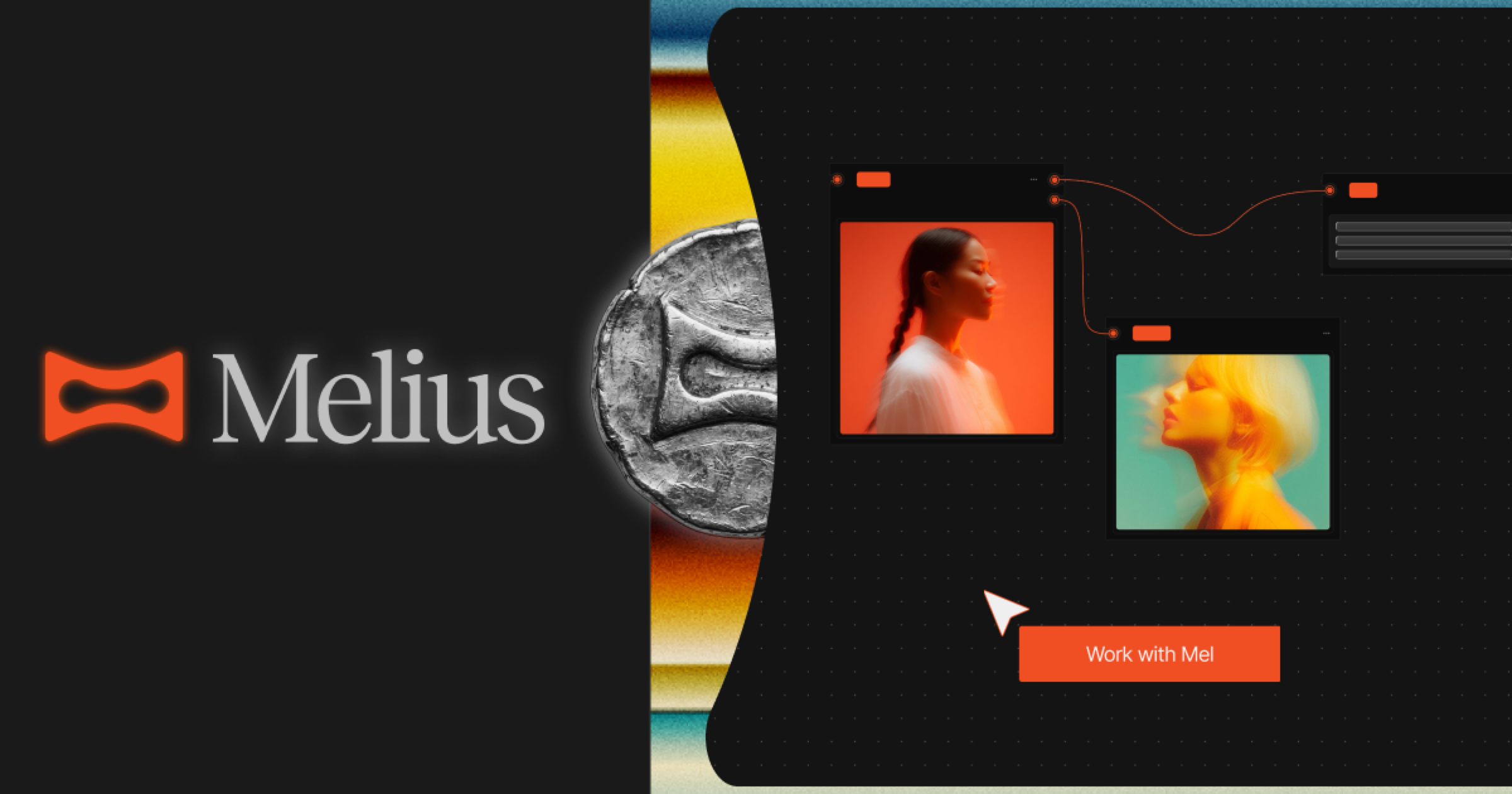
Melius raised $25 million to build a node-based creative canvas where AI agents chain image, video, and audio generation into repeatable workflows.
Deep dive
- Architecture: Node-based canvas allows chaining models; output of one node (e.g., image generation) becomes the input for the next (e.g., video animation).
- Models supported: Includes Nano Banana, Flux, Ideogram, Seedream for images, and Kling, Veo, Seedance for video.
- Functionality: Replaces chat-based interaction with a persistent, editable graph that maintains version history for every step.
- Workflow: Users can branch experiments side-by-side or reuse successful graphs as templates for recurring tasks like e-commerce photography.
- Business Model: Subscription-based with credit limits; allows for team-based workspaces and custom skill definitions for agents.
Decoder
- Node-based: A UI paradigm where complex processes are represented as a network of connected nodes, each performing a specific function, allowing for non-linear workflow management.
- MCP (Model Context Protocol): An open standard that enables AI models to interact with local development tools, data, and external systems consistently.
Original article
Create anything you imagine
AI agents for creative work. Bring your creative vision and collaborate with AI agents until the images, video, and audio land exactly as you imagined.
Hear from the teams who create with Melius
Solutions
Agencies
Concept work that wins the pitch. Variant work that runs the campaign. The same canvas does both — treatments and concept art at the brief's pace, ad variants and campaign creative at the campaign's volume.
CD/Filmmakers
You can see the shot. You can describe it. Single-model tools can't make it. Work with tunable, multimodal nodes until the frame matches what you imagined.
Marketers
The hero shot in minutes. The thousand-variant cascade in an afternoon. Localized for every market, sized for every channel, brand-checked before every approval.
E-commerce
The shoot that used to take three weeks, an afternoon on the canvas. Pack shots, on-model, hero imagery, all brand-consistent across every frame, at the pace of your ambitions.
GTM / Growth
Skip the design ticket. Event graphics, blog heroes, conference posters, decks that don't look like they were made in five minutes — all on the fly, without learning a single tool or writing a single prompt.
Our Pricing
Creator
Explore possibilities on Melius
- Access to all models
- Unlimited agent usage
- Import custom voices
Growth
Start creating on your own
- Everything in Creator
- Up to 3 agent skills
Professional
Go pro on your own terms
- Everything in Growth
- Up to 10 agent skills
- Slack agent access
- Search with AI
- AI prompt enhancement
- Better fonts
Team
Shared credits, shared workspaces, one bill
- Up to 10 agent skills
- Slack agent access
- Search with AI
- AI prompt enhancement
- Better fonts
Enterprise
For higher limits
- Everything in Team
- Priority queue access
- Real-time support
- Dedicated Slack channel
Frequently asked questions
What is Melius?
Melius is a node-based creative canvas for AI image, video, and audio. Every prompt, image, video, and audio clip is a node on an infinite canvas, and edges connect them so one node's output feeds the next. That's how you build a multi-step pipeline like reference image to image to video to voiceover to final cut. Describe what you want and the Mel agent wires the nodes, picks the right model for each, and leaves every prompt editable so you can rewire or re-run any step.
What is a node-based AI canvas?
A node-based canvas represents creative work as a graph instead of a chat thread. Every step is a node with its own model, settings, and version history: a prompt, a generated image, a video, an audio track, an uploaded reference. Edges pass output from one node into the next. Because the whole pipeline is visible, you can change an early step and re-run everything downstream, branch to compare variations side by side, and reuse a working graph as a template. On Melius, that graph is also what the Mel agent and external agents connected over MCP read and edit.
What kind of work is the Melius canvas best for?
Anything that takes more than one generation to get right. Video production teams storyboard, generate shots on parallel branches, and assemble takes in the built-in multi-track editor. Advertising and campaign teams build a graph per concept, then fan the approved one out to every placement and aspect ratio. E-commerce teams reuse one product photo as a reference node across lifestyle scenes and crops. Brand and design teams pin assets, fonts, and references as nodes so downstream generations stay on-brand, and agencies share canvases so feedback lands on a specific node rather than a finished file.
How does AI video generation work on Melius?
You start from a text prompt or an existing image, choose a video model or let Mel pick one, and Melius generates the clip. You can guide it with reference images, first and last frames, or input footage, then trim and assemble clips in the built-in video editor.
Is Melius free?
You can create a Melius account for free, but generating images, video, or audio uses credits — and the only way to get credits is a paid plan or a one-time credit purchase. So it's free to sign up and explore, and you pay only for what you generate. Paid plans start at $18 per month.
What AI models does Melius support?
Melius gives you access to a library of leading AI models for image, video, audio, and text. That includes image models like Nano Banana, GPT Image, Flux, Seedream, and Ideogram; video models like Seedance, Veo, and Kling; and audio and voice models like ElevenLabs, from providers including OpenAI, Google, ByteDance, and Black Forest Labs. The Mel agent can choose the best model for your prompt automatically, or you can pick one yourself.
Who owns the content I create, and can I use it commercially?
You own the content you create on Melius and can use, publish, and distribute it commercially, subject to the underlying model providers' terms. Melius doesn't claim ownership of your work and doesn't use it to train AI models.
How is Melius different from single-model tools like Midjourney?
A single-model tool gives you one model and one output at a time, with no record of how you got there. Melius is a node-based canvas: one subscription covers many models across image, video, and audio, and the graph keeps every step connected, editable, and re-runnable. You can swap the model on a single node, branch to compare two directions, and reuse the whole workflow as a template, instead of juggling several separate tools and rebuilding the process from scratch each time.
Fresh dev news, AI-digested daily. Never miss a trend at devoured.fyi