
JPEG XL, Welcome to the Web!
JPEG XL has arrived in Chrome and Firefox, offering a versatile, royalty-free successor for lossless images, high-bit-depth photography, and legacy JPEG archival.
Deep dive
- Lossless Transcoding: JXL can re-encode existing JPEG files to be smaller while remaining reconstructible to the exact original bitstream.
- Efficiency: Offers superior compression over legacy formats (JPEG, WebP) and handles complex image data like depth maps and CMYK natively.
- Parallelization: Designed for high-speed encoding and decoding using SIMD instructions on modern CPUs.
- Licensing: Released under the BSD 3-Clause license, making it royalty-free for commercial use.
- AVIF Comparison: While AVIF remains smaller for lossy web delivery, JXL significantly outperforms AVIF in lossless encoding speed and file size.
Decoder
- SIMD: Single Instruction, Multiple Data, a CPU architecture technique that performs the same operation on multiple data points simultaneously for faster image processing.
- AVIF: AV1 Image File Format, a modern, royalty-free format derived from the AV1 video codec designed for web delivery.
- Lossless: A compression technique where the original data can be perfectly reconstructed from the compressed file, with no data loss.
Original article
Big news: JPEG XL has finally landed in two major browsers: Google Chrome and Mozilla Firefox!
Check out Can I use:
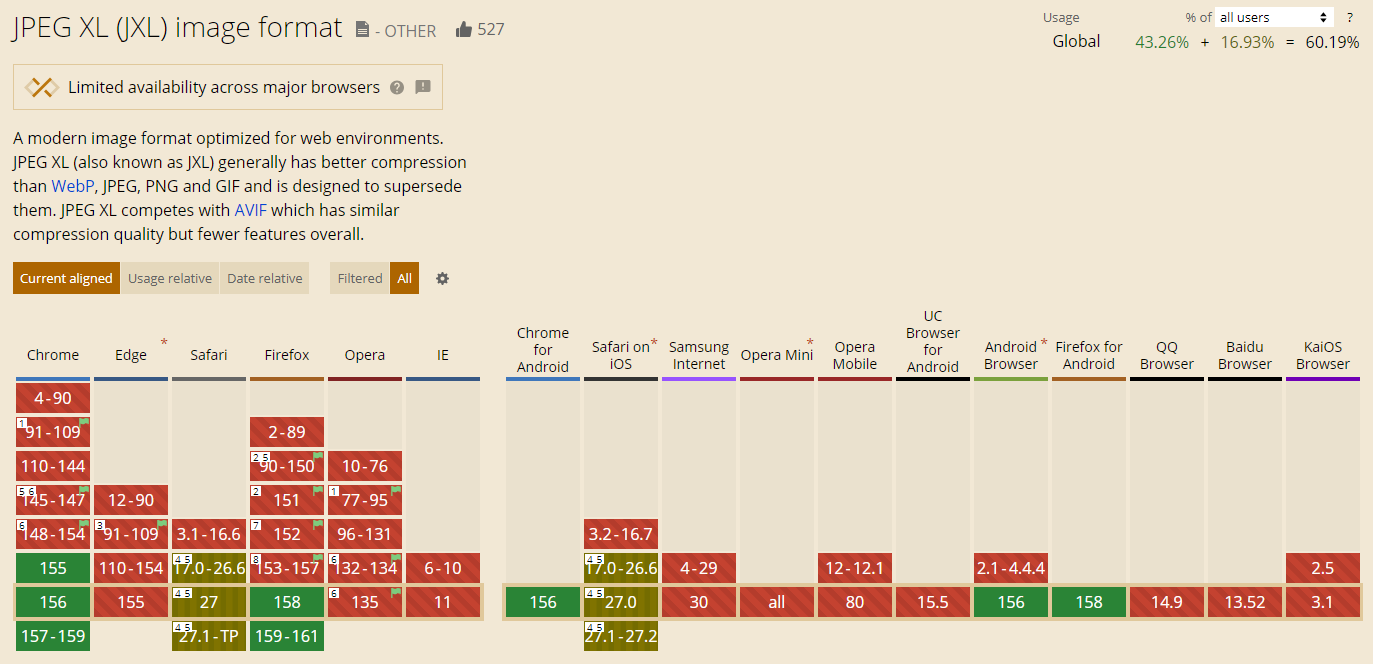
Why am I this excited? Oh, it's simple really…
JPEG XL Is the End-Game Universal Image Format!
Here's why:
- Excellent Compression Efficiency — JXL beats classic JPEG and WebP with fewer artifacts and smaller files, and holds its own against AVIF
- Universal Feature Set — JXL replaces the entire fragmented ecosystem of single-purpose formats. It handles lossless graphics (replacing
.png), variable-frame animations (replacing.gifand animated.webp), alpha transparency, and progressive streaming - Wide Color Depth, Gamut & Native HDR — unlike
.webp(capped at 8-bit color), JXL supports up to 32 bits per channel, including floating-point HDR data (though browser gain-map support is still catching up). It also supports arbitrary custom channels (depth maps, alpha, thermal, CMYK) and handles 16-bit professional master files without gradient banding - Lossless JPEG Transcoding — still blows my mind: the JXL encoder can take in a legacy
.jpg, shrink it by ~20%, and produce a valid.jxlimage. This image can then be used to reconstruct the original JPEG bit-for-bit on demand. This lets servers and storage archives shrink petabytes of legacy data without re-encoding or introducing generation loss - High-Speed, Parallel Software Encoding & Decoding — JXL decodes fast on modern CPUs via SIMD, with no GPU required (though AVIF currently edges it out in raw decode speed). Plus, there are plans for dedicated hardware acceleration*
- Open-Source and Permissive Licensing —
libjxlis released under the permissive BSD 3-Clause license, with royalty-free RAND-Z patent terms. Commercial vendors, OSS projects, and web platforms can integrate, modify, bundle, or distribute JXL tools without a cent in licensing fees. So, no patent traps, no legal restrictions!
*Still on the roadmap. Please, give it some time, it's very new.
JXL is the future-proof archival format, while AVIF is currently the better web delivery format — but JXL's lossless/transcoding capabilities are unmatched. The only thing holding it back for years was browser standards politics, which is finally resolving.
It's rare for a format to solve photography, archival storage, web delivery, and high-bit-depth precision all at once without compromises in core capability. The math is too good to ignore. Browser adoption is the last domino falling…
So, finally, I can use the <img> tag to embed a .jxl image into a page:

JPEG XL rules! Glory to the architects of libjxl!
Counterpoint:
Please note that I'm not saying AVIF is obsolete, or hating on it. How could I? It's basically a still frame from AV1 — and I love AV1! AVIF is an excellent format, royalty-free and already supported by most browsers.
Not only is it still relevant, but in recent comparisons it reliably beats JXL in file size for lossy web images. But for lossless, JPEG XL is the clear winner: AVIF lossless is 30–122% larger and slower to decode. Will this stay the case? Let's wait and see!
P.S. If you’re on an older Photoshop version (CS6 through v26.7, pre-June 2025), native support isn’t available by default. You can still import and export .jxl files, though, by installing the free, open-source JXL Photoshop Plugin. And while you’re at it, grab the AVIF plugin too.
Fresh dev news, AI-digested daily. Never miss a trend at devoured.fyi