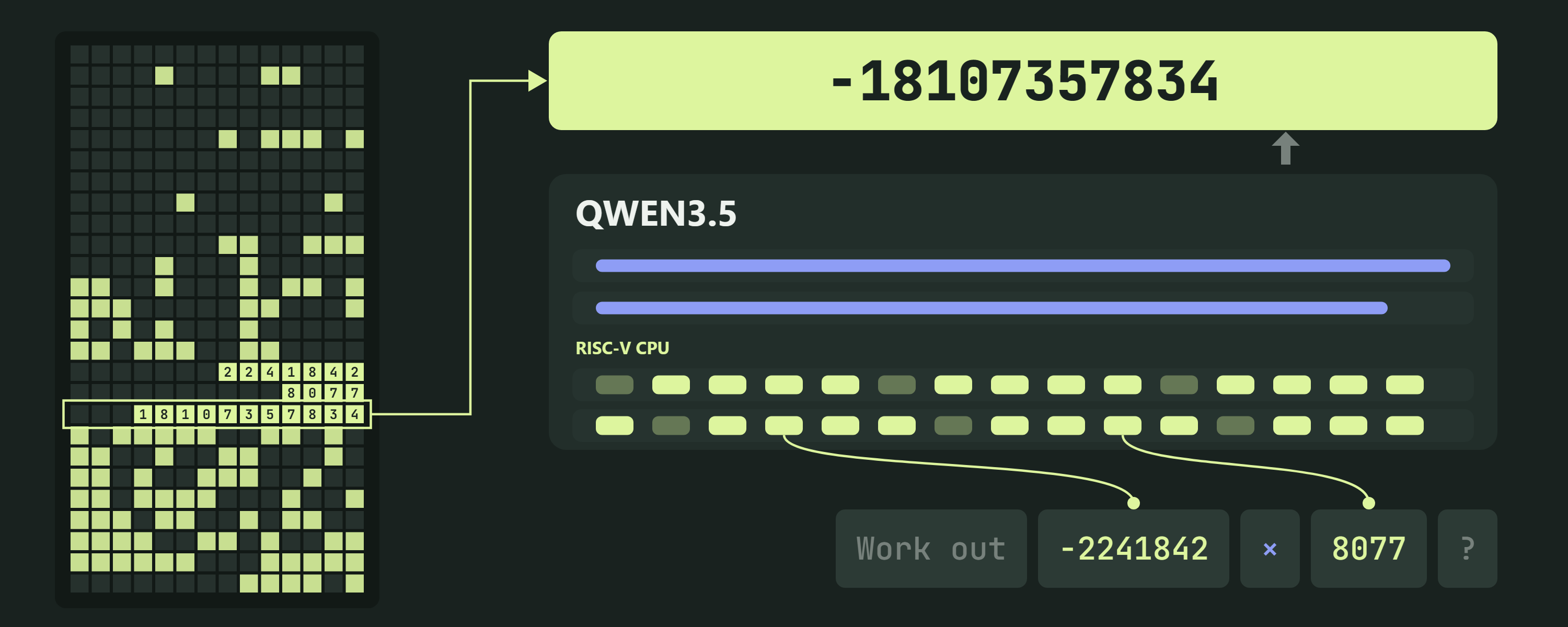
Qwenputer: a fully functioning, deterministic RISC-V CPU inside Qwen3.5
Qwenputer embeds a fully functional RISC-V CPU into Qwen3.5's weights, utilizing the model's Gated DeltaNet layers as deterministic RAM.
Deep dive
- Uses Gated DeltaNet (GDN) layers as addressable memory by setting gate parameters and using one-hot key encoding.
- The RISC-V CPU runs as part of the forward pass, using tokens as an execution trace.
- Includes an experimental in-model file storage system capable of holding 53,000 tokens of text.
- Requires an extra 18.8 GB of weights for the added layers but maintains base model performance for normal text generation.
- Serves as a testbed for AI safety research, specifically for studying hidden reasoning and model monitoring.
Decoder
- Gated DeltaNet (GDN): A type of linear Recurrent Neural Network (RNN) layer that uses a delta rule for state updates, often used as an alternative to standard attention.
- RISC-V: An open-standard instruction set architecture for microprocessors.
Original article
I can't believe it's not silicon
Qwenputer is a pretty fun experimental model. It's a stock Qwen 3.5 4B with one addition: a RISC-V CPU embedded within the weights that uses the model's own Gated DeltaNet attention layers as RAM. (To learn how GDN works, here's a handy guide.) This 'CPU' runs completely within the forward passes of the model, and can run arithmetic operations, C and MicroPython code without any external runtime or tool usage whatsoever.
To be very clear, it is not a plugin, a tool or a sandbox. This blog will explain exactly how this model works, and how the model utilises GDN layers as RAM, and how I also slotted in an experimental in-model file storage.
I also wrote up two follow-ups built on top of Qwenputer: how hybrid models can learn to hide their reasoning in their RNN state and evade CoT monitoring, and how compiled weights like these can work as inbuilt monitoring tools that the model itself can't tamper with.
You can grab Qwenputer from Hugging Face or ModelScope, and the code is on GitHub.
The RNN inside Qwen3.5 can be exact RAM
Qwen3-Next and Qwen 3.5 (the model Qwenputer is built on) use a pretty neat trick. 3 out of 4 attention layers in the model use Gated DeltaNet, a linear RNN, as the attention mechanism. Each head keeps a state matrix, and the delta rule keeps this updated.
Now, here's where our fun experiment starts. I found out that by setting the gate to 1, the write strength (beta) to 1, and using one-hot key encoding, every write we perform will overwrite exactly one row, and every one-hot query can retrieve an exact value. This means that the GDN layers themselves can work exactly as RAM, at a far lower cost than using normal attention as RAM, since a GDN head's state stays the same size however long the conversation gets, unlike attention's KV cache.
The idea that the delta rule acts as a memory isn't new: Schlag et al. (2021) showed that linear attention with the delta rule works as an associative memory, or "fast weights". The new thing here is making it exact and addressable, inside a production model, reliably enough to run a whole CPU on it.
This is the base on which this entire model is built. As it stands, default Qwen 3.5 does not keep exact values in the GDN. With this modification, we unlock the next part of this experiment.
Compiling a computer into layers
Since we have a fully functional, cheap and fast RAM now, we can go ahead with compiling a working CPU into the model weights. Luckily, there's no training involved: a compiler sets every weight directly. You describe the CPU as a circuit, a long list of small steps like "read this register", "add these two numbers" or "jump if zero", and the compiler turns each step into a piece of a transformer layer: attention heads that look things up, feed-forward units that do the arithmetic, and DeltaNet heads that hold the RAM. The CPU then runs as the model decodes.
Each instruction becomes a few generated tokens: one names the memory row to write (ADDR), the next carries the value (VAL), and a STEP token ends the instruction. Those tokens are the CPU's execution trace, so while Qwen is generating them, the CPU is actually running.
The CPU
The CPU is a 32-bit RISC-V core (RV32IM, plus the Zba extension and a small bignum unit for big-number arithmetic), and it takes up 11 layers in front of Qwen's 32. As it stands, it passes the official riscv-tests, its programs match qemu, and it has run 18 million instructions free-running without a single error.
This CPU can also run C and MicroPython code in the forward passes quite well (although a bit slowly). It is not a Linux-class chip yet, but it implements the full RV32IM instruction set.
How Qwen uses it
Qwen 3.5 4B is able to use this CPU quite well, without any post-training required. The CPU is used completely internally, and not invoked through any external tool calls.
In order to make the model use this reliably, I decided to go the cheap way: by piggybacking on the tool call format that models are quite well-trained on, Qwen sends the CPU its instructions and reads back the results. No external tool calls or runtime are used. Once our CPU receives the instructions, the computer layers run, and then write the tool response. We use a small driver called RvChat to load the firmware into the GDN state, and this keeps the trace tokens out of Qwen's layers.
Qwen's original weights stay exactly as they are. The computer weights are added on top of them, in extra dims and layers.
Does it work?
On the DeepMind sets:
- div_big: Qwenputer scores 97.5%, versus 95% by giving Qwen 3.5 4B a Python tool and 72.5% for base Qwen.
- mul_big: Qwenputer scores 97.5%, versus 100% with a Python tool and 55% for base Qwen.
- mul_div_multiple_longer: Qwenputer scores 100%, versus 97.5% with a Python tool and 90% for base Qwen.
- add_or_sub_big: Qwenputer scores 97.5%, the same as with a Python tool, and 87.5% for base Qwen.
On NUPA's long-integer arithmetic, Qwenputer goes from 48.6% to 100%, the same as giving Qwen a Python tool.
The numbers the CPU prints are exact, too: I replayed about 230,000 of its output positions against a reference machine and found zero mismatches. And bolting a computer onto Qwen doesn't change how it talks: its normal text stays within noise of base Qwen (KL 6e-4, against a noise floor of 5e-4).
A hard drive? In this economy?
Because a CPU inside a language model clearly wasn't cursed enough, I decided the prudent thing would be to give it a filesystem too.
Since we already have a functional RAM, this was mostly trivial. On the model side, it's exposed via internal put / append / get / list / delete operations. Once again, no actual tool calls. When Qwen 'saves' a file, the compiled layers hash its name into one of 1,024 slots in a directory kept in the DeltaNet state, and store the text itself in other heads, with eight tokens per row, chained together. In scenarios where two names end up landing on the same slot, it just checks the next one. Finding a file again takes roughly two or three steps instead of a scan, and it holds up to 512 files, which comes out to about 53,000 tokens of text.
Fun thing is, this is quite persistent. You can save the state at the end of a conversation, load it into the next one, and the files are still there. Using this filesystem, Qwen gets facts that changed between chats right 90% of the time, against 30% when you paste the old chats back in, and it's on par with giving Qwen memory tools run by Python (83.3% vs 78.9%).
Limits and what's next
Qwenputer is very much an experiment, so a few limitations. The extra layers and wider hidden size make the checkpoint 18.8 GB, roughly double base Qwen, although most of it is zero padding. It also needs a small driver (RvChat) to boot the firmware and keep the trace tokens out of Qwen's layers, so it doesn't run with a plain generate() call yet. And it's a bit slow, with every CPU instruction costing a few decoded tokens, so a big calculation takes seconds rather than milliseconds. The batched executor I used for the benchmarks runs about 3,200 CPU tokens a second on an L4.
Next up, I want Qwen to write Python and run it on the MicroPython inside its own weights, through a python() tool that works the same way calc does. Making the CPU faster is the other big one.
Beyond arithmetic
Exact control over the RNN layers is useful for a lot more than arithmetic. It also makes Qwenputer a really nice testbed for AI safety research.
Try it
If you want to play with it yourself, the model runs on a single 24 GB GPU. You'll need uv and the Hugging Face CLI. You don't need a tool server or a Python sandbox for the calculations: the CPU runs them inside the model.
git clone https://github.com/divagr18/qwenputer && cd qwenputer/experimental/riscv && uv sync --extra hf
hf download divagr1925/Qwen3.5-4B-Qwenputer --local-dir qwenputer-rv
uv run python -m chipformer.rv.chat qwenputer-rv --firmware tests/data/rv/calc-bridge.elf \
--ask "Use calc: what is 123456789 * 987654321?"Fresh dev news, AI-digested daily. Never miss a trend at devoured.fyi