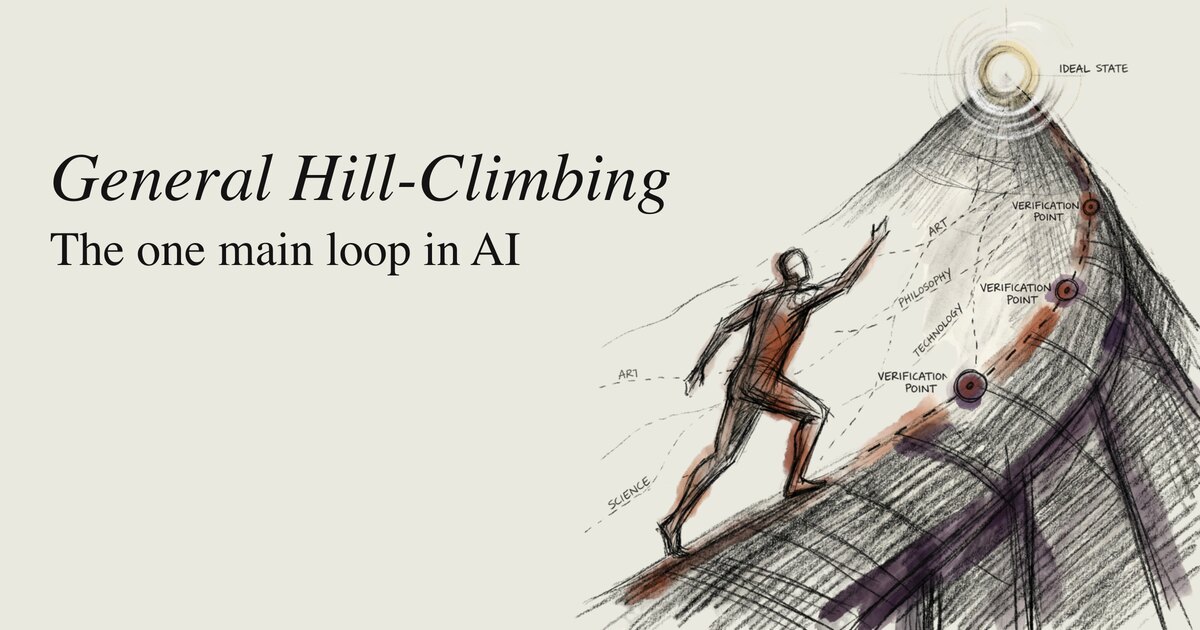
General Hill-Climbing: The One Main Loop in AI
Successful AI implementation requires treating every problem as a 'hill-climbing' loop: defining a precise ideal state and rigorously evaluating progress toward it.
Deep dive
- The core loop for AI development is Idea -> Articulation -> Build -> Evaluate -> Iterate.
- The most common failure mode is poor 'Ideal State' documentation; dictation is often more effective than typing to capture nuance.
- Treat 'Evals' as software tests for unstructured work: check for factual accuracy, format validity, and logical consistency.
- Run cheap, deterministic checks (e.g., code linting, word count) before using expensive AI judges for higher-level semantic evaluation.
- If an AI produces a result that passes all Evals but still feels wrong, it indicates your Evals do not yet perfectly represent your ideal state.
Decoder
- Hill-climbing: An iterative optimization algorithm that seeks to improve a solution by making small, incremental changes and keeping those that increase the quality score.
- Eval (Evaluation): A systematic test or rubric used to measure the quality of an AI model's output against a defined ground truth or set of constraints.
- Telos: A term used here to describe a comprehensive documentation framework that captures the goals, metrics, and strategy for a project in a single file.
Original article
General Hill-Climbing: The One Main Loop in AI
There is basically One Main Loop in AI, and it applies to everything from building software to managing pretty much anything.
I call it General Hill-climbing.
Here are the main components:
- Know what you want
- Be able to articulate it
- Be able to measure progress
- Do the work / test your ideas
- Adjust / Iterate / Climb / Repeat
In 2026/2027 modern language that means:
1. YOUR TELOS (Purpose)
You want to start with clear articulation of your current state, your ideal state, your goals, metrics, challenges, strategies, projects, etc. This is where you're trying to get to, where you are now, what you're trying to accomplish, how you measure progress, the things that are stopping you, what you're doing to overcome those issues, the work you're actively doing, etc.
Your TELOS captures this all together, in a single place, so that you, and other people, and your AI systems can all understand the overall direction. This is the starting point and center of reference for work we want to do.
2. CLEAR ARTICULATION OF IDEAL STATE
Step one is defining what you're trying to do overall, with as much context as you can provide around not just what you're doing, but why.
Here we want to specifically define the ideal state for a specific task. Like creating an app, or starting a business, or creating a plan for selling a new video game you made. Or writing a book. Whatever.
You need an extremely thorough and clear articulation of exactly what you want.
We believe very strongly that more and more AI failures today are not actually AI execution problems. AI is getting really good at doing exactly what we asked for.
The problem is often us either:
- a. Not giving a complete picture of what we wanted
- b. Giving an incorrect / conflicting picture of what we wanted
Layers of abstraction
Think of this as layers of abstraction.
1. The true thing is the idea in our head. That's ground truth. That's the thing we actually want to build.
2. The next step is the capture into an artifact. The moment we leave that and try to capture it via voice, or text, or whatever, we've lost something. Hopefully not that much. This step really matters. This is the step we have to do really well, because AI can't read our minds.
3. And finally we try to build the project. It's critical to understand that this comes from step 2, not from step 1. AI has no way to access number 1. It can only go off of number 2. This is why the ideal state capture piece is so essential.
So we have to address this by being extremely thorough in our description of what we want. This might mean doing a whole lot of dictation about the project, what you're trying to do with it, why you're doing it, how you hope it will help, etc.
Just know that the primary limitation for AI today is not its ability to build what you ask for. It's your ability to clearly articulate what you want.
3. INSTRUMENTATION (Evals)
Ok, so once we know our general direction we're building towards, and we know exactly what we're building in this specific case, you then need a system that can watch you executing work against a given target / goal / destination and tell you whether you're improving or getting worse.
This means measurability. This means specifics. And there's a reason why we call it "General" hill-climbing. You need to be able to measure progress or regression against any type of thing you're trying to do.
That means not just science and engineering, but product management, sales, marketing, design, etc...basically any work that you do. If you can't instrument the work in a way that's tied to the ideal state you're trying to get to, you can't know, discuss, or improve the situation.
This is where Evals come in. Evals come from software development but in this new AI model of the world, Evals will become far more general, making them pretty much universal and essential for any type of work.
The simplest way to think of Evals is as a set of checks to know if something is good or not. And they depend greatly on the type of work being done. They can be extremely simple, or elaborate and complex.
A set of Evals for a report, for example, might be something like:
- All the facts in the report are accurate
- The data in the report is no more than a year old
- The report does not include any mentions of ____
- The topic of ______ was addressed in the report
- There are no spelling or grammatical errors
Types of evals
- A simple check (are there any misspellings)
- Which one of these is better? (asking AI to judge between two things)
- Where on this scale does this report fall (asking AI to judge between Critical, High, Medium, Low, or whatever)
- Does it match the answer we already know is right? (comparing the output to a reference answer)
- Does it contain this exact thing? (a plain code check for a required phrase, link, or field, with no AI involved)
- Is it in the right shape? (correct length, valid format, every required section present)
- Is this claim actually true? (checking each fact against a source)
- How does it score on each part of a rubric? (AI grading against a written scale, like 1–10 for clarity where 10 is defined in advance)
- Which of these twenty is best? (a tournament, where AI compares them two at a time until one wins)
- Did it actually work? (running the code, clicking the button, or loading the page and seeing if it does what it should)
- Does it hold up every time? (running it ten times and seeing how many pass, not just once)
- Would I have picked this one? (an AI judge tuned on your own past ratings, so it scores the way you do)
Combined, they give you a way to rate the quality of a given piece of work. And when one, or some, or a lot of the different criteria fail, you have something to improve on. You have a way to hill-climb.
The IDEAL STATE criteria are the VERIFICATION criteria.
4. DOING THE WORK (Building to the Ideal)
So now we know our general direction, and we know specifically what we're building, and we also know how to measure whether the output is good or not. Now we're ready to do the work.
The AI is now building according to the Ideal State Artifact that you've created, and it's using the Evals you've created to know how it's going. It will produce an output, and your Evals will tell you how good it is.
5. ITERATION AND EXPERIMENTATION
- Our Ideal State is not static. We don't always have the complete picture in the beginning, and we often get more ideas as the project starts to develop.
- Our Evals can evolve as well. The best way to tell if you need to update your evals is if you get a result that perfectly passes your evals, but you still don't like it for some reason.
- Experimentation is your friend. The best thing about putting in the work on Ideal State and Evals is that you can experiment cheaply: change one thing, rerun the evals, and see whether you moved up or down the hill.
SUMMARY
Taking all these pieces together, what we have here is a General Hill-climbing System. It's basically a universal problem solver. Not instantly. Not perfect. But it's a path. It's a system. And it works on pretty much anything you throw at it.
Idea ⤓ Articulation ⤓ Build ⤓ Evaluate ⤓ Iterate
This is how I think of AI harnesses. This is how I think of AI for our personal improvement. This is how I think of AI for the enterprise. This is how I think of AI period. Knowing what we want, and hill-climbing towards it.
Fresh dev news, AI-digested daily. Never miss a trend at devoured.fyi