The Ads Model for Prompts Vertically Integrates AI
Meta’s new two-tier pricing for Muse Spark models treats user prompt data as currency, effectively creating an advertising-style model for AI inference.
Deep dive
- Pricing Strategy: Meta formalized a 92-95% discount for customers willing to trade data for inference costs.
- Data Valuation: The price spread reveals that Meta values incoming customer data at approximately $1.24 per million tokens.
- Economic Shift: This moves AI from a 'compute as utility' model to a 'data-barter' model.
- Competitive Advantage: By bypassing human labeling vendors, Meta creates a self-funding flywheel for reinforcement learning from AI feedback (RLAIF).
- Enterprise Implications: Enterprises processing large token volumes must now choose between significant cost savings or maintaining zero data retention (ZDR) compliance.
Decoder
- Zero Data Retention (ZDR): A policy where a vendor guarantees they will not store, inspect, or use customer data for training models.
- Inference: The process of running an AI model to generate predictions or responses based on input tokens.
- Tokens: The basic units of text that an LLM processes; 1 million tokens is roughly 750,000 words.
Original article
In short : Meta's Muse Spark 1.3 prices inference at two levels : $1.25/$4.25 per million tokens for private data, & $0.10/$0.20 for training consent : a 92% price spread. Michael Mauboussin taught that market prices contain information about underlying expectations. This spread establishes a liquid clearing price of $1.24/m tokens for user & agent prompt data, allowing Meta to vertically integrate the AI data supply chain & acquire post-training data at pennies on the dollar compared to specialized data labs.
Meta launched two things yesterday : a state-of-the-art model & a new pricing system for foundation models. Muse Spark propels US open source models to the frontier. Meanwhile, the pricing system resets the industry’s economics.
For thirty years, enterprise software operated on strict licensing fees with a guarantee of total privacy & zero data retention. Consumer technology operated on the opposite principle : free software in exchange for behavioral data. Consumers trade queries for convenience, but enterprises fiercely protect their intellectual property.
Now that model is coming to AI with a twist.
Meta’s new pricing makes the barter explicit through a two-tier pricing structure with & without privacy :
- The Standard Tier (
muse-spark-1.3) : $1.25/m input tokens & $4.25/m output tokens. Your prompts & completions are never used to train Meta’s foundation models. - The Contributor Tier (
muse-spark-1.3-contributor) : $0.10/m input tokens & $0.20/m output tokens. In exchange for a 92% discount on input & a 95% discount on output, Meta retains the right to train future models on your data.
No other foundation model provider currently offers this kind of explicit barter on its API. This is the ads model coming to AI.
As Michael Mauboussin writes in Expectations Investing, there is information in prices. When Meta charges two radically different prices for the same AI, the difference in price tells us the value of the data.
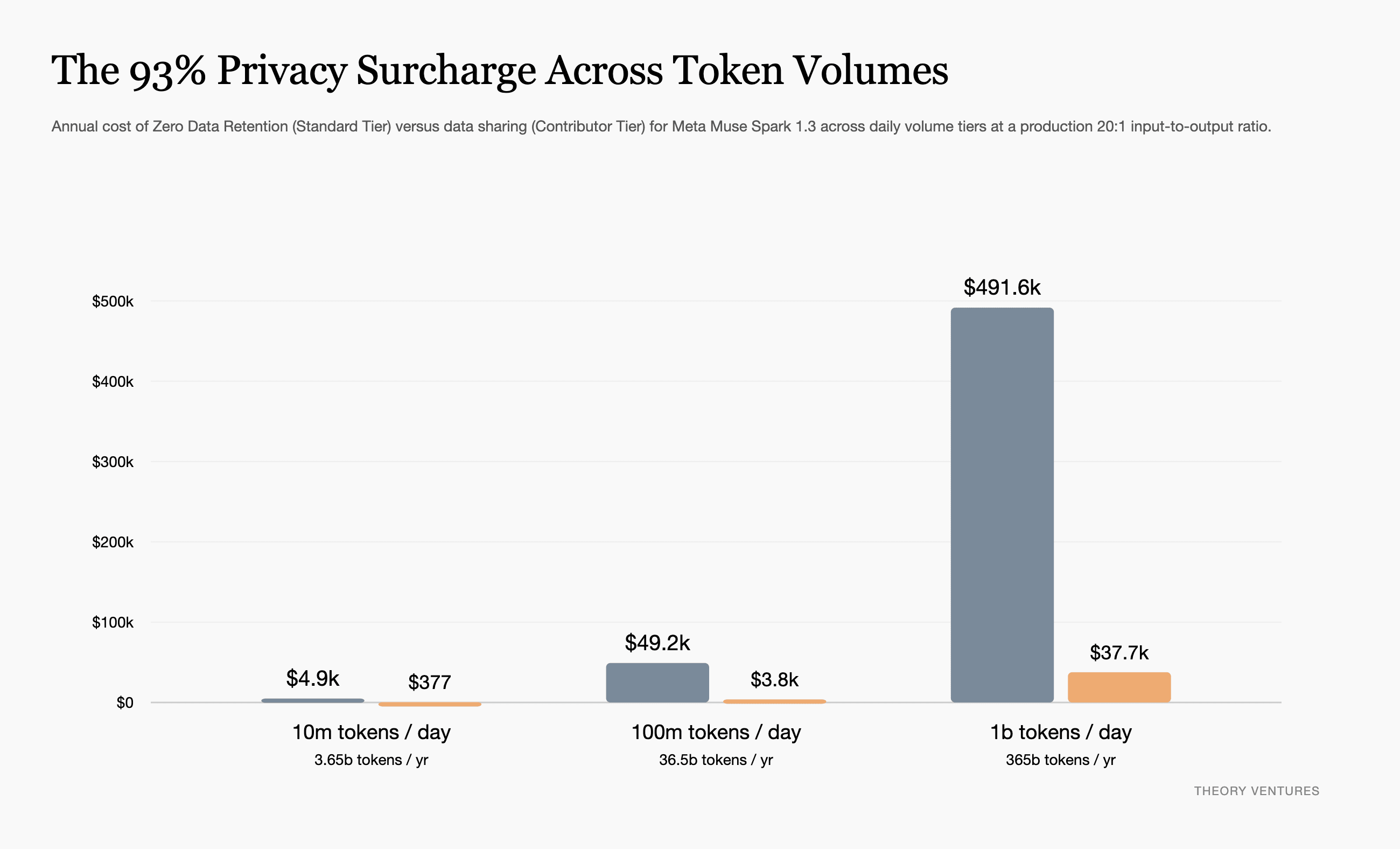
At an agentic 30:1 input-to-output ratio, the blended standard tier costs $1.35/m tokens, while the contributor tier costs $0.103/m. The difference is a $1.24/m token spread, an effective 92.3% subsidy.
| Daily Token Volume | Monthly Tokens | Annual Cost (Private / ZDR) | Annual Cost (Data Sharing) | Annual Data Dividend |
|---|---|---|---|---|
| 10m tokens / day | 300m | $4,916 | $377 | $4,539 |
| 100m tokens / day | 3b | $49,157 | $3,768 | $45,389 |
| 1b tokens / day | 30b | $491,573 | $37,677 | $453,895 |
For an enterprise processing 1b tokens per day, opting into Zero Data Retention (ZDR) is a $454,000 annual privacy surcharge. That difference is how Meta values incoming customer data : $1.24/m tokens.
This unbundles the $20 monthly consumer subscription. Labs absorbed compute losses on flat-rate consumer plans because default terms granted training rights, an implicit data subsidy that Meta has now formalized per token.
Why surrender 92% of inference revenue? It is not out of altruism.
The public web has been exhaustively crawled ; frontier gains now come from post-training, reinforcement learning from AI feedback, & user usage patterns. Estimates place the market for training data & human labeling at $10b in annual revenue.
Meta’s pricing model bypasses this intermediary. Just as search & social platforms vertically integrated the digital advertising supply chain by capturing behavioral data directly from users, Meta is vertically integrating the AI data supply chain. Instead of paying labeling vendors to simulate human behavior, Meta turns its inference network into a self-funding data flywheel.
At $1.24/m tokens of subsidy, Meta acquires organic reasoning traces at pennies on the dollar compared to specialized data labs, while undercutting closed foundation models on inference price.
Compute is no longer sold simply as an infrastructure utility. It has become a currency traded directly for the training tokens needed to build the next frontier model.
Ultimately, this solves the business model for American open source. Just like ads, the barter is simple : subsidized access in exchange for data.
Fresh dev news, AI-digested daily. Never miss a trend at devoured.fyi