DEVOURED
The Curiously Playable Universe
The perceived "intelligence" of AI may actually stem from humans increasingly converting messy real-world domains into formalized, game-like environments.
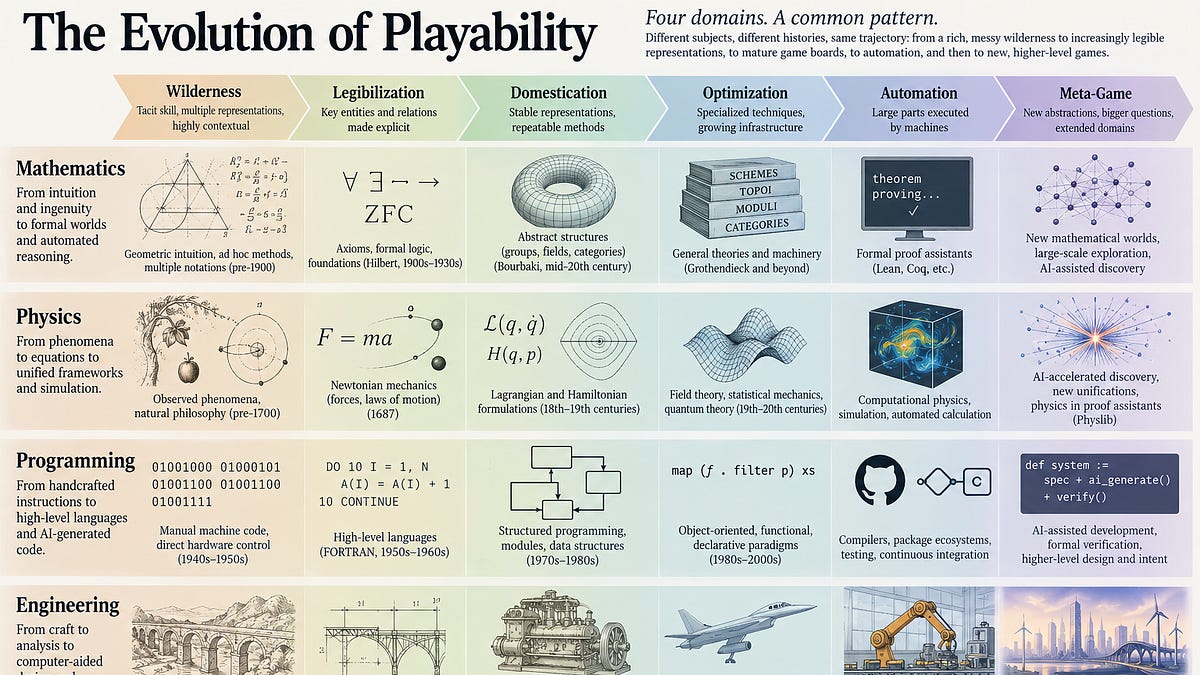
What: Venkatesh Rao argues that domains like mathematics (via Lean), programming, and physics are becoming "playable" through standardizing representations, which makes them easier for AI to solve.
Why it matters: This challenges the assumption that AI success is purely about better algorithms, suggesting instead that progress relies on creating architectures where complex problems can be simplified and mechanically verified.
Deep dive
- Modern AI success is less about emergent cognition and more about human-engineered legibility.
- Domains move from a 'wilderness' state to 'domestication' via formalization.
- Formalization is a form of lossy compression that preserves invariants required for automated play.
- The 'Curiously Playable Universe' hypothesis suggests reality is more modular and amenable to game-like abstraction than expected.
- Lean and similar formal tools create environments with verifiable rewards, enabling AI to perform at superhuman levels.
- Automation does not replace human work but displaces it toward designing higher-level architectures and meta-games.
Decoder
- Lean: A functional programming language and theorem prover used for verifying formal mathematical proofs.
- Formal verification: The process of using mathematical methods to prove that a system or proof satisfies specific requirements without bugs.
- Goodhart’s Law: The principle that when a measure becomes a target, it ceases to be a good measure.
Original article
Full article content is not available for inline reading.
Explore all 68 articles in today's digest
Fresh dev news, AI-digested daily. Never miss a trend at devoured.fyi