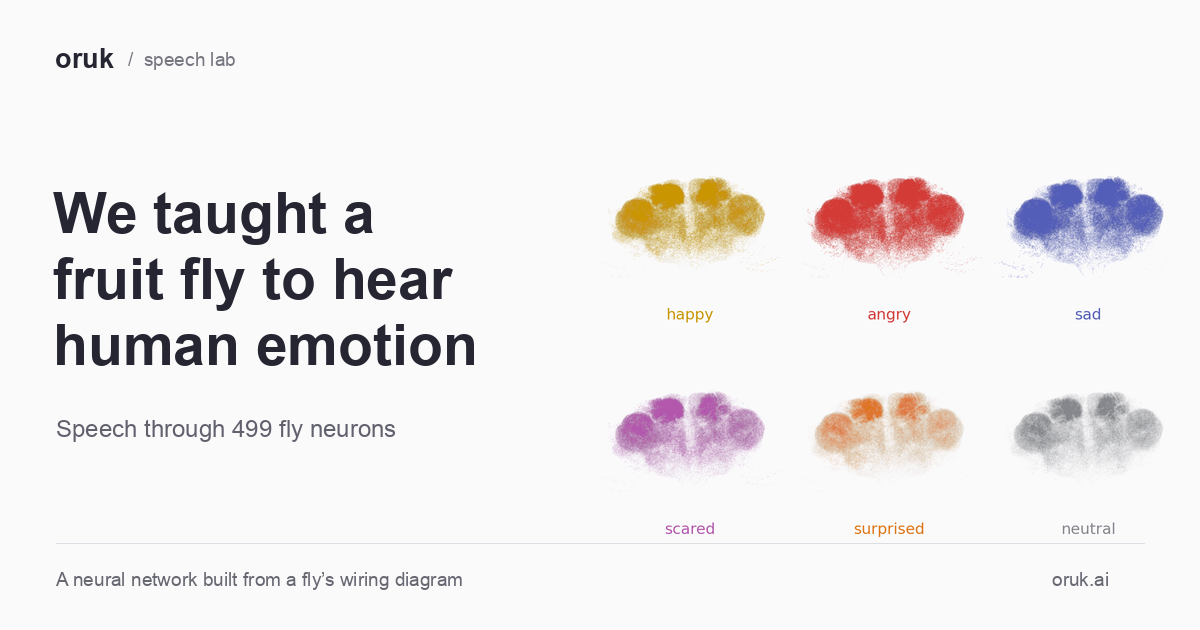
We taught a fruit fly to hear human emotion
Simulating fruit fly brain connections in software yielded no performance gain in emotion recognition, proving that biological wiring is not a drop-in shortcut for AI.
Deep dive
- The model utilized 15,865 connections and 867,344 synaptic contacts derived from the fruit fly's MaleCNS v1.0 wiring diagram.
- The team employed reservoir computing, where the recurrent neural network remains fixed, and only a linear readout layer is trained.
- The fly-circuit model achieved a mean average precision (mAP) of 16.84%, while a scrambled version scored 16.88%, effectively a statistical tie.
- Removing neurons with high readout weights significantly degraded performance, indicating the model learned to use the available features regardless of whether they mapped to specific biological functions.
- The study concludes that the specific biological connectivity of a fruit fly does not inherently optimize the processing of emotional human speech.
Decoder
- Connectome: A comprehensive map of neural connections within an organism's nervous system.
- Reservoir computing: A framework for recurrent neural networks where the internal weights of the 'reservoir' are fixed, and only the output weights are trained.
- mAP (mean Average Precision): A metric used to evaluate the accuracy of information retrieval or classification tasks across multiple labels.
Original article
We taught a fruit fly to hear human emotion
We took 499 neurons from a fruit fly's wiring diagram, copied their connections into software, and fed them human voices. A small output layer learned to predict the emotion labels people had given those recordings.
Most of this model never learned anything about speech. The connections inside the fly circuit stayed fixed through training. We only taught a readout what to make of the activity that came out.
The model uses 499 neurons from the fly's central brain. We gave them an artificial input pathway and simple mathematical dynamics. The task is to predict how a voice sounds to a listener; this experiment says nothing about whether a living fly understands human feelings.
Building a neural network from a fly brain
The MaleCNS release includes connection tables and reconstructed neuron shapes. We selected a densely connected group in which every neuron can reach every other neuron through some directed path. That gave us 15,865 connections, supported by 867,344 synaptic contacts.
A connection in the model gets stronger when the reconstruction contains more synaptic contacts. We also assign positive or negative signs using neurotransmitter annotations. These are engineering choices: a wiring diagram does not supply every receptor, time constant or physiological detail needed to simulate the original cells.
What it does supply is a recurrent network. A signal can travel through several neurons and feed back into cells it has already reached. We wanted to see what that network would do with a human voice.
Teaching the model to recognize emotion
Every 10 milliseconds, we turn the sound into 32 numbers describing its energy across frequency bands. A fixed random projection sends those numbers into the circuit. Each neuron combines that input with the previous activity of its neighbors and retains part of its own previous state. The resulting activity depends on both the present sound and what happened just before it.
This is reservoir computing. You feed a signal through a fixed recurrent network and train a small model to read its response. Suárez and colleagues built conn2res to study this with biological connectomes. Costi and colleagues have already used a fruit fly connectome for time-series prediction. Our experiment applies the approach to listener judgments of speech.
We average the neuron states within four successive parts of each recording and fit a linear readout to 15 emotion labels and 16 speaking styles. The readout also gets a direct set of pooled audio features. That branch matters: some of what this model predicts can come straight from the voice without passing through the fly circuit.
Training used 16,995 voice clips. We chose the settings on a separate validation set, then evaluated the models on 2,022 test clips. Known speakers stay in one split; where speaker identity is unreliable, we keep the entire source corpus together.
What emotional speech does to the network
Those differences limit what we can infer from the picture. A bright patch can reflect the words, pitch, speaker or recording conditions. Calling the indigo cells "sadness neurons" would turn a color choice into a finding. We use these examples to inspect the model; the held-out test is where we measure whether it learned anything useful.
Scrambled wiring worked just as well
A fly-shaped network is an appealing thing to look at. The harder question is whether the biological wiring helps.
We shuffled the destinations of the connections, preserving each source neuron's outgoing connection count, signs and weight values before rescaling. Then we selected the settings and trained a new readout for that network. We also trained an audio-only model and a version with the connections between neurons removed.
Fly wiring scored 16.84% mAP. Scrambled wiring scored 16.88%. Their paired difference was −0.04 percentage points, with a 95% interval from −0.16 to +0.07. On this split, the two were effectively tied.
Constant scores give 9.71% mAP on this test set, so the models learned some useful ranking. This is a modest speech classifier, and the comparison gives us no evidence that the fly's particular wiring is an advantage.
What happens when 50 neurons go silent?
With all 499 neurons intact, the anger score for this recording is +0.29. Switch off 50 and it drops to −0.43. These are raw linear scores, so the negative value has no interpretation as a probability. It means the altered circuit gives the fixed readout less evidence for that label.
The effect extends beyond this one clip. For this fitted model, silencing the same 50 neurons drops test mAP from 16.91% to 10.83%. Those neurons are useful to the readout we trained. That does not make them biological emotion cells, or show that their wiring was the best starting point.
There is no contradiction between this result and the scrambled control. A readout learns to use the features its circuit produces. Remove part of that circuit after training and the features change under it. Give a different circuit its own training run and its readout can learn to use different features just as well.
I'd repeat this with many different fly circuits and the same sentence spoken in several emotional styles. This run used one circuit and mostly one listener judgment per recording. Both choices could matter more than the fly.
How we ran the experiment
The dataset contains 21,256 distinct waveforms and 21,600 retained ratings: 16,995 training clips, 2,239 validation clips and 2,022 test clips. Most recordings have one listener rating. Repeated ratings become soft targets; evaluation treats a label selected by at least half of the available ratings as positive. Exact duplicate audio and speaker/corpus groups have no overlap across splits.
The 499 neurons form the largest strongly connected component among the 512 strongest eligible central-brain intrinsic neurons in MaleCNS v1.0. We retained traced cells with the modeled transmitter signs and at least five contacts per edge. We assign acetylcholine a positive sign and GABA and glutamate negative signs. Each weight starts as sign × log(1 + contact count), followed by global spectral scaling. These assignments are model assumptions.
x[t] = (1 − α)x[t−1] + α tanh(Wx[t−1] + Wᵢₙu[t])The interactive circuit uses α = 0.15 and a target spectral radius of 0.9.
Audio is resampled to 8 kHz, converted to 32 log-mel bands with a 25 ms window and 10 ms hop, normalized using training frames, and clipped to ±5. Four temporal means of 499 states are concatenated with 128 pooled audio features. The 31-output ridge readout is the only learned part. The demos use the validation-selected seed-42 model, input scale 0.3 and ridge penalty 10.
The model comparison averages three prespecified seeds per reservoir architecture; the audio-only baseline is deterministic. The 95% intervals use 500 paired bootstrap resamples of the 45 test speaker/corpus groups, without refitting. They are conditional on this split and these fitted models. The single-model intervention starts at 16.91% mAP, which differs from the 16.84% three-seed mean.
The six recordings are illustrative positive held-out examples from CREMA-D and VCTK. Display labels come from listener judgments and can differ from the emotion an actor was asked to perform. We selected the public excerpts for illustration and redistribution; their selection does not change the fitting, split or benchmark results.
Fresh dev news, AI-digested daily. Never miss a trend at devoured.fyi