DEVOURED
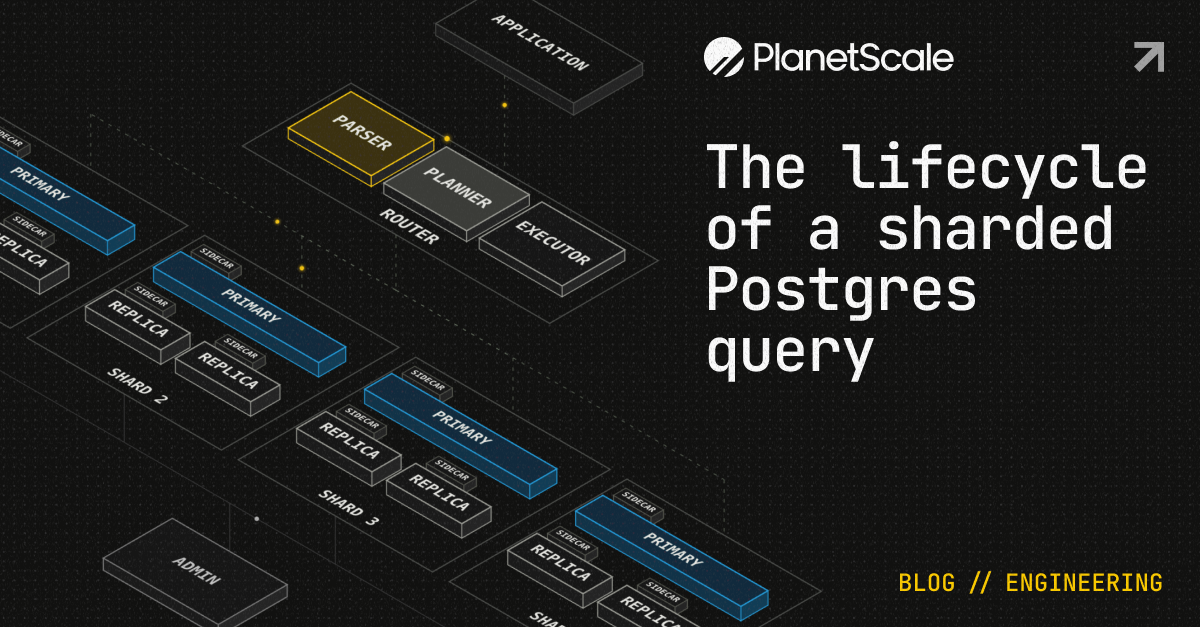
The lifecycle of a sharded Postgres query
Scaling PostgreSQL to thousands of servers requires a sophisticated query router to handle distributed planning, connection pooling, and cross-shard joins.
What: This deep-dive explains how a distributed Postgres system uses routers to handle authentication, parse queries into abstract syntax trees, and construct execution plans that join data across multiple shards.
Why it matters: As applications exceed the limits of a single database instance, understanding query planning at the router level is essential for debugging performance bottlenecks in massive, distributed systems.
Takeaway: If you are sharding your database, prioritize co-locating related data (e.g., orders sharded by customer_id) to avoid the high latency and compute overhead of performing joins within the router layer.
Deep dive
- Authentication: The router intercepts Postgres protocols (including SCRAM-SHA-256) to validate identity without moving credentials to shards.
- Protocol Handling: Routers must support both Postgres Simple and Extended protocols to ensure compatibility with standard application drivers.
- Query Planning: The router must maintain a schema cache and a topology map (stored in etcd) to resolve which shards hold necessary data.
- Hash Joins: When joins cannot be localized to a shard, routers build hash tables in memory to match rows returned from different physical servers.
- Sidecars: Dedicated processes alongside Postgres instances manage connection pools to overcome the memory constraints of Postgres's process-per-connection architecture.
- Evaluation Engine: Routers perform heavy lifting for aggregations (like SUM/COUNT) that cannot be computed by individual shards in isolation.
Decoder
- Sharding: A database partitioning technique that separates large data sets into smaller, faster, more easily managed pieces called shards.
- Abstract Syntax Tree (AST): A tree representation of the abstract syntactic structure of source code, used here to parse SQL into a structure the router can manipulate.
- gRPC: A high-performance, open-source universal RPC framework used here for communication between the router and database sidecars.
Original article
Full article content is not available for inline reading.
Explore all 56 articles in today's digest
Fresh dev news, AI-digested daily. Never miss a trend at devoured.fyi