DEVOURED
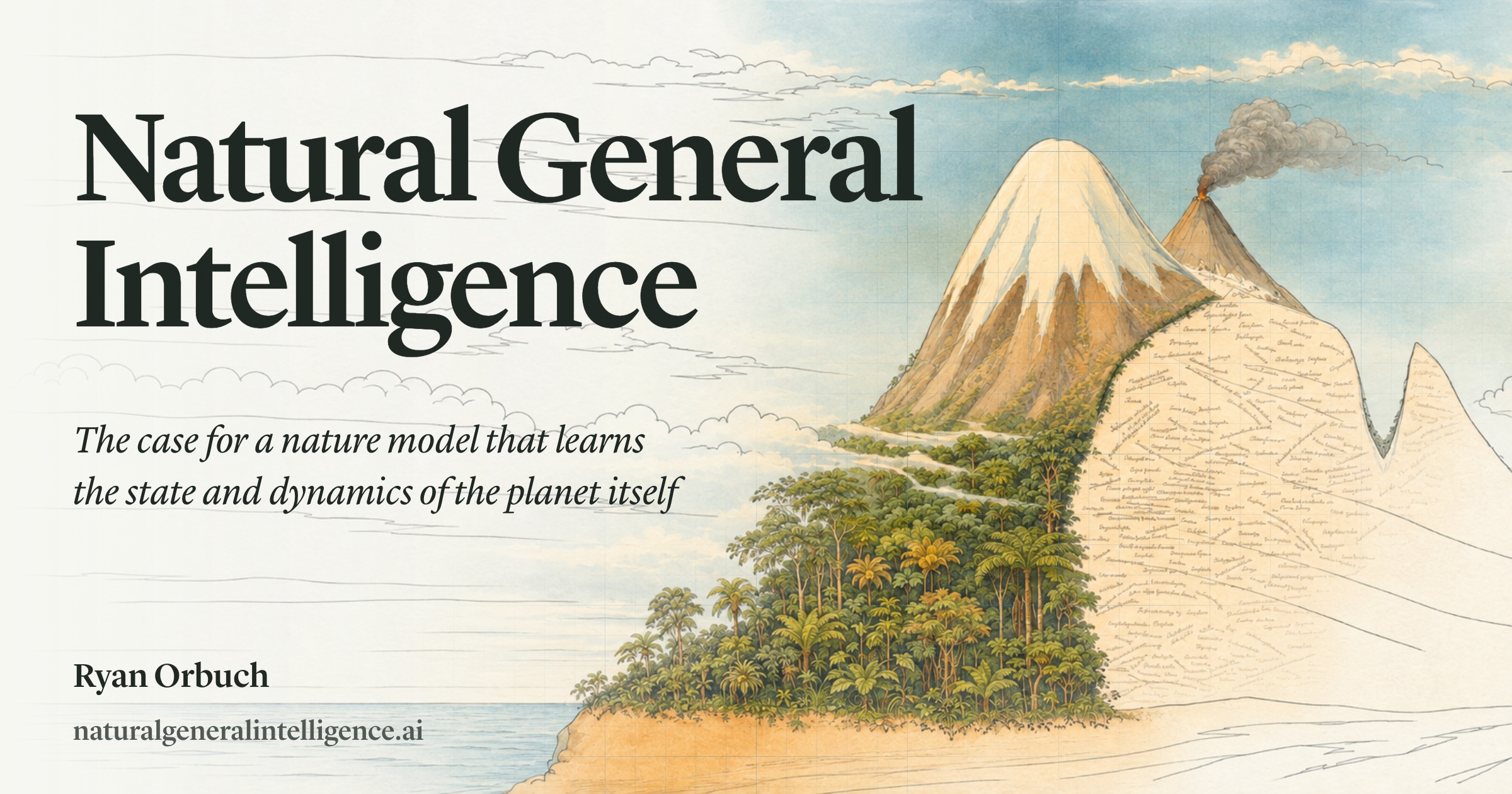
Natural General Intelligence
Ryan Orbuch proposes 'Natural General Intelligence,' a foundation model that learns the planetary state to bridge the gap between AI agents and real-world Earth systems.
What: Ryan Orbuch from Lowercarbon Capital outlines a blueprint for a 'nature model' that integrates multimodal Earth-observing data—from satellite imagery to sensor-equipped marine mammals—to provide an empirical, closed-loop interface for AI stewardship of the biosphere.
Why it matters: This proposal highlights that AI development is currently siloed from physical reality; building models grounded in the Earth's state is essential to move from mere knowledge automation to active ecological and resource management.
Takeaway: If you are working on agentic AI, you can contribute to this framework by emailing ryan+agents@lowercarbon.com with a proposed project to improve data archival, cross-domain measurement, or observational benchmarking.
Deep dive
- The Earth system is already 'automated' by natural cycles, but human interventions are often negligent because they lack systemic visibility.
- A 'nature model' would act as a world model that ingests continuous Earth data to simulate outcomes of human intervention.
- Current modeling relies on fragmented, outdated pipelines; a new model must learn directly from raw observations, not just pre-rendered climate reanalysis.
- The proposal advocates for five core principles: learning directly from observations, preserving high resolution, obeying physical constraints, discovering cross-system couplings, and actively fetching new data.
- The 'bitter lesson'—that data and compute outperform hand-tuned heuristics—applies to Earth science just as it does to language models.
- Monitoring tools like smartphones, bioacoustic sensors, and subsea fiber optics show how existing infrastructure can be repurposed for planetary sensing.
- The model would not manage politics or goals, but would make the causal consequences of human actions legible.
Decoder
- Data assimilation: The process of integrating observational data into a numerical model to improve its estimate of the system's current state.
- Reanalysis: A systematic, multi-decadal reconstruction of atmospheric or ocean states using a fixed, consistent modeling system to analyze past climate.
- Sankey: A type of flow diagram used to visualize data volumes or distributions between categories.
- Biogeochemical: Relating to the cycling of chemical elements and compounds between living organisms and their environment.
- Coupling: The method by which separate simulation models (e.g., ocean, atmosphere) exchange variables to influence each other's state.
Original article
Full article content is not available for inline reading.
Explore all 58 articles in today's digest
Fresh dev news, AI-digested daily. Never miss a trend at devoured.fyi