DEVOURED
Training a 4B model to produce 81% faster query plans than Postgres
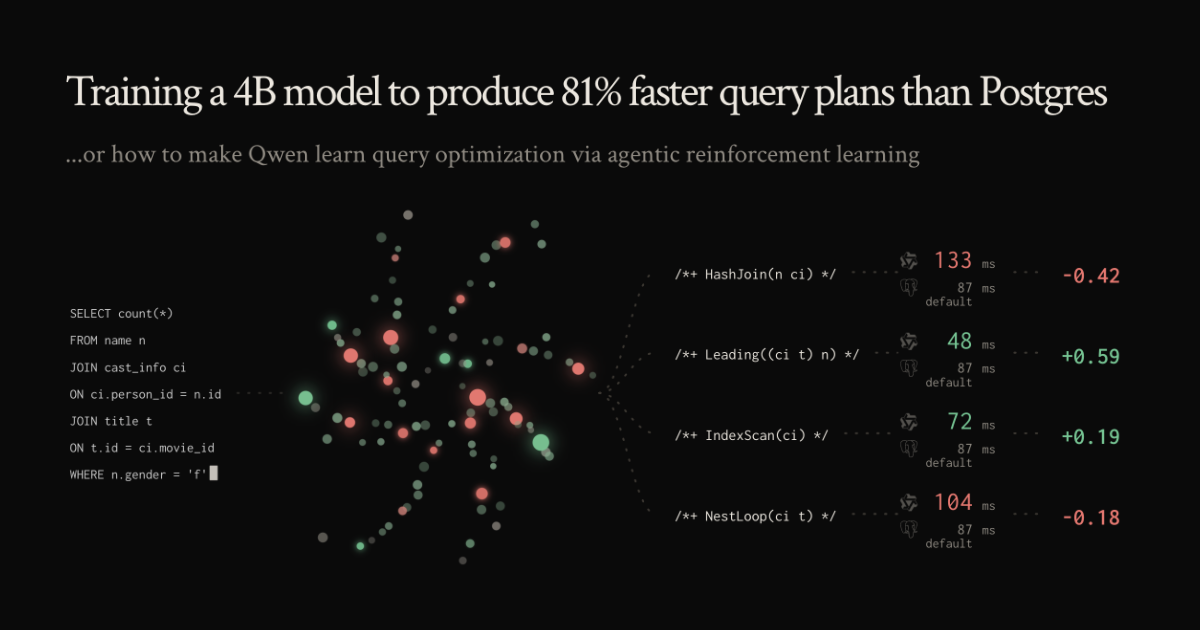
A 4B parameter language model successfully learned to generate PostgreSQL query plans that are 1.81x faster than the database's native default.
What: Rohan Bansal fine-tuned a 4B parameter Qwen model to optimize join-heavy PostgreSQL queries. By training on execution-time feedback via reinforcement learning, the model reduced overall workload latency by 44.7% across 113 complex queries compared to the standard cost-based optimizer.
Why it matters: This proves that small, specialized models can outperform traditional heuristic-based database optimizers by learning from real-world execution metrics rather than relying solely on static cost estimations.
Deep dive
- Methodology: The model was post-trained using SFT and GRPO (Group Relative Policy Optimization) on a custom measurement rig.
- Efficiency: The approach effectively turns query optimization into a reinforcement learning task by using execution time as a verifiable reward signal.
- Performance: Achieved a 1.81x geometric mean speedup over default PostgreSQL plans.
- Scalability: Demonstrated that even small 4B parameter models can handle complex join ordering tasks that are traditionally NP-hard for conventional optimizers.
Decoder
- Join ordering: The process of determining the most efficient sequence in which to join multiple database tables; it is a complex optimization problem that significantly impacts query speed.
- GRPO: Group Relative Policy Optimization, a reinforcement learning method that evaluates multiple output candidates against each other to improve policy training in noisy environments.
Original article
Full article content is not available for inline reading.
Explore all 67 articles in today's digest
Fresh dev news, AI-digested daily. Never miss a trend at devoured.fyi