Production-ready Design from a Crew of AI Agents (Website)
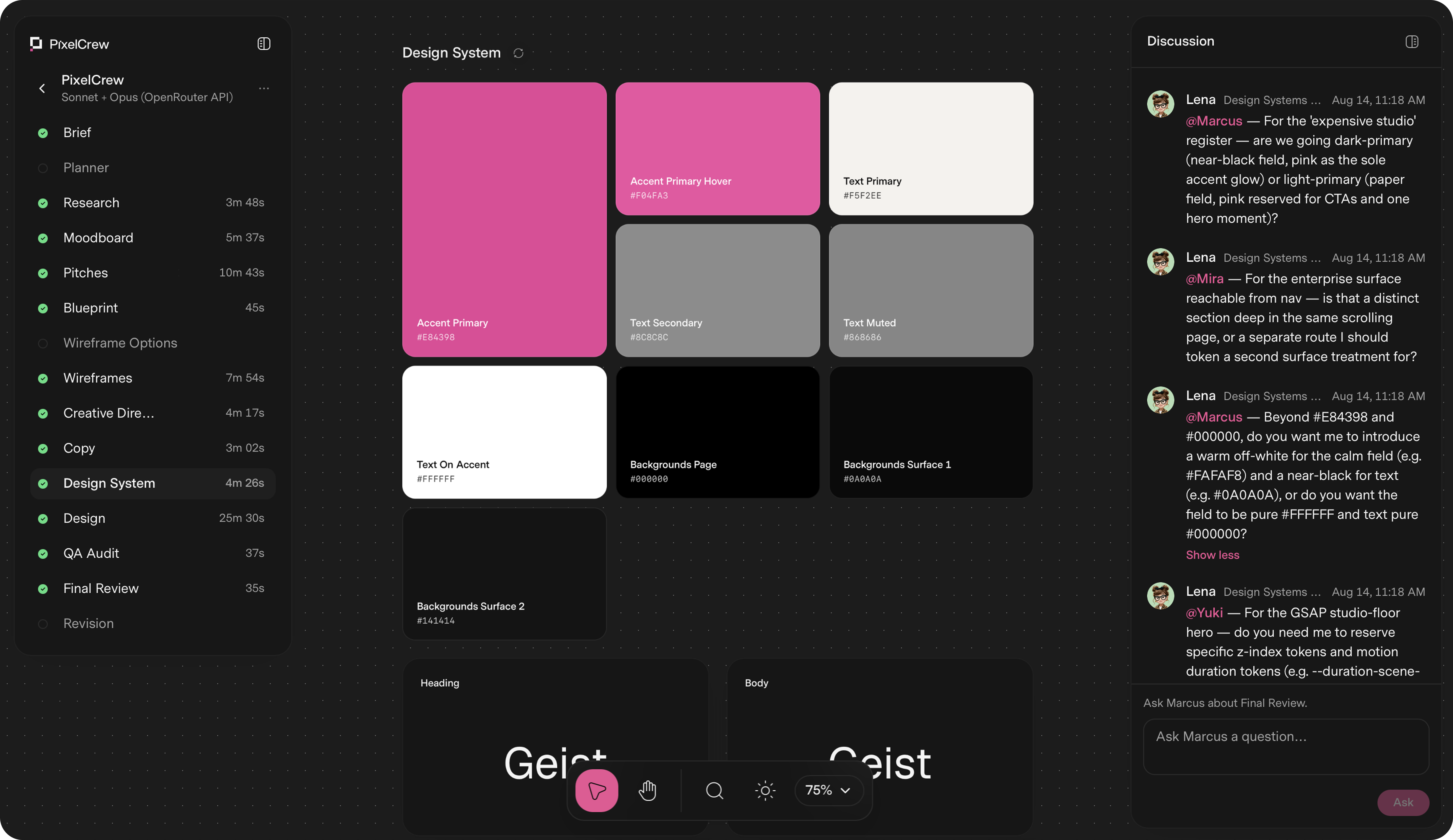
PixelCrew launches an alpha service that uses a sequence of specialized AI agents to generate production-ready HTML, Tailwind CSS, and design systems from briefs.
Deep dive
- The platform uses sequential agents: Elena (research/strategy), Marcus (art direction/creative brief), and Mira (UX/HTML wireframing).
- Output includes structured research markdown, design tokens, component libraries, and full-page HTML code.
- It currently operates in alpha, charging no platform fees, only usage costs directly to the chosen LLM provider.
- The workflow is designed to replace template-heavy design processes with context-aware, bespoke generation.
- It provides QA-audited output aimed at immediate developer implementation.
Decoder
- Design system: A collection of reusable components, tokens (colors, spacing, type scales), and standards that ensure consistency across a product's interface.
- Tailwind: A utility-first CSS framework that speeds up styling by using predefined classes directly in HTML.
Original article
Multiple agents. One brief. Production output.
Each agent has a named specialization, a defined scope, and a clear handoff. Together they work sequentially and with context, the way a real team does.
Brief → Research → Strategy
Elena reads your brief and executes structured discovery: audience personas, competitive analysis, jobs-to-be-done mapping, and an information architecture recommendation. She hands Marcus a validated research foundation, not assumptions.
- Audience and persona analysis
- Competitive audit and gap mapping
- Information architecture and flow definition
- Jobs-to-be-done mapping
Creative Direction
Marcus takes Elena's research and makes creative decisions: visual direction, brand language, layout approach. Outputs a creative brief that Mira builds from.
- 3 pitches
- Moodboard
- Creative brief
UX Architecture
Mira takes Marcus's creative brief and builds the blueprint: wireframes, user flows, information architecture, and a section-by-section spec. The build crew turns it into production HTML.
- Wireframes
- UX-flow
Brief in. Deliverable out.
The crew runs in sequence. You provide context. Agents coordinate. You receive production-quality output you can ship or hand to a developer.
Submit your brief
Describe what you need: a landing page, a product dashboard, a design system, a pitch deck. Free text. No templates to fill in. The agents read your intent.
Elena maps the research
The researcher runs competitive analysis, maps your audience and their jobs-to-be-done, and defines the information architecture. Output: a structured research document Marcus reads from.
Marcus sets creative direction
The director writes three distinct visual pitches, selects the strongest, and produces a full creative brief: palette, typography, layout direction, section-by-section composition guidance.
Mira builds the wireframe
The designer builds from Marcus's brief: UX flows, section architecture, user interactions, HTML wireframes. Every screen. Every edge case. All states resolved.
Copy and design system take shape
The crew writes the copy and assembles the design system: tokens, type scale, color, components. Design happens inside the system, not around it.
QA audit and final review
Every screen goes through a QA audit and a final review pass. Issues get flagged, revised, and rechecked before anything reaches you.
You receive production output
Production-ready HTML and Tailwind. A complete design system. Documentation. Everything your engineering team needs to ship, or hand to any developer.
Briefs in. Deliverables out.
Demonstration projects produced with PixelCrew from written briefs. Business names and brands shown are illustrative and are not clients or endorsements.
After Dark - Neighborhood Coffee Shop
Corner coffee shop, no marketing team, strong opinions about espresso. The brief asked for a site that feels like the room: dark, warm, unhurried. Menu, hours, and atmosphere shipped as production HTML.
Modena Coupé - Automotive Showcase
Luxury automotive landing page in an editorial register. Full-bleed photography, serif display type, performance stats, and a request-information flow. Restraint as the design argument.
MicroProject - Team Task Manager
Working task manager UI for small teams: list views, project sidebar, shared lists, overdue states. Light theme, a complete component set, production HTML the team built on directly.
Geisha Porto - Roastery & Listening Lounge
Coffee roastery and jazz listening lounge in Porto. Product catalog with harvest data, a vinyl audio archive, and a rooftop terrace section in a Swiss editorial layout.
No fees from us. Bring your own keys.
PixelCrew charges nothing while in alpha. Connect your own API key, the agents run on it, and you pay model costs directly to the provider. OpenRouter is the recommended path; Anthropic and Google Gemini keys work too. No subscription, no markup, no card on file.
How bring-your-own-key works
Create a key at openrouter.ai, paste it into PixelCrew once, and set your own spend limit. Prefer Anthropic or Google Gemini? Their keys work too. A typical brief costs a few dollars in model usage.
Every brief is a step toward an internet where nothing feels generic, because bespoke costs minutes instead of weeks.
Fresh dev news, AI-digested daily. Never miss a trend at devoured.fyi