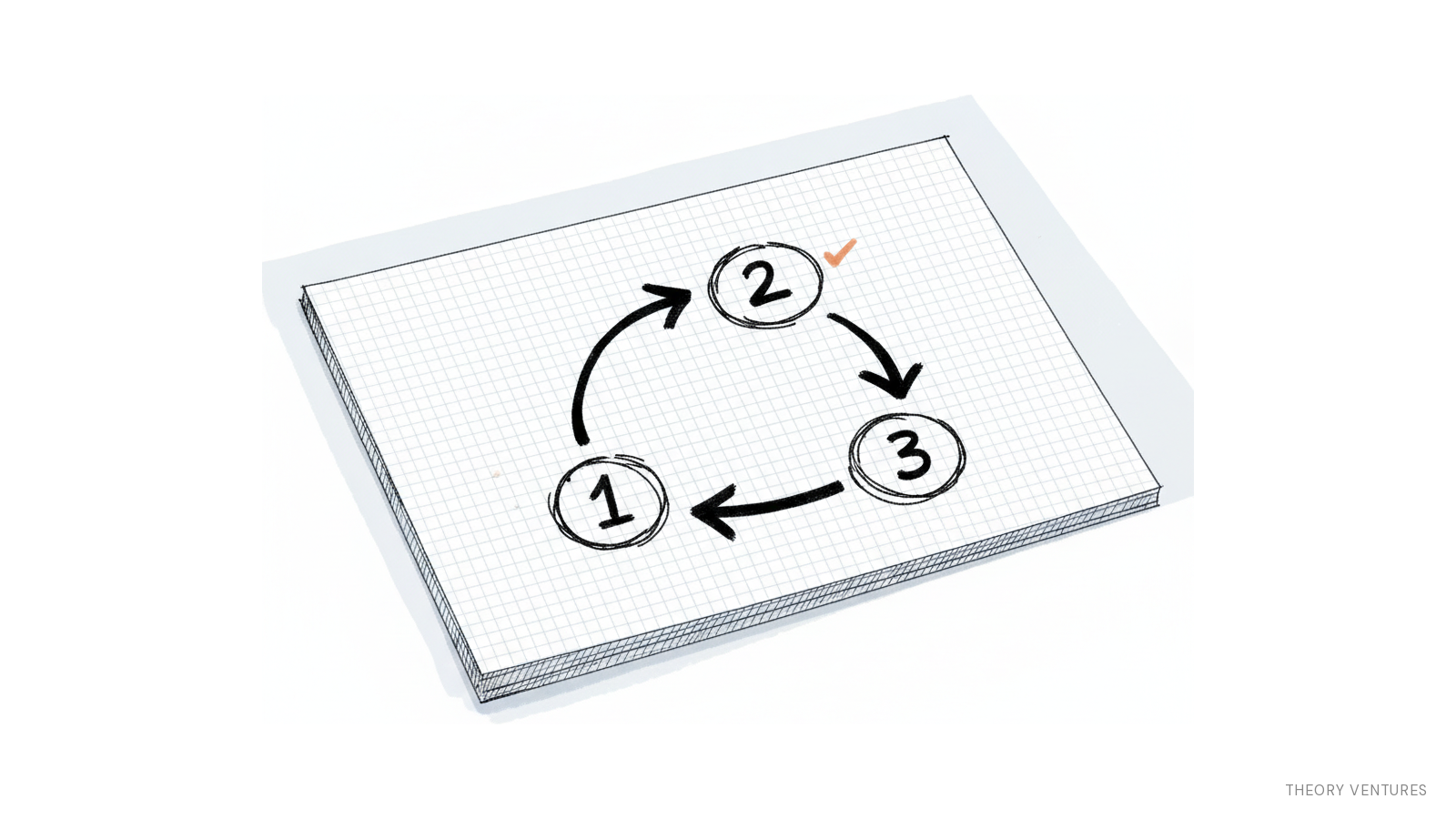
Thinking in Systems, Shipping in Loops
The future of software engineering is shifting from writing code by hand to designing autonomous loops that manage AI-generated output at scale.
Deep dive
- Shift in role: Engineers are evolving into architects who design the 'loops' that decide if AI-generated code is production-ready.
- Resilience: AI systems must check their own work through multi-gate reviewer agents and observability loops.
- Self-organization: Failure patterns should be treated as data to refine the agent's future behavior.
- Hierarchy: Complex tasks are decomposed into composable components (skills, tools, sandboxes) verified for reuse.
- Productivity: High-performance teams (e.g., Artemis) have scaled to 16 merged PRs per engineer per day by fully adopting AI-authored platforms.
Decoder
- Agentic system: A software system using AI agents that can plan, reason, and take action autonomously to reach a goal.
- Pull request (PR): A change set submitted by a developer to be reviewed and merged into a codebase.
- Observability: The ability to understand the internal state of a system based on its external outputs and logs.
Original article
In short : AI has removed the typing from software engineering & left the system design. DHH told Rails World that writing code by hand is no longer economically productive ; Artemis engineers merged 16 pull requests per day by August, & Lauren Tan ships 2,000 a month. The craft of fitting code together by hand is over ; what remains is designing the loop that decides whether the output is right. Donella Meadows's three properties of great system design, resilience, self-organization & hierarchy, describe how those loops are built. The architect's drafting table was always scarce because the foundation was scarce, not the talent.
“Writing code by hand is no longer an economically productive enterprise for the vast majority of programmers working at the vast majority of companies. That’s today. By the end of the year, it will be virtually all domains, virtually all programmers, virtually all companies.”
Software engineering have evolved to systems architecture. That was always the destination.
This is the new software engineering : designing the systems that let AI write code correctly at scale.
We see this in our portfolio companies. Artemis engineers merged 2 pull requests per day in January, 6 by May & 16 by August, 30,000 in eight months. Dan Shiebler, their CTO, describes the division of labor plainly : every line of the platform is written by agents, & the engineers design systems, set constraints & review outputs.
Great design scales. Lauren Tan, an engineer on SpaceXAI’s Grok team, ships 2,000 pull requests a month to production, nearly one hundred a working day. Asked what makes that possible, she does not name a model but verification, loops that enable AI to validate its work.
Dartmouth professor Donella Meadows argued that the most powerful places to intervene in a system are the least intuitive, & that people reliably find them & then turn them the wrong way.
Three properties define great system design : resilience, self-organization & hierarchy.
Resilience is AI checking its own work, robustly, through tests, a reviewer agent & production observability rather than one gate. Self-organization is the loop learning, so a class of failure becomes a new skill the agent applies next time. Hierarchy is the layering of skills, tools & sandboxes into composable components that are reused once verified to work.
This work isn’t easy. Systems architecture never has been. It was my goal in 2005 as a Java software engineer just as much as it is today as we build out our agentic systems.
“A new career as a professional maker of things. Yes, you will no longer be chiseling that code by hand, but you will be making amazing things. You will be steering intelligence.”
Fresh dev news, AI-digested daily. Never miss a trend at devoured.fyi