DEVOURED
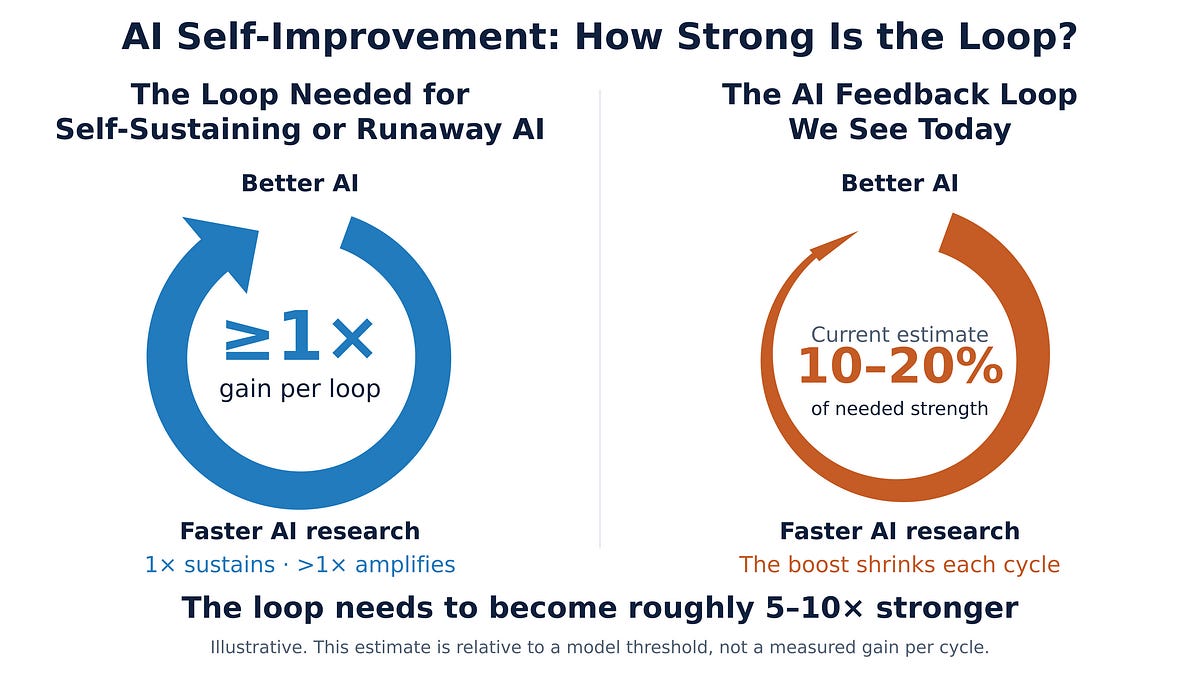
Can AI self-improvement overcome diminishing returns?
Data from OpenAI and Anthropic suggests that AI self-improvement is currently too weak to trigger a runaway intelligence explosion.
What: Ramez Naam analyzes internal research data showing that AI-driven productivity gains face significant diminishing returns, requiring 5-10x more efficiency to achieve self-sustaining growth.
Why it matters: The findings challenge the "fast takeoff" narrative, suggesting that increasing compute and token usage yields steadily smaller marginal improvements in model capability.
Deep dive
- Recursive Self-Improvement (RSI): The concept where AI improves its own code or architecture.
- Diminishing Returns: Each additional unit of compute or data produces less improvement than the previous unit.
- ECI Scores: A benchmark for measuring overall AI capability levels.
- Type 1-5 RSI: A taxonomy ranging from basic productivity gains to runaway superintelligence.
- Eroom's Law: The observation that R&D costs for new drugs/tech increase exponentially over time despite technological progress.
Decoder
- Fast Takeoff: A theoretical scenario where AI rapidly self-improves until it reaches superintelligence in a very short timeframe.
- Inference Compute: The processing power used to run a model after training.
Original article
Full article content is not available for inline reading.
Explore all 67 articles in today's digest
Fresh dev news, AI-digested daily. Never miss a trend at devoured.fyi