DEVOURED
Building an Ultra-High Throughput AI-SQL Engine
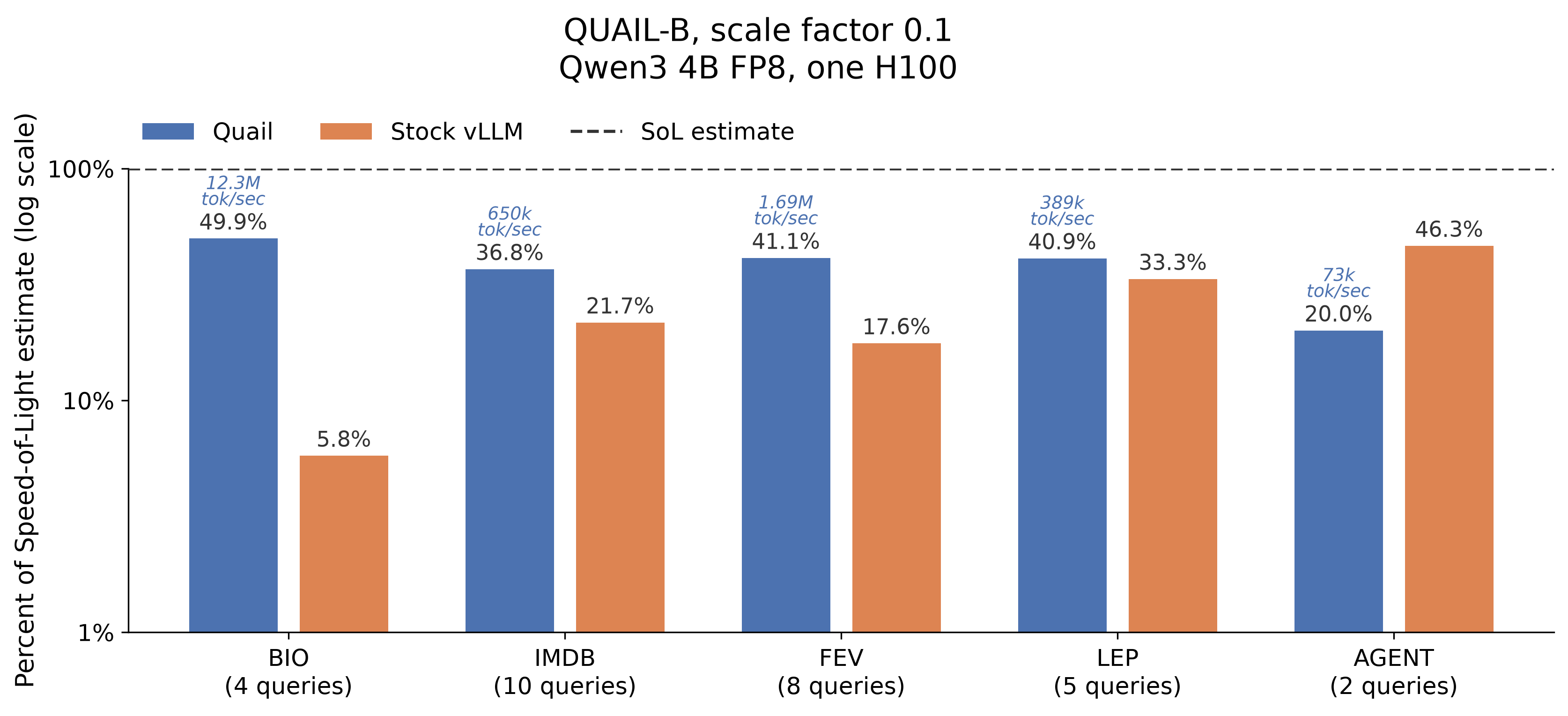
Quail is an open-source AI-SQL engine that achieves up to 14x faster inference by jointly optimizing query planning and LLM execution.
What: Shreya Shankar, Charles Frye, and colleagues introduced Quail, which reduces GPU scheduling overhead and KV-cache waste during large-scale AI-SQL tasks. It outperforms vLLM on benchmarks like BIO-4, primarily by grouping related model calls to maximize KV reuse and minimizing CPU-GPU communication gaps.
Why it matters: This signals a trend toward database-native inference engines that treat AI function calls as first-class query operators rather than isolated API requests, significantly lowering the cost of processing massive, unstructured datasets.
Takeaway: Try the live Quail demo or use their Python library for AI-SQL workloads by installing 'quail-engine==0.1.0' via pip.
Deep dive
- Uses a DAG-based physical plan to stream data between operators, avoiding full materialization.
- Implements KV-manager to 'rewind' and retain specific KV states across join operations.
- Fuses normalization, quantization, and RoPE into custom Triton kernels to reduce HBM traffic.
- Employs tree-based attention logic to share anchor KV across multiple partner requests.
- Restricts final output head computations to only TRUE/FALSE tokens, saving memory and compute.
- Currently lacks automatic cross-row prefix caching, leading to underperformance on some agent-related traces.
Decoder
- AI-SQL: Relational database systems extended with user-defined functions that perform LLM-powered classification, filtering, or transformation on unstructured data.
- KV Cache: Key-Value cache storing intermediate attention states of an LLM to prevent redundant computations during generation.
- KV Regret: Measure of redundant computation where the model re-processes tokens that were already computed or could have been reused.
- ROPE (Rotary Positional Embeddings): Method for encoding positional information in transformer models to allow better generalization to sequence lengths not seen during training.
Original article
Full article content is not available for inline reading.
Explore all 67 articles in today's digest
Fresh dev news, AI-digested daily. Never miss a trend at devoured.fyi