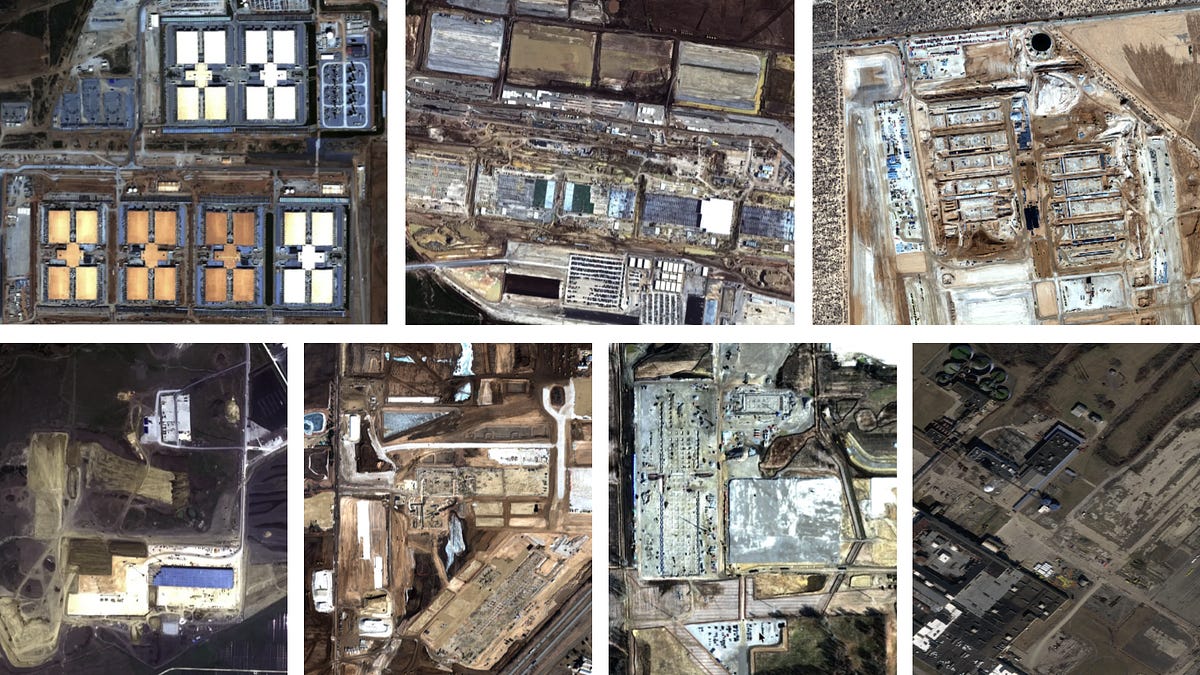
OpenAI Stargate: where the US sites stand (9 minute read)
The Stargate AI infrastructure project is building seven massive data center sites across the US with over 9 gigawatts of capacity, enough to match all AI compute that existed worldwide at the end of 2025.
Deep dive
- The seven Stargate sites represent a total planned capacity exceeding 9 gigawatts by 2029, with 0.3 GW already operational in Abilene, Texas as of April 2026
- Abilene currently has four of eight buildings operational housing Nvidia Blackwell chips, with planned expansion to 1.2 GW by Q4 2026 (down from originally planned 2.1 GW)
- The largest site is Doña Ana County, New Mexico at 2.2 GW projected capacity, followed by Shackelford County, Texas at 2 GW with a massive 1,200-acre campus
- At least three sites will use on-site natural gas plants to bypass lengthy grid connection queues, while at least six will use closed-loop liquid cooling to avoid water evaporation concerns
- SoftBank will own hardware at Milam County and Ohio sites, while Oracle owns hardware at remaining sites, with all sites serving OpenAI workloads
- The Shackelford County site already shows roofing underway for its first building with late 2026 delivery, spanning 10 buildings powered by an on-site natural gas microgrid
- Milam County is being built as a "fast-build" site by SoftBank subsidiary SB Energy with first building delivery targeted for October 2026
- Port Washington, Wisconsin aims for 70% renewable power from solar, wind, and battery storage, branded as "sustainable-by-design"
- The Lordstown, Ohio site is primarily a manufacturing facility for AI servers (SoftBank-Foxconn joint venture) with only minor data center capacity under 0.3 GW
- Plans remain fluid even after construction begins, evidenced by OpenAI redirecting Abilene's planned expansion to other locations and Microsoft partnering with Crusoe for an adjacent 900 MW site
- Political opposition poses risks, including a ban on future data centers in Lordstown and local resistance to the Michigan site
- The trade-offs are clear: on-site power generation and closed-loop cooling save time but significantly increase facility costs compared to traditional data center designs
Decoder
- Gigawatt (GW): Unit of power equal to one billion watts; 9 GW is roughly equivalent to New York City's peak electricity demand
- H100-equivalent: A standardization metric based on Nvidia's H100 GPU computing power, used to compare different chip generations using 8-bit operations per second
- IT power vs facility power: IT power is just the electricity for computing hardware, while facility power includes cooling, lighting, and infrastructure (typically 40-50% higher)
- Closed-loop liquid cooling: A cooling system that recirculates liquid without evaporating water, avoiding public water consumption concerns but less energy-efficient than evaporative cooling
- Microgrid: An on-site power generation system (often natural gas) that operates independently from the main electrical grid
- Nvidia Blackwell/Rubin: Next-generation AI chips succeeding the H100, with Blackwell already deployed in Abilene and Rubin expected later
Original article
OpenAI Stargate: where the US sites stand
The $500 billion AI data center initiative is projected to exceed 9 gigawatts of capacity by 2029, with 0.3 gigawatts already operational in Abilene and six more US sites under active construction.
Updated April 23, 2026
Introduction
The United States is in the middle of an unprecedented build-out of AI infrastructure. No project illustrates the scale of that effort more than Stargate, a $500 billion endeavor involving AI developer OpenAI, cloud provider Oracle, and investment company SoftBank.
Stargate has seven locations across the US, all of which are now showing active development. The most advanced—in Abilene, Texas—is already operating at an estimated capacity of 0.3 gigawatts (GW).1 The six other sites include two more in Texas, as well as facilities in New Mexico, Wisconsin, Michigan, and Ohio. Together, the seven sites add up to over 9 GW of planned capacity, which is comparable to the peak power demand of New York City.2 This will be enough to power the equivalent of 20 million Nvidia H100 GPUs, which was the total amount of AI compute in the world by the end of 2025.3
Stargate's design choices reveal how builders are navigating the key challenges of gigawatt-scale AI data centers in the US. To sidestep lengthy queues for connecting to energy grids, at least three of the seven sites will make use of on-site natural gas plants. To address public concerns about water usage, at least six sites will use closed-loop liquid cooling systems, which do not evaporate water.4 These decisions will likely save the project time but raise the cost of the facilities.
Based on announcements from 2025, SoftBank will own the hardware at the Milam County and Ohio sites, while Oracle will own the hardware at the remaining sites. All sites will serve OpenAI's workloads.
The sites
Abilene, Texas
Current capacity: 0.3 GW | 250,000 H100-equivalents5
Projected capacity: 1.2 GW | 1.0 million H100-equivalents
Projected completion: Q4 2026
The Stargate project's flagship location is in Abilene, Texas. Built by AI infrastructure company Crusoe, Abilene is the most complete Stargate site to date, with an estimated four of the eight buildings already operational. These buildings house state-of-the-art Nvidia Blackwell chips.
Power is currently supplied by a mix of on-site natural gas and grid power, which includes local wind power.
OpenAI had planned to expand this site to 2.1 GW, but recently reversed course, deciding to direct that capacity to other locations. Microsoft has since partnered with Crusoe for the adjacent 900 MW site.
Shackelford County, Texas
Current capacity: 0 GW
Projected capacity: 2 GW | 4.2 million H100-equivalents
Projected completion: Q4 2028
Just across the county line from the Abilene site, data center developer Vantage is constructing a massive 1,200-acre (4.9-square-kilometer) campus with 10 buildings.
The campus will be powered by an onsite natural gas microgrid.
Vantage has given a delivery date for the site's first building of late 2026.6 Satellite imagery shows that roofing is underway for this building (visible in bright white).
Doña Ana County, New Mexico
Current capacity: 0 GW
Projected capacity: 2.2 GW | 4.6 million H100-equivalents
Projected completion: Q4 2028
In New Mexico, STACK Infrastructure is developing Project Jupiter, which consists of four large buildings. Satellite imagery shows that foundation work is underway.
This site will be powered by two natural gas microgrids designed to limit impact on the local grid.
Milam County, Texas
Current capacity: 0 GW
Projected capacity: 1.2 GW | 2.5 million H100-equivalents
Projected completion: Q4 2028
SoftBank subsidiary SB Energy is building and operating what is described as a "fast-build" site in Milam County, Texas, around 70 miles (110 kilometers) northeast of Austin. A satellite image from March shows steel framing and roofing for the first building (visible as a blue rectangle). Regulatory filings indicate this building will be delivered by October.
SB plans to fund and build new energy generation and storage to supply the majority of the campus's power.
Port Washington, Wisconsin
Current capacity: 0 GW
Projected capacity: 1.3 GW | 2.6 million H100-equivalents
Projected completion: Q4 2028
Vantage, which is also the developer behind the Shackelford County site, has broken ground on a campus named "Lighthouse" in Port Washington, just north of Milwaukee. Foundation work can be seen in satellite imagery.
The site is described as "sustainable-by-design," with 70% of power drawn from solar, wind, and battery storage.
Saline Township, Michigan
Current capacity: 0 GW
Projected capacity: 1.4 GW | 2.9 million H100-equivalents
Projected completion: Q4 2028
Related Digital is developing a campus dubbed "The Barn" in Saline Township, southwest of Detroit. Satellite imagery shows foundation work underway for the first building.
DTE Energy will provide 100% of the power, augmented by a battery storage system financed by the project.
Lordstown, Ohio
Current capacity: 0 GW
Projected capacity: <0.3 GW | <0.3 million H100-equivalents
Projected completion: Unknown
The seventh site is in Ohio, where some land has been cleared, but no large-scale data center construction is visible. The site is primarily a manufacturing facility for AI servers and data center equipment, operated as a joint venture between SoftBank and Foxconn. The capacity of the data center will likely be no more than 0.3 GW, with OpenAI announcing that the Milam County and Lordstown sites could scale to a combined 1.5 GW by 2027.
The Lordstown data center will likely draw power from the grid, as the Foxconn plant already has a substation connected.
The road ahead
At this point, the full $500 billion Stargate project is more than pure ambition. The build-out has started all over the US, leaving enough time to finish by 2029. However, there is a long road ahead for all seven sites. Plans can change even after construction begins, as shown by OpenAI pulling out of the Abilene expansion. Financing and procuring equipment will also be challenging at this unprecedented scale. Finally, political opposition is a real factor, as evidenced by a ban on future data centers in Lordstown and local opposition to the Michigan site. Epoch AI will be following the Stargate project and the broader data center build-out closely to see how this all pans out.
1 All stated power capacities refer to total facility power, including power for GPUs, cooling, lighting, etc. Power capacities for the Stargate sites have not been reported consistently as total facility power or IT power. For some sites, we estimated the total facility power based on the reported IT power. For example, Vantage reports Shackelford County as 1.4 GW of IT power. Given the hot summer climate of Texas and closed-loop cooling (which is less energy-efficient than evaporative cooling), we estimated the total facility power to be about 2 GW.
2 The NYISO 2025 Gold Book (p.30) forecasts about 11 GW of peak summer demand for New York City (Zone J) from 2026 through 2030. This represents the single highest hour of demand annually.
3 The H100 is just an example: the actual chips in these data centers will probably be Nvidia Blackwell, and later Nvidia Rubin. The total amount of compute in the world is based on the AI Chip Sales database, which estimates about 20 million H100-equivalents worth of AI chips sold by Q4 2025. The projected compute for the Stargate sites is estimated from the power capacities and the trend in energy efficiency for leading machine learning hardware—except for Abilene, which was disclosed by Crusoe to have 50,000 Blackwell GPUs per building.
4 Sources: Abilene, Shackelford County, Doña Ana County, Port Washington, Saline Township, and Lordstown. We did not find direct confirmation of a closed-loop system for Milam County, but it is designed to minimize water usage.
5 One H100-equivalent is the computing power equivalent to one Nvidia H100 GPU, measured in operations/second. The H100-equivalent unit uses a chip's highest 8-bit operations/second specification to convert between chips.
6 This is when the completed building is handed over to the tenant, not when the data center is fully operational.
Updates
Apr. 23, 2026:
We previously estimated that 0.6 GW was operational for Stargate Abilene. However, a subsequent post by Oracle implied that only 200 megawatts (or about 0.3 GW of total facility power by our estimate) was operational as of April 22nd. We updated the Stargate Abilene timeline accordingly. We now estimate that the 0.6 GW will be achieved in late May, while the full 1.2 GW will be achieved in Q4 2026.