The case for a variable PTC deadline with affine metering (5 minute read)
A new Ethereum proposal could roughly double network throughput by using variable payload deadlines that shift based on calldata usage, avoiding the limitations of the current EIP-7976 approach.
What: The proposal introduces "affine metering" for Ethereum, where the PTC (Payload Timeliness Committee) deadline varies linearly with calldata usage and all calldata is priced uniformly at a single rate (e.g., 32 gas/byte), rather than having multiple price tiers. This allows unused propagation time to be converted into additional execution time.
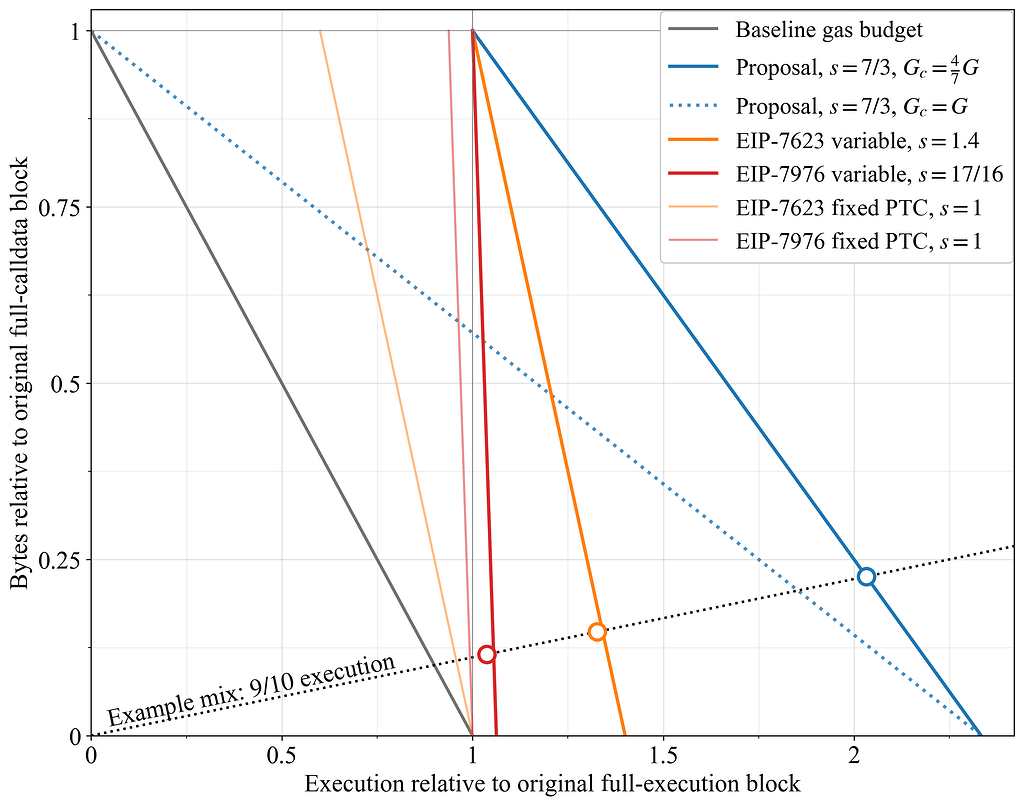
Why it matters: Under the current EIP-7976 approach with dual calldata pricing, variable deadlines only enable a 1/16 (6.25%) gas limit increase because cheap calldata can crowd out execution. The proposed unified pricing model could increase the gas limit by a factor of 7/3 (over 2x) for typical block compositions, significantly improving Ethereum's throughput without compromising network propagation constraints.
Takeaway: Ethereum researchers and client developers should evaluate whether unified calldata pricing with affine metering is preferable to EIP-7976 for the upcoming Glamsterdam or subsequent network upgrades.
Deep dive
- The proposal combines three elements: variable PTC deadlines, affine metering (where calldata linearly shifts the deadline), and unified calldata pricing
- Under ePBS (enshrined Proposer-Builder Separation), the PTC deadline serves two roles: a propagation timeliness threshold and a determinant of remaining execution time
- EIP-7976's dual pricing (cheap calldata bundled with execution vs. floor-priced calldata) limits variable deadline benefits to just 1/16 gas limit increase
- With dual pricing, transactions can buy 16 gas worth of floor-priced calldata for only 1 gas in the worst case, creating a scaling bottleneck
- Unified pricing (e.g., 32 gas/byte) makes calldata consumption directly proportional to its propagation burden, allowing full utilization of the variable deadline range
- Mathematical model shows execution window expands as W_e(p) = (T_3-T_2) + (1-p)(T_2-T_1-c), where p is the proportion of calldata budget used
- Under illustrative timing (3s attestation deadline, 9s latest PTC, 12s slot end, 2s overhead), the gas limit could increase by 7/3x for execution-heavy blocks
- With G=300M gas limit and unified pricing, maximum calldata would be 5.36 MB at 32 gas/byte or 3.57 MB at 48 gas/byte
- The proposal prevents gameability where transactions with heavy execution might auction off their cheap calldata allowance due to price differentials
- Affine metering is compatible with multidimensional fee markets like EIP-7999, where calldata could become a separate resource with its own base fee
- For typical block compositions (9:1 execution-to-byte ratio), the proposed design achieves roughly twice the throughput of EIP-7976
- The main tradeoff is that all calldata pricing must change, not just the floor cost, but this may be acceptable if broader repricing is already planned
Decoder
- PTC (Payload Timeliness Committee): In ePBS, the committee that validates whether block payloads arrive on time for consensus
- ePBS (enshrined Proposer-Builder Separation): Ethereum protocol change separating block proposal from block building at the consensus layer
- Affine metering: Resource accounting where calldata usage linearly shifts the PTC deadline, creating an affine (linear with offset) constraint between calldata and execution
- Calldata: Data included in Ethereum transactions, typically used by smart contracts; cheaper than storage but still consumes block space
- EIP-7976: A proposal with dual calldata pricing where some calldata can be carried cheaply with execution while the rest is floor-priced
- Gas limit: Maximum computational work (measured in gas) that can be included in an Ethereum block
- Propagation window: Time available for a block to spread across the network before validation deadlines
- Execution window: Time available for nodes to execute (run) the transactions in a block after it arrives
Original article
This proposal introduces variable PTC deadlines paired with affine metering and unified calldata pricing to optimize Ethereum network efficiency. By coupling variable deadlines with execution caps, the approach ensures propagation windows remain functional, effectively balancing calldata usage and execution time to improve overall protocol performance and scalability.