What Physical ‘Life Force' Turns Biology's Wheels? (14 minute read)
Scientists have finally cracked how the bacterial flagellar motor works after 50 years, revealing a molecular machine that uses flowing protons to spin hundreds of times per second and propel bacteria toward food.
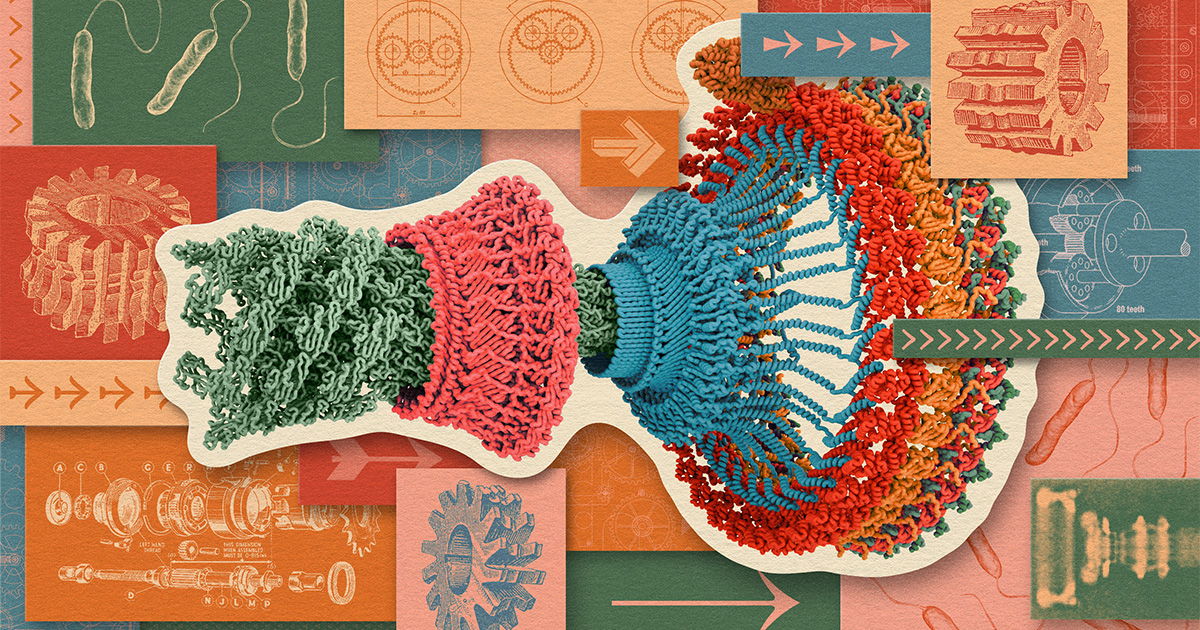
What: The bacterial flagellar motor is a self-assembling molecular machine that enables single-celled bacteria to swim toward nutrients by rotating a tail-like flagellum at several hundred revolutions per second. Recent cryo-electron microscopy breakthroughs (2020-2026) revealed exactly how small protein cogwheels turn the larger base ring, and how the motor reverses direction when bacteria need to change course.
Why it matters: The motor's workings illuminate the fundamental physical force that powers all cellular life: the proton motive force, where thousands of protons per second flow into cells while being continuously pumped back out, creating a current that biological machines harness to do work.
Deep dive
- Howard Berg discovered the flagellar motor in the 1970s by inventing an automatic tracking microscope to follow fast-moving bacteria, hypothesizing rotation 50 years before the complete mechanism was understood
- Bacteria "run and tumble" by switching between forward swimming (counterclockwise rotation) and chaotic rolling (clockwise rotation) to navigate toward higher concentrations of nutrients
- The motor consists of a C-ring of 34 proteins at the flagellum's base, surrounded by 10-12 smaller "stator" complexes that act like turnstiles
- Each stator has a pentagonal ring of 5 proteins surrounding 2 central proteins, a 5:2 geometry revealed by cryo-EM studies in 2020
- Over 2,000 protons per second flow through these pentagonal turnstiles, each pushing the ring one-tenth of a revolution and collectively spinning the larger C-ring
- Direction switching occurs when phosphorylated CheY proteins bind to the C-ring in response to declining nutrient levels, causing the entire ring to snap into an alternate configuration like a hair clip
- In the flipped state, the clockwise-rotating stators engage the inner edge of the C-ring instead of the outer edge, making the C-ring also turn clockwise and causing the bacterial bundle to fall apart
- The final pieces of the puzzle were published as recently as March 2026, when researchers confirmed the system responds to a single signaling molecule
- The proton motive force was proposed by Peter Mitchell in 1961, initially ridiculed but ultimately earning a 1978 Nobel Prize in Chemistry
- Bacteria maintain fewer than 100 free protons inside while the surrounding water has tens of thousands, creating a concentration gradient that drives protons inward while electron transport chains pump them back out
- The system operates at incredible equilibrium speeds, with thousands of protons flowing in and being pumped out every second while maintaining the low internal concentration
- If the proton flow is interrupted (such as when cells starve), the voltage drops instantly and all cellular machinery shuts down
Decoder
- Flagellar motor: A rotating molecular machine at the base of bacterial flagella (tail-like appendages) that spins to propel bacteria through water
- Cryo-EM: Cryogenic electron microscopy, an imaging technique that flash-freezes samples to reveal molecular structures at near-atomic resolution
- C-ring: The cytoplasmic ring of 34 proteins at the motor's base that rotates to turn the flagellum
- Stators: Small protein complexes that anchor above the C-ring and act as motors, with pentagonal rings that rotate when protons flow through them
- Proton motive force: The driving force created by protons constantly flowing into cells (due to concentration gradients) while being actively pumped back out
- Phosphorylation: The process of attaching phosphorus atoms to proteins, which changes their behavior and triggers cellular responses
- CheY proteins: Signaling molecules that, when phosphorylated, bind to the C-ring and trigger the motor to switch rotation direction
- Electron transport chains: Molecular machines in cell membranes that pump protons out of the cell, maintaining the proton gradient
Original article
This article tells the story of how scientists figured out how the flagellar motor worked. The flagellar motor was discovered by Howard Berg, who set out in the early 1970s to apply his training in physics to understand how bacteria move. Bacteria move quickly, so Berg had to invent and build an automatic tracking microscope to keep them in view. He hypothesized how the mechanism worked 50 years before scientists discovered how the motor works.