DEVOURED
Stablecoins are going local
Stablecoins are shifting from crypto trading tools to everyday payment infrastructure, with local transactions now dominating over cross-border use.
What: Data analysis from a16z crypto showing stablecoins evolving beyond trading instruments, with Q1 2026 volume hitting $4.5 trillion, consumer-to-business transactions growing 128% year-over-year, and velocity doubling to 6x since early 2024.
Why it matters: The surprise finding is that stablecoins are becoming local payment rails rather than primarily cross-border tools as widely assumed, with intra-country payments growing from 50% to 75% of volume, challenging the dominant narrative and suggesting they're maturing into general-purpose financial infrastructure that happens to run on global blockchain networks.
Takeaway: Developers building payment infrastructure should monitor stablecoin payment APIs and local currency stablecoin variants, particularly in emerging markets where adoption is accelerating.
Deep dive
- US regulatory clarity through the GENIUS Act and Europe's MiCA framework accelerated institutional participation, with Q1 2026 adjusted volume reaching approximately $4.5 trillion after several quarters of pre-existing growth
- MiCA compliance caused major exchanges to delist USDT, creating a spike in non-USD stablecoin activity exceeding $40B that has since stabilized at $15-25B per month, establishing a persistent market where one barely existed before
- Consumer-to-business stablecoin transactions more than doubled year-over-year from 124.9M in 2024 to 284.6M in 2025, the fastest growing category despite consumer-to-consumer dominating by raw count with 789.5M transactions
- Stablecoin card infrastructure collateral deposits across Rain-powered programs grew from near zero in November 2024 to over $300M per month by early 2026, providing tangible evidence of commerce adoption
- Stablecoin velocity doubled from 2.6x to 6x since early 2024, indicating demand for transactions is outpacing new issuance and existing supply is being actively used rather than just held
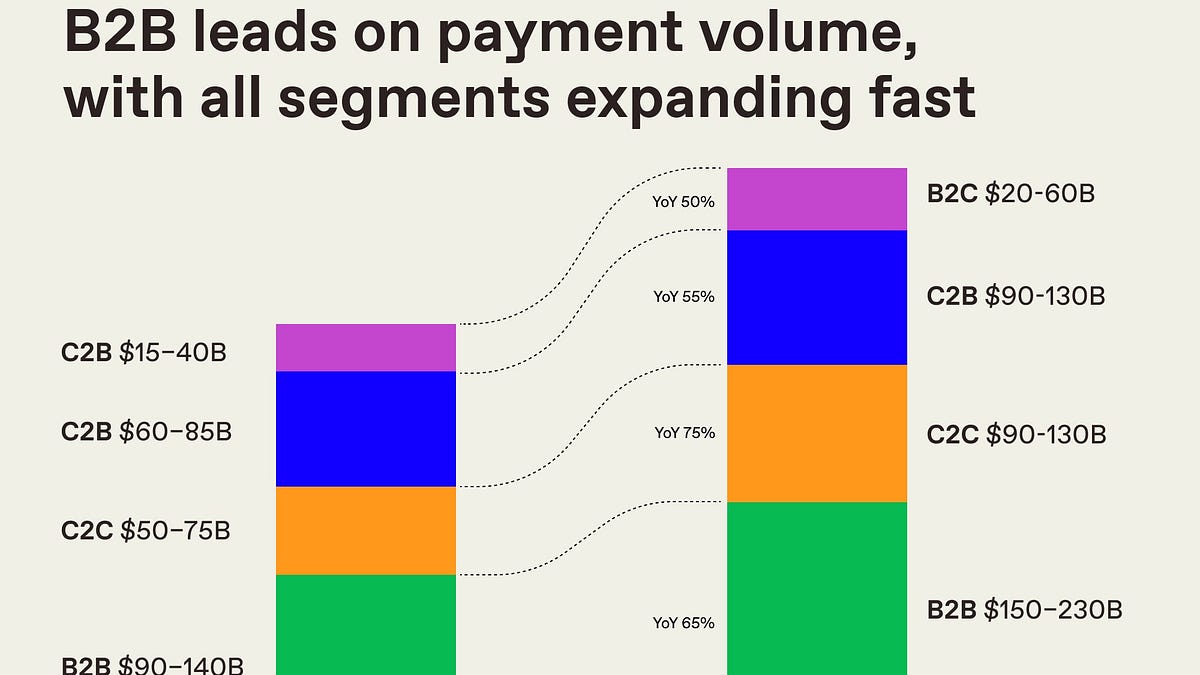
- After stripping out trading, treasury flows, and exchange mechanics, an estimated $350-550B in actual payments between different parties occurred in 2025, with business-to-business dominating by volume
- Geographic distribution is heavily concentrated with Asia accounting for nearly two-thirds of volume (primarily Singapore, Hong Kong, and Japan), North America roughly one quarter, Europe about 13%, and Latin America plus Africa under $1B combined
- Intra-country stablecoin transactions grew from roughly 50% of payment volume in early 2024 to nearly 75% by early 2026, contradicting the common narrative that stablecoins are primarily a cross-border tool
- Non-USD stablecoins are gaining meaningful traction, with Brazilian-real-backed BRLA growing from near zero in early 2023 to roughly $400M per month by early 2026, aided by integration with Brazil's instant payments network PIX
- The data collectively suggests stablecoins are developing into general-purpose payment infrastructure that is global by design but increasingly local in practice, finding footing as a domestic payments medium running on global blockchain rails
Decoder
- GENIUS Act: First federal framework for stablecoin issuance in the United States, establishing regulatory clarity
- MiCA (Markets in Crypto-Assets): European Union's comprehensive regulatory framework for crypto assets including stablecoins, which took full effect at the end of 2024
- Velocity: Ratio of transaction volume to circulating supply, measuring how frequently each dollar of stablecoin changes hands; higher velocity indicates more active usage
- C2B/C2C/B2B: Consumer-to-business, consumer-to-consumer, and business-to-business transaction categories
- PIX: Brazil's instant payments network operated by the central bank
- USDT: Tether, the largest USD-backed stablecoin by market capitalization
- BRLA: Brazilian-real-backed stablecoin gaining adoption in Brazil
Original article
Stablecoins are shifting from trading tools to core financial infrastructure. Q1 2026 volume reached $4.5 trillion, with consumer-to-business transactions growing 128% year-over-year. Velocity doubled to 6x, while intra-country payments now account for 75% of volume, signaling a transition toward local, general-purpose payment rails on global blockchain networks.
Explore all 66 articles in today's digest
Fresh dev news, AI-digested daily. Never miss a trend at devoured.fyi