DEVOURED
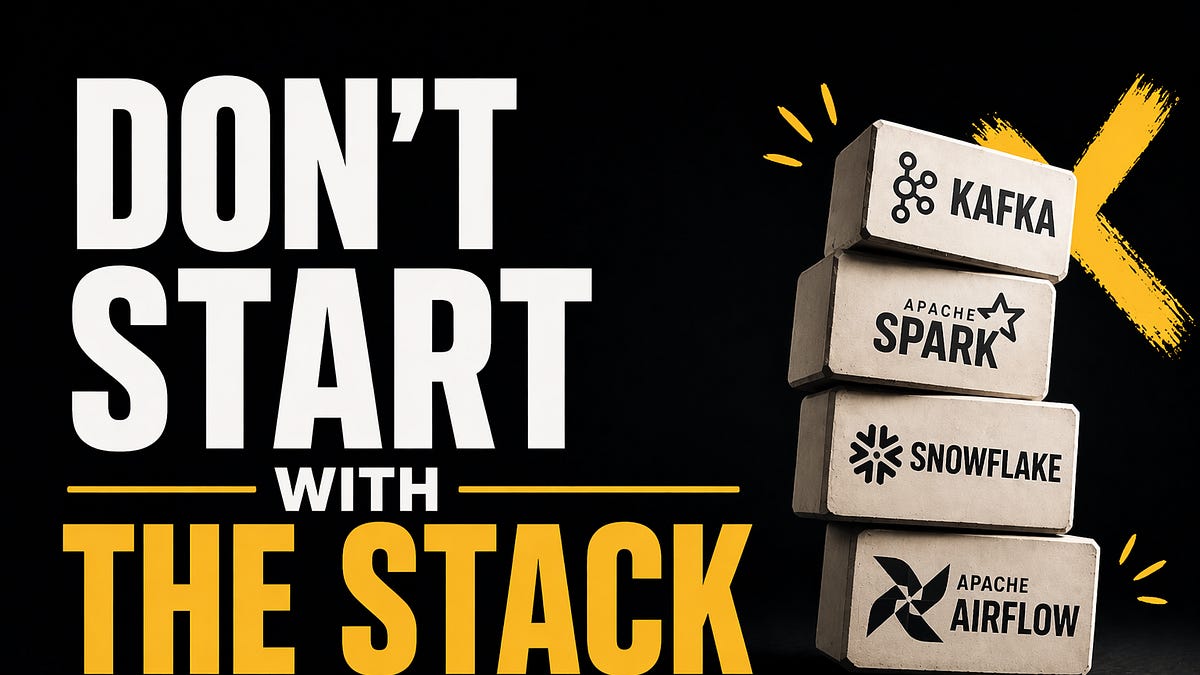
Stop Letting Tools Lead Your Platform Decisions
Data engineers often choose their tech stack before understanding requirements, leading to overengineered systems that could be much simpler.
What: An opinion piece by Andreas Kretz arguing that data platform decisions should begin with use cases, constraints, and operating requirements rather than defaulting to popular tools like Kafka, Spark, Snowflake, or Airflow.
Why it matters: Teams gravitate toward trendy or "enterprise" tools before analyzing actual needs, resulting in unnecessary complexity that wastes budget and makes systems harder to maintain when simpler solutions would work better.
Takeaway: Before choosing your data stack, answer these questions first: What are the actual use cases? What latency do you need? What's your budget? Who will consume this data? Then pick the simplest solution that fits those constraints.
Deep dive
- The common anti-pattern: teams start projects by declaring "we'll use Kafka, Spark, Snowflake, and Airflow" before defining what they're actually building or why
- This stack-first approach is fine for learning projects but becomes problematic when building production systems people depend on
- The correct sequence: define use cases → identify constraints → understand user patterns → design architecture → select tools
- Critical questions that should come first: Do you need streaming or is batch sufficient? What latency is acceptable? What storage fits your access patterns? Do you need strong consistency everywhere?
- Real coaching example: team initially planned real-time Spark processing, but analysis revealed weekly API ingestion and historical queries, leading to simplified batch processing with small streaming component only where actually needed
- Tools should follow strategy, not define it—don't pick Kafka because it's "standard," Snowflake because it's hyped, or Spark because it sounds enterprise
- Selection should account for your specific team capabilities, budget constraints, timelines, and actual system complexity requirements
- The better solution is very often the simpler one, but simplicity requires slowing down at the start to ask the right questions
- Key framework: What really needs to happen? Where does speed actually matter? What can stay simple without breaking requirements?
- No reward exists for having the most complex stack, and initial time investment in understanding requirements pays off by making subsequent decisions obvious
Original article
Data platform decisions should start with use cases, constraints, and operating requirements, not with Kafka, Spark, Snowflake, or Airflow. The key questions are latency, data freshness, cost, failure handling, and who will consume the system. Choose the simplest stack that fits the problem, team, budget, and timelines.
Explore all 66 articles in today's digest
Fresh dev news, AI-digested daily. Never miss a trend at devoured.fyi