DEVOURED
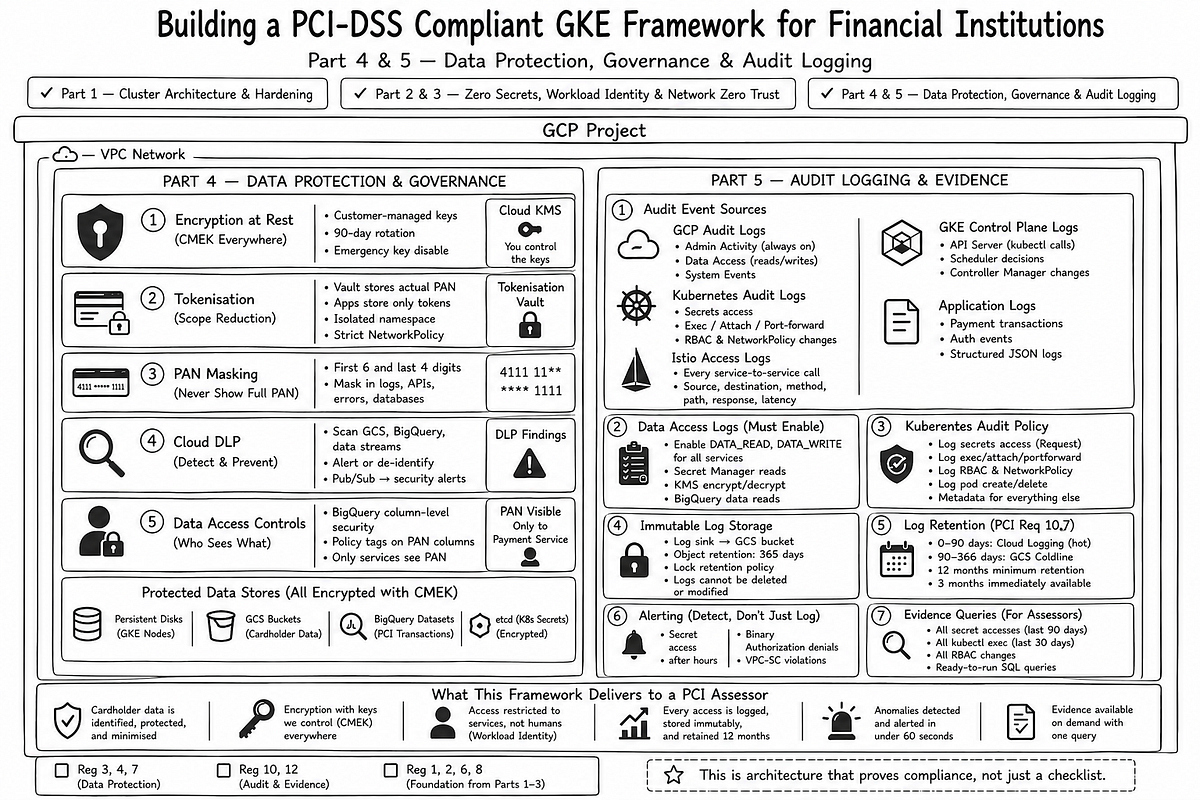
Building a PCI-DSS Compliant GKE Framework for Financial Institutions: Data Protection, Governance…
This guide shows how to build a PCI-DSS compliant payment processing system on Google Kubernetes Engine using customer-controlled encryption keys and tokenization to secure cardholder data.
What: A technical implementation guide for achieving PCI-DSS compliance on Google Kubernetes Engine, focusing on customer-managed encryption keys (CMEK) that give full control over data encryption, tokenization to reduce PCI scope, and audit logging across GKE, GCS, and BigQuery. Part 4 of a series covering data protection and governance.
Why it matters: PCI-DSS compliance is mandatory for payment processing but most teams struggle with scope - by default, every system touching cardholder data must be compliant. This framework shows how to use CMEK for instant breach response (disable keys to make exfiltrated data unreadable) and tokenization to keep actual card numbers out of application databases entirely, dramatically reducing which systems need full PCI compliance.
Takeaway: If you're building payment systems on GKE, start by implementing CMEK on your cluster and storage layers, then isolate actual PAN storage in a tokenization vault service to minimize your PCI-scoped infrastructure.
Deep dive
- PCI-DSS compliance hinges on two questions: where is cardholder data, and how do you prove nothing happened to it - data protection and audit logging must work together
- Google encrypts everything at rest by default, but PCI Requirement 3 requires you control your own encryption keys - Google-managed keys don't let you instantly revoke access during a breach
- CMEK provides an emergency stop: if you suspect a breach, disable the key version and all encrypted data becomes unreadable even if already exfiltrated
- The encryption flow works by intercepting writes and calling Cloud KMS to encrypt data with your key before storing it on disk, GCS, or BigQuery
- Keys should rotate every 90 days per PCI requirements - rotation creates new key versions but doesn't re-encrypt existing data, old versions remain for decryption
- Enable CMEK on GKE node boot disks and database-encryption-key for etcd - without this, Kubernetes Secrets are only base64 encoded, not encrypted
- Critical distinction: CVV must NEVER be stored, not encrypted, not hashed - a database column for CVV is an immediate PCI finding regardless of other protections
- Tokenization dramatically reduces PCI scope by replacing PANs with random tokens - only the tokenization vault stores actual PANs, everything else sees tokens
- Without tokenization every microservice touching orders is PCI-scoped; with it only the vault service requires full compliance
- Implement the tokenization vault as an isolated namespace with NetworkPolicy allowing only payment-service ingress - not monitoring, not logging agents, not developers
- Verify CMEK is working by checking that all objects in GCS buckets show your key, not Google-managed keys
- The framework addresses assessor questions like "show me every time someone accessed cardholder data in the last 90 days" through automated logging across all GCP services
Decoder
- PCI-DSS: Payment Card Industry Data Security Standard - required compliance framework for any system processing credit card data
- CMEK: Customer-Managed Encryption Keys - encryption keys you control versus Google-managed keys
- PAN: Primary Account Number - the 16-digit credit card number, always requires protection
- CHD: Cardholder Data - PAN plus associated data like cardholder name and expiration when stored together
- SAD: Sensitive Authentication Data - magnetic stripe, CVV, PIN that must NEVER be stored after authorization
- GKE: Google Kubernetes Engine - Google's managed Kubernetes service
- DLP: Data Loss Prevention - scanning to detect sensitive data before it's stored improperly
- QSA: Qualified Security Assessor - auditor who certifies PCI-DSS compliance
- Cloud KMS: Google Cloud Key Management Service - manages encryption keys
- etcd: Kubernetes' backing store for cluster data including Secrets
Original article
This post details how to implement PCI-DSS-compliant data protection and audit logging on Google Kubernetes Engine (GKE). It covers customer-managed encryption keys (CMEK), tokenization, DLP scanning, and 12-month immutable audit trails. The implementation framework addresses specific PCI requirements by securing cardholder data with controlled encryption keys that can be instantly revoked during breaches, while maintaining automated logging across GKE clusters, GCS buckets, and BigQuery to answer assessor questions like "show me every time someone accessed cardholder data in the last 90 days."
Explore all 66 articles in today's digest
Fresh dev news, AI-digested daily. Never miss a trend at devoured.fyi