Point Lookups on the Lakehouse: How Hudi Indexes Accelerate Read-Heavy Workloads
Apache Hudi now supports queryable indexes that allow lakehouse tables to perform database-style point lookups rather than scanning entire datasets.
Deep dive
- Lakehouses typically struggle with high-cardinality point lookups because partition pruning fails on non-partition keys.
- Hudi maintains index mappings (record-to-file location) within a transactionally consistent metadata table.
- Secondary indexes allow queries on non-key columns to skip irrelevant files.
- Expression indexes enable pruning for transformed columns like epoch timestamps.
- Index maintenance occurs transactionally alongside writes, allowing background async indexing without stopping ingestion.
- Spark SQL currently supports full index acceleration, while Trino support is ongoing.
Decoder
- High-cardinality: A column containing many unique values, making it ineffective for standard partition-based pruning.
Original article
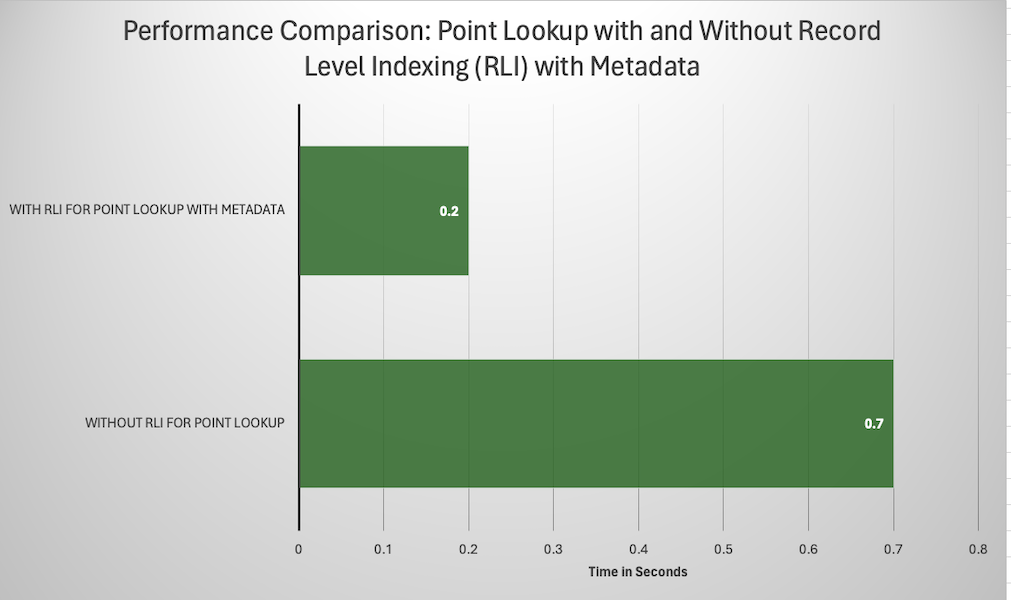
Analytical scans are not the only workload a lakehouse table serves. In many production query mixes, a large share of queries are needle-in-haystack reads: fetch one order by order_id, pull a user's profile by user_id, trace a request by uuid, list all events for one customer_id. These queries touch a few rows out of billions — and they are exactly where the lake's two standard pruning tools, partition pruning and min/max file statistics, stop helping. Apache Hudi answers this with queryable indexes maintained inside its metadata table: a record-level index that maps each record key to its file group, secondary indexes that map non-key column values to record keys, expression indexes over transformed columns, and centrally stored bloom filters. At query planning time, these indexes prune the scan down to the few files that actually contain matching rows. The effect is not subtle: on a 400 GB table with 20,000 file groups, a record-key lookup dropped from 977 seconds to 12 seconds once the record index was in play.
This post is the read-side companion to our write-heavy comparison. Same approach: mechanisms first, and only benchmark numbers that have already been published, with dates and sources.
Why Selective Queries Are Hard on a Data Lake
Lakehouse tables are laid out for scans: large immutable columnar files, grouped into partitions, described by file-level statistics. Every standard read optimization prunes at one of those granularities, and each one has a blind spot for selective predicates on high-cardinality columns:
- Partition pruning only helps if the filter column is the partition column. Nobody partitions by
user_idoruuid— the cardinality is far too high — so a point lookup on such a column matches every partition. - Min/max file statistics help when values correlate with file layout. A filter on an ingestion timestamp prunes beautifully, because each file covers a narrow time range. But a random key like a UUID is uniformly spread: every file's min/max range spans nearly the whole keyspace, so every file "might" contain the value and nothing is pruned. Sorting or clustering the data can rescue statistics for one column, but a table can only be physically ordered one way.
- Parquet footer bloom filters and page indexes operate per file — the engine still has to open every candidate file to consult them, which at thousands of files is itself the bottleneck.
The result is familiar to anyone who has run SELECT * FROM events WHERE request_id = '...' on a large table: a full scan of the key column across the table, minutes of compute, and (on scan-priced engines) a bill proportional to table size rather than result size. What the query needed was a database-style answer to "which files contain this value?" — an index.
How Hudi Indexes Serve Reads
Hudi has maintained indexes since its inception, originally to make upserts and deletes fast. With the multi-modal indexing subsystem, those same structures are consulted at query planning time. The indexes live as partitions of Hudi's metadata table — itself a Merge-on-Read Hudi table using an HFile format optimized for point lookups — and are updated transactionally with every commit, so index results are always consistent with the data. The read-relevant ones:
- Record-level index (RLI) — an exact mapping from record key to file location, hash-sharded across file groups to scale to very large keyspaces. A query with an equality predicate on the record key (
WHERE uuid = '...') resolves directly to the file group holding that key; only that file is scanned. - Secondary index — introduced in Hudi 1.0, an index on any non-key column. It maps secondary key values (e.g.,
city,driver,customer_id) to the record keys that carry them; the record index then maps those keys to file locations. Equality andINpredicates on indexed columns prune to exactly the files containing matches. - Expression index — an index on a function of a column, in two flavors: column-stats over transformed values (e.g.,
from_unixtime(ts)for date filters on epoch columns) and bloom filters over transformed values for equality matching on high-cardinality columns. - Bloom filter index — bloom filters for all data files stored centrally in the metadata table, so candidate files can be eliminated without touching each file's footer.
- Column stats and partition stats indexes — the min/max statistics story, but stored in the scalable metadata table and usable for range predicates and partition-level skipping.
The planning flow for a secondary-index lookup: the engine pushes the equality predicate down to Hudi's integration layer, the secondary index returns the matching record keys, the record index returns the enclosing file locations, and the engine plans a scan over just those files. Two point lookups against compact metadata replace a scan over the table — the same shape a database index lookup takes, running over lake storage.
Using It from Spark SQL
Index-accelerated reads are plain SQL. Create a table with the record index enabled (secondary indexes require it, along with a primary key and the COMMIT_TIME_ORDERING merge mode), then create indexes with CREATE INDEX:
CREATE TABLE hudi_table (
    ts BIGINT,
    uuid STRING,
    rider STRING,
    driver STRING,
    fare DOUBLE,
    city STRING
) USING hudi
OPTIONS (
    primaryKey = 'uuid',
    hoodie.metadata.record.index.enable = 'true',
    hoodie.write.record.merge.mode = 'COMMIT_TIME_ORDERING'
)
PARTITIONED BY (city);

-- record index first; secondary indexes build on it
CREATE INDEX record_index ON hudi_table (uuid);
-- secondary index on a non-key, high-cardinality column
CREATE INDEX idx_rider ON hudi_table (rider);
Queries need no hints — equality predicates on indexed columns are pruned automatically during planning:
-- point lookup on the record key, served by the record-level index
SELECT * FROM hudi_table
WHERE uuid = 'c8abbe79-8d89-47ea-b4ce-4d224bae5bfa';

-- selective filter on a non-key column, served by the secondary index
SELECT * FROM hudi_table WHERE rider = 'rider-B';
Expression indexes cover predicates with inline transformations, and bloom-filter expression indexes handle equality matching where an exact mapping would be overkill:
-- date filters on an epoch column
CREATE INDEX idx_column_ts ON hudi_table
  USING column_stats(ts) OPTIONS(expr='from_unixtime', format='yyyy-MM-dd');

-- bloom-filter pruning for equality predicates on driver
CREATE INDEX idx_bloom_driver ON hudi_table
  USING bloom_filters(driver) OPTIONS(expr='identity');
What About Trino?
Honestly stated: index-based pruning through the record-level, secondary, and expression indexes is a Spark SQL capability today. When secondary indexes shipped in Hudi 1.0, support was planned for Flink, Presto, and Trino in a subsequent release; that work rides on the fact that the indexes are engine-neutral storage structures — partitions of the metadata table on disk, not Spark-private state — so an engine integration implements the lookup against index data that is already there.
What Trino supports today: Hudi tables are queried through the native Hudi connector (Trino 398 onward) or via the Hive connector with table redirection. Both paths support snapshot queries on Copy-on-Write tables and read-optimized queries on Merge-on-Read tables. So a Trino-fronted deployment gets Hudi's transactional reads and columnar scan performance now, and a practical pattern for selective workloads is to route the highly selective lookups through Spark SQL (where index acceleration is live) while Trino serves the scan-shaped dashboards and ad-hoc analytics.
What Published Results Show
Two data points, both from Hudi's own published material, both with setups disclosed:
- Record-level index: on a 400 GB synthetic Hudi table with 20,000 file groups, a query filtering on a single record key dropped from 977 seconds to 12 seconds — a 98% reduction — with the record index in use.
- Secondary index: on the TPC-DS 1 TB dataset (Hudi 1.0.1, Spark 3.5.5 on EMR, 10 executors), a join query with a customer-id lookup on
web_salesran ~33% faster on the first run and ~58% faster on a warm second run with a secondary index onws_ship_customer_sk. Data scanned fell ~90% — from 67 GB across 5,000 files to 7 GB across 521 files, and from 719M rows scanned to 75M.
How This Compares Architecturally
Lakehouse table formats broadly take one of two positions on selective reads. One position is file-statistics-only pruning: keep per-file min/max statistics (plus partition values) in table metadata, and make them effective by physically clustering data so that values correlate with files. This is metadata that is cheap to maintain and works well when queries filter on the clustering dimensions — but a table can only be clustered one way, and predicates on other high-cardinality columns degrade toward scanning the column across all files.
Hudi's position is queryable index metadata: spend additional storage and write-path work maintaining exact value-to-location mappings (record-level and secondary indexes) and auxiliary structures (bloom filters, expression indexes) in a scalable, transactionally-updated metadata table. The trade is explicit: index storage and maintenance cost in exchange for bounded lookup cost regardless of which column the predicate hits.
Operational Notes
Two things keep this practical in production. First, indexes are maintained transactionally with each commit. Second, adding an index to a table that is already ingesting does not require stopping it: Hudi's async indexing builds a new index in the background while writers keep committing, then reconciles the seam. Start with the record index for key lookups, add secondary indexes for the handful of non-key columns that appear in selective predicates, and use expression indexes where predicates transform columns inline.
Conclusion
Point lookups and selective filters on high-cardinality columns are a real, often dominant slice of production query traffic. Hudi's answer is the one databases settled on decades ago — indexes — rebuilt for lake storage as transactional partitions of a scalable metadata table: a record-level index for key equality, secondary indexes for non-key columns, expression indexes for transformed predicates, and centrally stored bloom filters, all consulted at query planning to shrink the scan to files that matter.
FAQ
Can you do point lookups on a data lake? Yes, with a table format that maintains indexes. On a plain columnar lake, a point lookup on a high-cardinality column degrades to scanning that column across all files. Apache Hudi maintains a record-level index mapping each record key to its file location and secondary indexes for non-key columns inside its metadata table.
What is a secondary index in Apache Hudi? A secondary index is an index on any column other than the record key. It stores mappings from secondary key values to record keys in the metadata table; at query time the matched record keys are resolved to file locations through the record-level index.
Does Trino use Hudi indexes? Not yet for record-level and secondary index pruning — that acceleration is available from Spark SQL today. Because Hudi's indexes are engine-neutral structures, engine integrations can adopt them, and support for Presto, Trino, and Flink was announced as planned.
How much faster are queries with Hudi's indexes? Per Hudi's published measurements: a record-key lookup on a 400 GB synthetic table with 20,000 file groups fell from 977 seconds to 12 seconds with the record-level index (a 98% reduction), and a TPC-DS 1 TB join query with a customer-id filter ran about 33-58% faster with a secondary index while scanning roughly 90% less data.
Does maintaining indexes for reads slow down ingestion? Indexes are updated transactionally with each commit, which adds bounded write-path work per index. Adding a new index to a live table does not require stopping ingestion: Hudi's async indexing service builds the index in the background.
Fresh dev news, AI-digested daily. Never miss a trend at devoured.fyi