DEVOURED
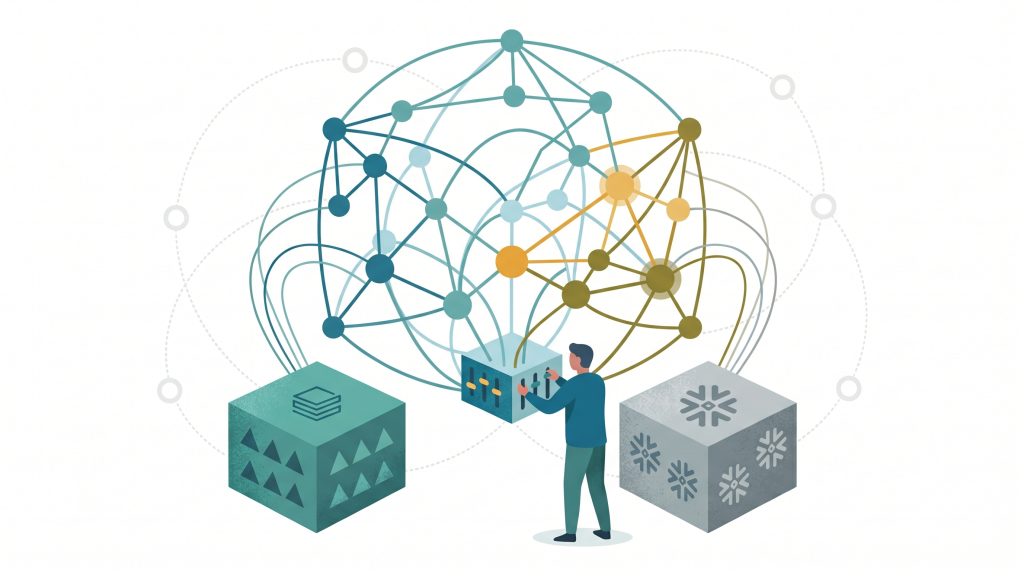
Introducing Neo4j Virtual Graph: Graph reasoning on the data you already have
Neo4j launched Virtual Graph, a private preview feature enabling users to run Cypher queries and graph algorithms directly on data in SQL warehouses like Snowflake and Databricks without moving it.
What: Firat Tekiner and Michael Simons announced Neo4j Virtual Graph, now in private preview, which allows graph reasoning on existing enterprise data in SQL warehouses and lakehouses. It compiles Cypher queries into native SQL, letting teams run traversals and graph algorithms against current data without ETL pipelines, supporting GraphRAG and agentic workflows where seconds-to-minutes latency is acceptable.
Why it matters: This product addresses a core enterprise dilemma: the need for graph intelligence for AI agents while avoiding data duplication and maintaining existing data governance. It signifies a strategic move to broaden graph database adoption by meeting data where it already lives, making graph capabilities accessible to a much wider array of data professionals.
Takeaway: If your organization has large datasets in Snowflake or Databricks and is exploring graph-based AI/agentic workflows but is hesitant to move data, consider joining the Neo4j Virtual Graph private preview.
Deep dive
- Neo4j Virtual Graph, now in private preview, enables graph reasoning directly on data stored in existing SQL warehouses (Snowflake, Databricks).
- It uses a "zero-copy" architecture, meaning data remains in its original location, governed by existing controls.
- The system compiles Cypher queries into native SQL, pushing computation down to the existing warehouse engine.
- It addresses the challenge of providing connected data for AI agents and GraphRAG without requiring data migration or ETL.
- Virtual Graph automatically generates a graph data model from existing SQL tables, inferring nodes, relationships (even without foreign keys), and properties.
- It is designed for analytical and batch agentic workloads where latencies of seconds to minutes are acceptable, rather than real-time, millisecond-latency traversals.
- The solution integrates with Neo4j Aura and consists of a data model, a query translator, and a graph compute layer.
- Neo4j clarifies that Virtual Graph complements, rather than replaces, native Neo4j-stored graphs, which are still recommended for high-latency, ACID-compliant, continuously updated, or naturally graph-shaped data.
- Future plans include support for more SQL sources (any JDBC/SQL interface), adaptive caching for lower latency, and composite queries spanning both AuraDB and Virtual Graph.
Decoder
- GraphRAG (Retrieval Augmented Generation with Graphs): An AI architecture that combines a large language model (LLM) with a graph database to enhance the LLM's ability to retrieve and reason over complex, connected information for more accurate and contextually relevant responses.
- Cypher: Neo4j's declarative graph query language, optimized for expressing patterns and relationships in graph databases.
- SQL Lakehouse: A data architecture that combines the low-cost storage of a data lake with the data management and analytics capabilities of a data warehouse, typically built on open formats like Parquet and Delta Lake.
- ETL pipeline (Extract, Transform, Load): A process used in data warehousing to extract data from sources, transform it into a consistent format, and load it into a target system.
Original article
Full article content is not available for inline reading.
Explore all 68 articles in today's digest
Fresh dev news, AI-digested daily. Never miss a trend at devoured.fyi