DEVOURED
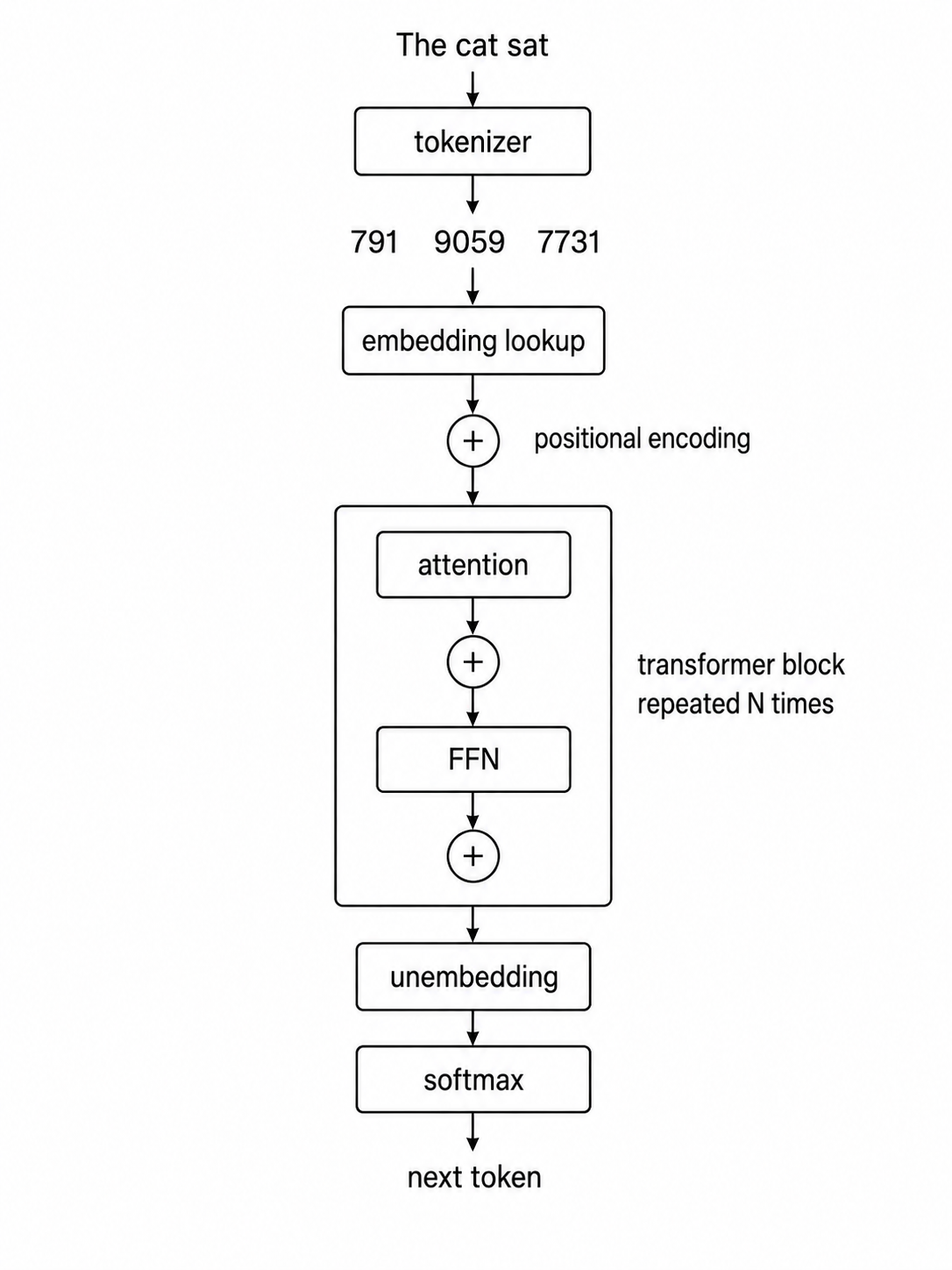
How LLMs Actually Work
Modern LLMs rely on a standardized transformer skeleton, with differences emerging from data, configuration choices, and post-training refinements.
What: This deep-dive explains how transformer architectures function, covering tokenization, embedding matrices, rotary positional embeddings (RoPE), and the mechanism of multi-head attention. It highlights that most frontier models share common design choices like pre-norm placement, RMSNorm, and SwiGLU activations.
Why it matters: The industry has converged on a common transformer-based architecture; understanding these core building blocks is now essential for evaluating new model papers and architectural shifts like Mixture-of-Experts (MoE).
Deep dive
- LLMs operate on integer token IDs via subword tokenization, not raw text.
- Embeddings represent semantic meaning as learned vectors in a high-dimensional space.
- Rotary Position Embeddings (RoPE) provide order information more effectively than additive methods.
- Attention heads act as independent filters that focus on specific relationships (e.g., induction heads for pattern copying).
- The feed-forward network (FFN) contains the majority of an LLM's parameters and factual knowledge.
- Residual streams enable training of very deep networks by allowing gradient flow through additive connections.
- Mixture of Experts (MoE) scales parameters while keeping inference costs manageable by activating only specific network pathways.
Decoder
- Softmax: A function that converts a vector of raw scores (logits) into a probability distribution that sums to one.
- KV Cache: A memory buffer that stores intermediate keys and values from previous tokens to avoid recomputing the full prompt during generation.
- SwiGLU: A modern, non-linear activation function often used in the feed-forward network to improve model convergence.
- Logits: Raw, unnormalized prediction scores produced by the final model layer before applying softmax.
Original article
Full article content is not available for inline reading.
Explore all 68 articles in today's digest
Fresh dev news, AI-digested daily. Never miss a trend at devoured.fyi