The Hidden Why: Behavioral Economics for UX
Behavioral economics frameworks like the 3B model offer a structured approach to identifying and removing the psychological friction preventing users from completing tasks.
Deep dive
- Define the target behavior precisely (e.g., 'a user completes signup in one session').
- Map the actual steps users take, not the intended path.
- Use behavioral data, not just emotional sentiment.
- Identify barriers (attention, cognitive load, status quo).
- Identify benefits (functional, emotional, social).
- Design specific experiments based on a clear hypothesis to remove one identified barrier.
Decoder
- 3B Framework: A behavioral design model (Behavior, Barriers, Benefits) used to diagnose and improve user engagement.
- Cognitive Load: The amount of mental effort being used in the working memory.
- Status Quo Bias: The psychological preference for the current state of affairs, making users resistant to change.
Original article
The Hidden Why: Behavioral Economics for UX
Use behavioral-economics frameworks to uncover hidden friction in your experience and design UX solutions that better support user action.
People often intend to take action — join a gym, open a savings account, register for a class, or book tickets to a show — but never follow through. Most of us know this frustrating gap between what we intend to do and what we actually do.
Behavioral economics helps UX practitioners investigate why intention fails to become action. It enables them to look beyond whether users can complete a task and uncover what shapes their motivation, attention, confidence, and decisions along the way.
The Promise of Behavioral Economics
Behavioral economics combines economics and psychology to understand how people behave in real contexts. Emotions, habits, uncertainty, social cues, perceived risk, effort, and the way information is presented all influence what people do.
In UX, behavioral economics is especially useful because experiences often depend on users making decisions and following through. Users may need to create an account, choose a plan, schedule an appointment, share information, or complete a purchase. These actions are driven not only by usability, but also by what users notice, believe, feel, avoid, or expect others to do.
When teams understand these influences, they can design experiences that better support users’ goals and improve business outcomes. In fact, Gallup reports that companies that apply behavioral economics effectively can outperform peers by 85% in sales growth and more than 25% in gross margin.
How to Apply Behavioral Economics to Your Work
Behavioral economics is rich in theory, which is part of what makes it so useful. But that richness can also create challenges for UX teams. Understanding concepts like cognitive biases, prospect theory, and nudging does not automatically tell teams when those concepts apply, to whom they apply, or how to account for them in design.
Luckily, excellent frameworks exist to help translate behavioral economics into practice. Models such as COM-B, the Fogg Behavior Model, the 3B Framework, and EAST provide teams with structured questions to better understand user behavior in the specific context they are designing for.
Case Study: Applying the 3B Framework to a UX Problem
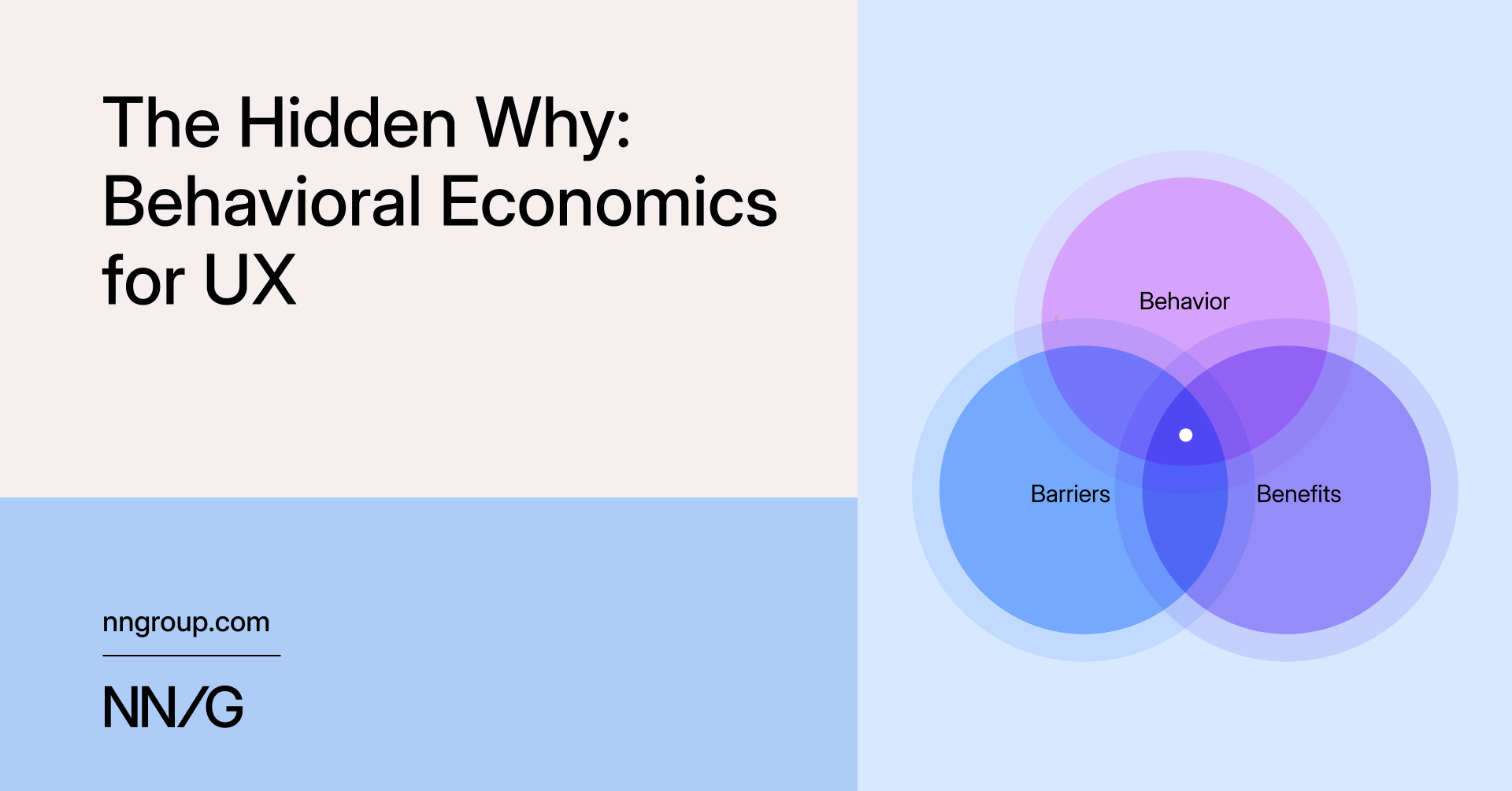
The 3B Framework was created by Irrational Labs, a behavioral-design consulting firm. The framework is a simple 3-step process, organized around the 3 B’s:
- Behavior: What action do you want the user to take?
- Barriers: What might prevent the user from taking that action?
- Benefits: What might make the user feel that the action is worthwhile, relevant, or motivating?
Let’s explore how this framework can help us uncover hidden behavioral friction in the context of a common UX problem: users starting a signup flow but not completing it. To make things concrete, let’s assume that the signup flow is for a gym membership.
1. Behavior
The first step is to define the desired behavior and map the steps users need to take to complete it.
Be as specific as possible — Irrational Labs calls this getting “uncomfortably specific.” The behavior should describe what the user does, when they do it, and what completion looks like.
Next, map every step users would currently need to take to engage in the target behavior. The map should reflect actual steps when possible, not the ideal path the team expects users to follow.
2. Barriers
The next step is to identify potential psychological barriers at each moment in the behavior map.
Barriers make the target behavior harder to complete. They can come from the interface, but also from cognitive, emotional, or social friction. Irrational Labs highlights common barrier categories such as attention, cognitive load, status quo, and mental models.
3. Benefits
The last step involves identifying potential psychological benefits at each moment in the behavior map.
Benefits make the behavior feel more worthwhile or motivating; they may be functional (e.g., saving money, gaining access to a service), emotional (e.g., feeling confident, proud, supported), or social (e.g., feeling aligned with what others are doing). Identify where the flow already creates benefits for users, then look for opportunities to add more immediate rewards.
4. The Behavioral Intervention
This last step builds upon the knowledge accumulated in steps 1–3.
Here you choose one barrier to remove or one benefit to strengthen, then design a solution around it. You can’t solve everything at once, so prioritize the barrier or benefit most likely to influence the target behavior.
Before testing, write a clear hypothesis about why you believe the intervention will work. Then test it with users and measure whether the target behavior improves compared to the baseline.
Conclusion
Behavioral economics frameworks help make the hidden forces shaping user behavior more visible. They can help teams form better hypotheses, design targeted interventions, and test what actually changes behavior.
Fresh dev news, AI-digested daily. Never miss a trend at devoured.fyi