DEVOURED
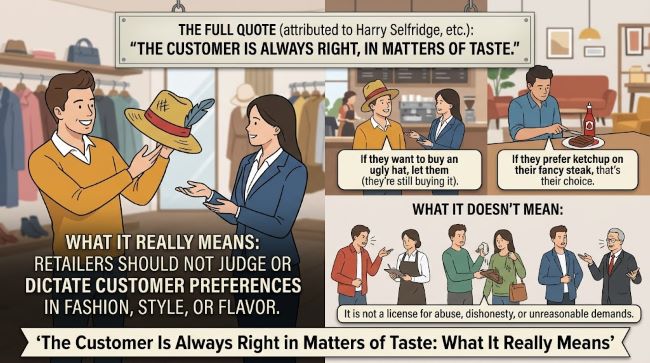
The Customer is Always Right in Matters of Taste: What it Really Means
The classic mantra 'the customer is always right' was never an absolute; it was a qualifier about subjective aesthetic taste.
What: The phrase originated in early 20th-century retail (attributed to Harry Gordon Selfridge) to stop merchants from imposing their own style preferences over customers, but it does not apply to facts, safety, law, or staff treatment.
Why it matters: Confusing subjective preference with objective fact leads to operational failures in creative and service industries.
Original article
The phrase "the customer is always right" is widely misquoted — its original form includes a crucial qualifier: "in matters of taste." Attributed to Harry Gordon Selfridge and other early 20th-century retailers, it was meant to counter paternalistic merchants who imposed their preferences over customers' subjective choices. The principle applies to taste-based decisions in retail, food, and creative services, but not to factual disputes, safety, legal compliance, or staff mistreatment — where other standards must hold.
Explore all 42 articles in today's digest
Fresh dev news, AI-digested daily. Never miss a trend at devoured.fyi