DEVOURED
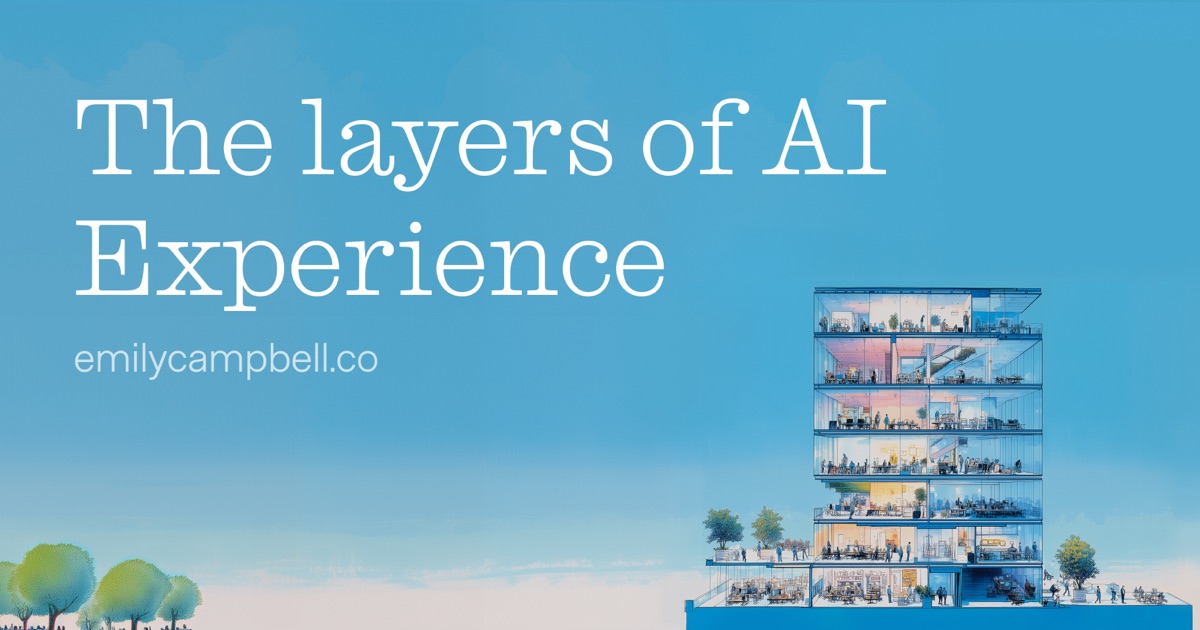
The Layers of AI Experience
Designing for AI requires a new full-stack approach that extends influence far below the surface interface into models, context, and emergent behaviors.
What: Emily Campbell introduces a six-layer framework—User Interface, Context, Harness, Model, Governance, and Emergence—to map how AI products are built. Designers must be fluent in these layers to account for the probabilistic nature of AI where output is dynamic and often unpredictable.
Why it matters: Traditional 'deterministic' design is dying; AI necessitates a move toward 'probabilistic' system design where designers shape conditions rather than defining every user state.
Deep dive
- UI Layer: Directs the user's interaction; increasingly becomes an oversight surface.
- Context Layer: Provides memory and state; prevents the system from 'starting cold'.
- Harness Layer: Manages connectors, tools, and permissions; provides the operational structure for agents.
- Model Layer: The engine; requires designers to understand differences in latency, reasoning depth, and personality.
- Governance Layer: The constraints; includes legal and safety policies that fundamentally dictate model behavior.
- Emergence Layer: The unpredictable; requires observability and interpretability tools rather than simple debugging.
Decoder
- Deterministic: A system where every input produces a guaranteed, predictable, and reproducible output.
- Probabilistic: A system that produces outputs based on likelihoods and statistical patterns, allowing for variance that cannot be fully controlled or predicted.
- Context Rot: A degradation of AI performance caused by bloated memory files or irrelevant long-term context that consumes tokens and muddies outputs.
- Harness: The operational infrastructure surrounding a model that manages access to data, tools, and workflows.
Original article
Full article content is not available for inline reading.
Explore all 42 articles in today's digest
Fresh dev news, AI-digested daily. Never miss a trend at devoured.fyi