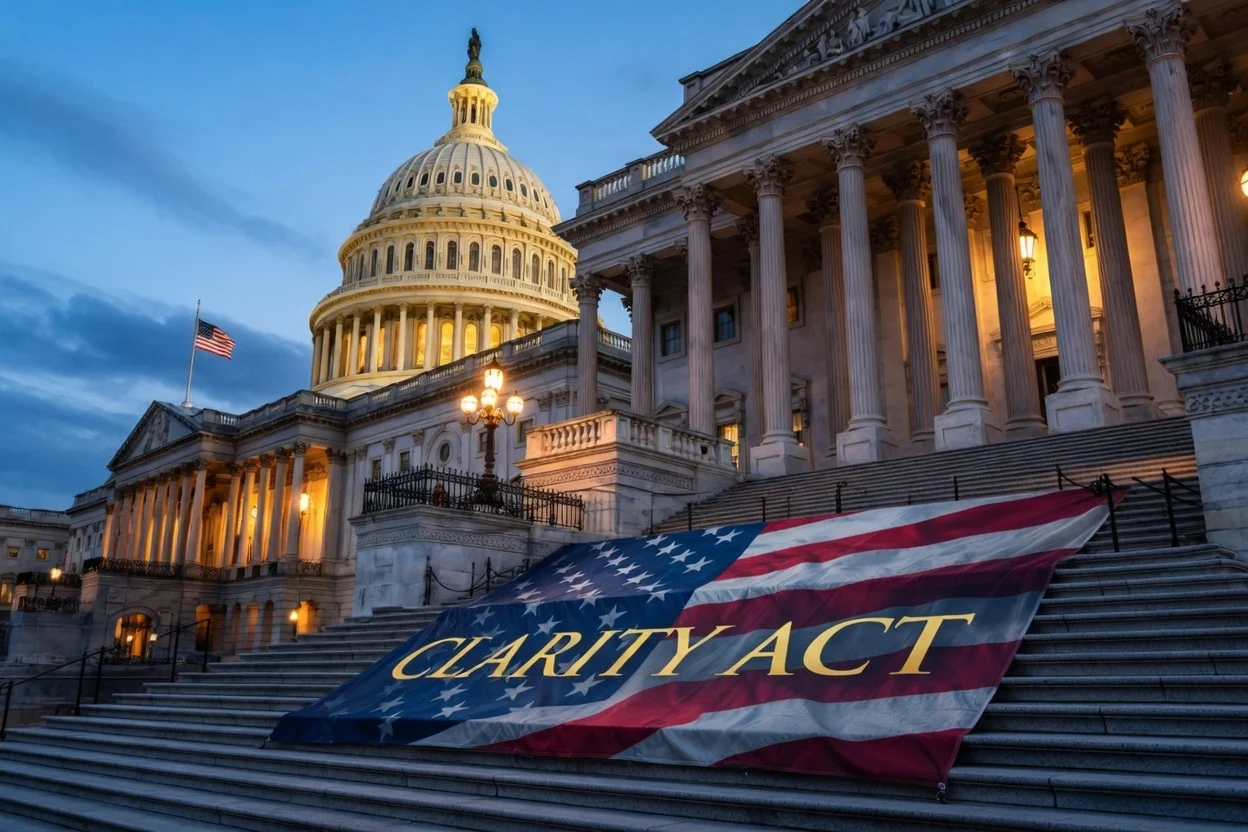
Banks claim stablecoin yields would slash lending by 20%, but White House economists say 0.02%, exposing a three-orders-of-magnitude gap as the bipartisan CLARITY Act compromise heads to Senate markup in mid-May 2026.
Deep dive
- Senators Thom Tillis and Angela Alsobrooks announced their final Section 404 compromise on May 5, 2026, declaring negotiations closed despite banking opposition with "we respectfully agree to disagree"
- The compromise bans stablecoin compensation "economically or functionally equivalent" to bank deposit interest while preserving activity-based rewards (trading volume, staking, platform engagement)
- The American Bankers Association condemned the deal, warning broad stablecoin adoption could cut consumer and small-business lending by one-fifth or more
- White House economists disputed banks' projection, estimating a stablecoin yield ban would increase bank lending by only $2.1 billion, a 0.02% increase—three orders of magnitude smaller than banks' claim
- Coinbase and Circle backed the compromise, with Circle stock jumping 20% and Coinbase CLO Paul Grewal commending the bipartisan consensus
- The CLARITY Act passed the House 294-134 last July, establishing SEC/CFTC regulatory jurisdiction boundaries for digital assets
- Senate Banking Committee Chair Tim Scott indicated "real progress" with markup scheduled for mid-May 2026
- Full Senate vote could occur in June or July 2026, with President Trump signaling he would immediately sign the bill upon passage
- Polymarket probability for 2026 enactment rose to 70%, the highest in over 30 days following the announcement
- Senator Cynthia Lummis called the settlement "the culmination of months of hard work" and suggested the CLARITY Act's enactment is imminent
- The regulatory framework addresses a principal obstacle to institutional capital deployment—unclear SEC vs CFTC jurisdiction over digital assets
- Lawmakers acknowledged banking sector representatives participated throughout negotiations and received consideration, though the fundamental framework remains unchanged
Decoder
- Stablecoin: Cryptocurrency pegged to a reserve asset (typically US dollar) designed to maintain stable value, such as USDC or USDT
- CLARITY Act (Digital Asset Market Clarity Act): Federal legislation establishing regulatory framework for digital assets, including stablecoin rules and SEC/CFTC jurisdiction boundaries
- Section 404: Specific provision in the CLARITY Act addressing stablecoin yield and rewards programs
- Polymarket: Cryptocurrency-based prediction market platform where users bet on real-world event outcomes
- Senate Banking Committee markup: Committee session where senators review, amend, and vote on legislation before sending it to the full Senate
Original article
The American Bankers Association is opposing stablecoin yield provisions in the CLARITY Act compromise, arguing the Tillis-Alsobrooks text falls short on deposit protection even though the bill passed the House 294-134 last July. Banks warn that broad stablecoin adoption could cut consumer and small-business lending by one-fifth or more. White House economists disputed that projection, estimating a stablecoin yield ban would raise bank lending by only $2.1 billion, a 0.02% increase. Coinbase and Circle have backed the compromise, which bans stablecoin rewards economically or functionally equivalent to deposit interest while preserving a carve-out for bona fide activities.
Fresh dev news, AI-digested daily. Never miss a trend at devoured.fyi