DEVOURED
MacBook Neo Deep Dive: Benchmarks, Wafer Economics, and the 8GB Gamble
Apple's $599 MacBook Neo uses iPhone 16 Pro silicon hitting M3 single-core performance for 60 seconds before thermal-throttling 87%, timed as 2026 DRAM shortage drove competitor laptops from $600 to $750.
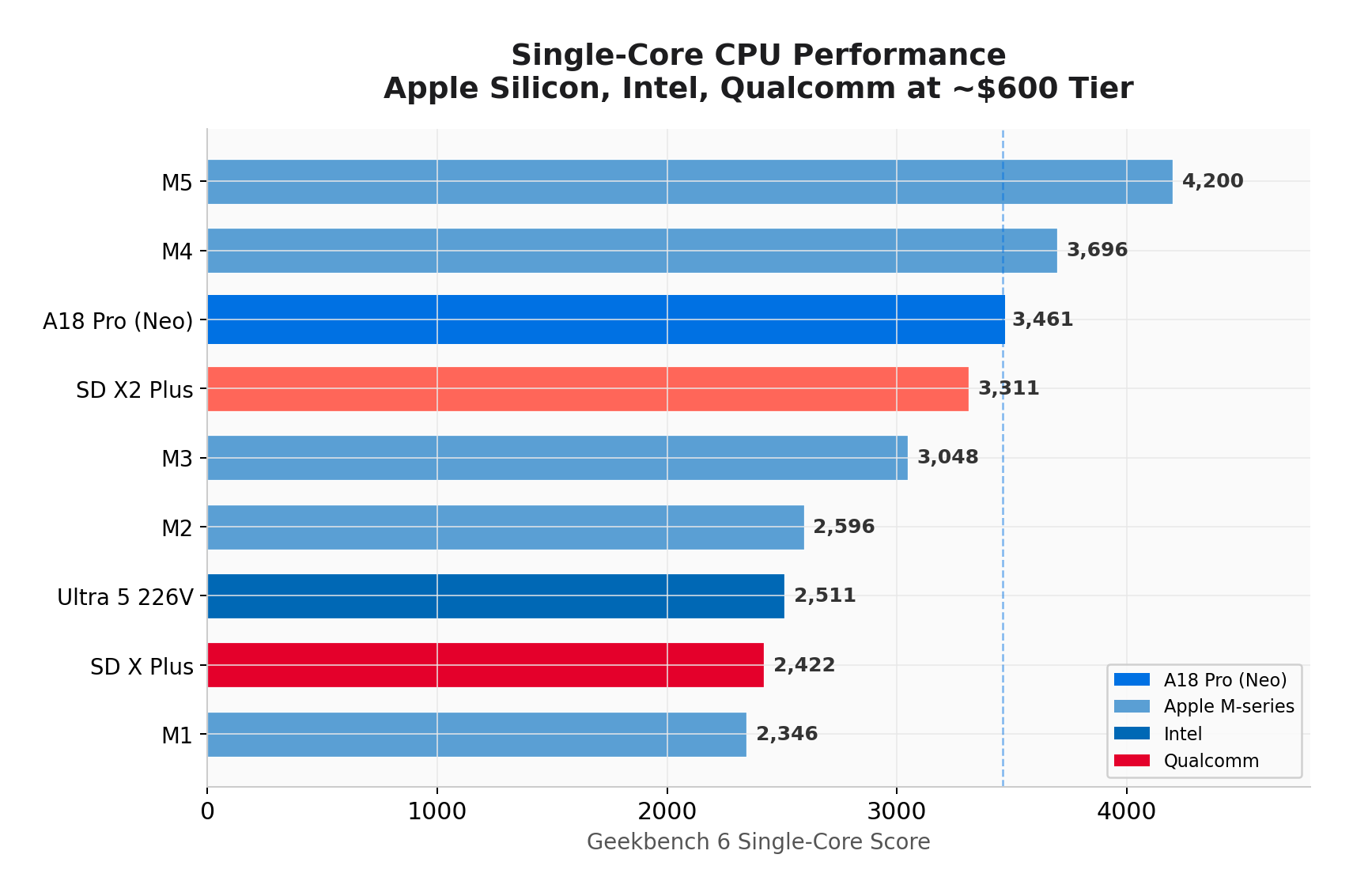
What: Apple launched MacBook Neo at $599 using A18 Pro (iPhone 16 Pro chip) that scores 3,569 Geekbench single-core (between M3 and M4) but thermal-throttles from 570% to 207% CPU utilization in 15 seconds after one minute of sustained load. Die measures 105 mm² yielding 498-527 chips per $18,000-$20,000 TSMC wafer at $38-47 per SoC versus M4's ~3x cost. Context: 2026 DRAM shortage saw DDR5 32GB kits jump from $120 to $350 as HBM production for AI GPUs consumes 40% of memory fab capacity, pushing PC prices up 17% and competitor laptops 15-20% higher.
Why it matters: Apple's vertical integration (230 million iPhones annually amortizing A18 Pro R&D costs to zero for Mac) plus strategic 8GB-only configuration minimizes DRAM shortage exposure while competitors absorb full memory price increases. The fixed $599 becomes more competitive monthly without Apple changing anything, creating a pricing umbrella to capture budget market during supply crisis. This signals Apple can now compete in segments previously ceded to Chromebooks and budget Windows laptops.
Deep dive
- A18 Pro and M4 share identical ARM core architecture (Everest/Sawtooth cores, ARMv9.2-A), both on TSMC N3E 3nm, with ~857 Geekbench points per GHz IPC showing the cores are the same
- System-level differences matter: A18 Pro has 60 GB/s memory bandwidth vs M4's 120 GB/s, 24 MB vs 16 MB System Level Cache, 6 cores vs 10, and ~10W thermal envelope vs M4's 20-25W sustained
- Thermal testing across three states: 3,569/8,879 cold start, 709/1,305 with Claude Code running (80% drop), 476/1,340 after 5-minute stress test (87% single-core drop)
- Fanless chassis hits thermal wall at 60 seconds: CPU utilization crashes from 570% to 207% in 15 seconds, stays throttled at 188-360% for remaining load. Case surface measures 97.6°F while chip hits 105°C internally
- Wafer economics: 105 mm² die yields ~586 gross dies per wafer, 85-90% yield produces 498-527 good chips, costing $38-47 per SoC versus M4's roughly 3x cost and M4 Max's 4x cost at 440 mm²
- Neo likely uses binned A18 Pro dies that failed sixth GPU core during iPhone production (ships with 5 GPU cores vs iPhone's 6), standard industry practice for yield improvement
- 2026 DRAM shortage is structural reallocation: HBM for AI accelerators consumes 3x wafer area per GB versus DDR5/LPDDR5x, with Samsung/SK Hynix/Micron (93% global production) allocating up to 40% of capacity to HBM
- Memory pricing impact: DDR5 32GB went $120 (Q3 2025) to $350 (Q1 2026), memory share of PC BOM rose 16% to 23%, TrendForce projects 90-95% QoQ contract price jump Q1 2026
- Gartner projects 10.4% PC shipment decline in 2026, average prices up 17%, sub-$500 segment disappears by 2028. Data centers will consume 70% of all memory chips in 2026
- 8GB limitation is three factors: cost savings ($25-35 for 8GB vs $50-70 for 16GB at shortage pricing), A18 Pro memory controller designed for iPhone's 8GB package requiring different PCB routing for 16GB, and strategic pricing umbrella
- Estimated $200-290 BOM at $599 retail implies ~50-58% gross margin before R&D/marketing, consistent with Apple's 47% company-wide margin on $436B revenue. Not a loss leader.
- TweakTown and Hackaday modders showed 18% Geekbench improvement and doubled gaming fps with liquid cooling mods, confirming cooling is the constraint not silicon capability
- Ecosystem revenue math: Neo buyer subscribing to iCloud+ and Apple One generates $240-480 services revenue over 2-year lifecycle, making hardware margin less critical than converting Chromebook users into Apple ecosystem
- Good for web/office/streaming/light photo work where single-core and burst performance matter. Not for development, VMs, content creation, or heavy multitasking requiring >1.5-2GB available after macOS overhead
- I/O severely limited: one USB-C 3 (10 Gbps) + one USB-C 2 (480 Mbps, functionally useless) + 3.5mm, no Thunderbolt, no MagSafe, charging occupies the only fast port
Decoder
- HBM (High Bandwidth Memory): Specialized DRAM used in AI accelerators like Nvidia H100/B200, stacked vertically using Through-Silicon Vias. Requires 3x the wafer area per gigabyte versus standard DDR5 and achieves only 50-60% yield for 12-high stacks, causing global memory shortage as fabs reallocate capacity.
- Die yield: Percentage of chips on a silicon wafer that pass testing after fabrication. Smaller dies have higher yields because defects are less likely to land on any given chip (Neo's 105 mm² at 85-90% yield vs larger M4 Max at 440 mm² with lower yields).
- Wafer cost: TSMC charges per 300mm silicon wafer (~$18,000-$20,000 for N3E 3nm process). Many chips are cut from each wafer, so smaller die area = more chips per wafer = lower per-chip cost.
- Binned dies: Chips that failed to meet full specifications during testing (e.g., one GPU core defective) but work at reduced specs. Reused in lower-tier products rather than discarded. Neo likely uses A18 Pro dies that failed the 6th GPU core.
- IPC (Instructions Per Clock): CPU efficiency metric measuring work done per clock cycle. A18 Pro and M4 both achieve ~857 Geekbench points per GHz, proving the core architecture is identical despite different branding.
- System Level Cache (SLC): Large shared cache between CPU/GPU/Neural Engine on Apple Silicon, reduces main memory access. Neo has 24 MB vs M4's 16 MB to partially compensate for half the memory bandwidth.
- Thermal throttling: Automatic CPU/GPU clock speed reduction when temperature limits reached to prevent hardware damage. Neo drops from 4.04 GHz to ~2.3 GHz after 60 seconds sustained load as fanless chassis cannot dissipate heat.
Original article
The MacBook Neo is Apple's cheapest Mac at $599. It uses the iPhone-derived A18 Pro to deliver strong bursty single-core performance, good battery life, and a premium-feeling build at a low price. Its biggest tradeoffs are the 8GB RAM limit, weak port setup, and severe thermal throttling under sustained workloads, making it better for everyday student/general use than development, creative work, gaming, or heavy multitasking.
Explore all 66 articles in today's digest
Fresh dev news, AI-digested daily. Never miss a trend at devoured.fyi