DEVOURED
Eugene Yan runs 3-6 parallel Claude Code sessions simultaneously with models watching models, revealing AI development's bottleneck has shifted from doing work to writing specs and reviewing outputs fast enough.
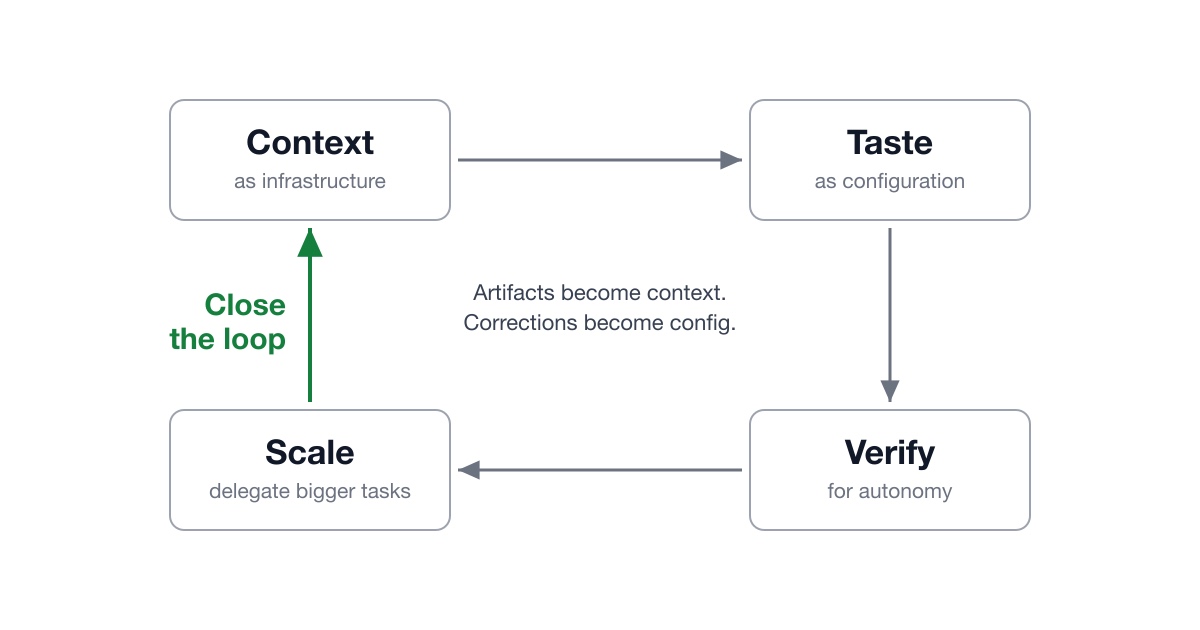
What: Eugene Yan published a guide on working with Claude Code built around five principles: organize context (~/src for code, ~/vault for knowledge, per-project INDEX.md and CLAUDE.md files), encode taste as config (behavioral contracts in ~/.claude/CLAUDE.md, skills as markdown workflows), build verification ladders (post-edit hooks with ruff, evals, Claude in Chrome), delegate bigger tasks (running 3-6 parallel sessions with git worktrees), and mine transcripts for config updates. He uses stop hooks that play sounds when sessions finish and /remote-control to check in while AFK.
Why it matters: This shows AI-assisted development maturing from pair-programming to delegation, where the bottleneck moves from execution to spec-writing and output review. The framework mirrors traditional software engineering practices—good context, encoded preferences, verification, delegation, closed-loop learning—suggesting these human collaboration patterns will persist as models improve and scale.
Takeaway: Create a ~/.claude/CLAUDE.md file with behavioral preferences and teaching style, then build your first skill by doing a task once interactively and asking the model to convert the session into a reusable markdown workflow.
Deep dive
- Eugene Yan organizes all code in ~/src and knowledge work in ~/vault (projects/, notes/, kb/) to make context retrieval straightforward via grep/glob
- Each project has an INDEX.md with annotated URLs (owner, description, when to read) so models don't waste tokens opening every link to figure out relevance
- The ~/.claude/CLAUDE.md file serves as a behavioral contract loaded in every session, containing preferences like 'be direct and push back when you disagree' and 'when unsure, say you're unsure rather than guessing confidently'
- Configuration is scoped by directory: ~/.claude/CLAUDE.md for global preferences, repo root for repo conventions, project directory for project-specific context—Claude Code walks up the tree and loads each
- Skills are markdown workflows with triggers and procedures that encode both steps and judgment (e.g., /polish checks diffs, runs evals for metrics, uses Claude in Chrome for browser output, iterates until no critical feedback)
- Bootstrap skills by doing a task once interactively, asking the model to convert it to a skill, running it on a similar task, correcting output within the session (not editing the file directly), then having the model merge feedback into the skill
- Verification is treated as a ladder: deterministic post-edit hooks (ruff format, ruff check --fix) at the bottom, then tests and evals, then LLM reviews at the top—catch errors at the lowest possible rung
- For long-running tasks, a secondary session with fresh context reads the original spec and recent turns of the primary session to check for execution drift (tactical errors like ignoring errors) and direction drift (strategic misinterpretation)
- Yan typically runs 3-6 sessions simultaneously using git worktrees (each session gets its own checkout), with tmux window titles showing status emojis (⏳ working, 🟢 complete) and Haiku-generated labels
- A stop hook plays a sound when sessions finish, and /remote-control in Claude Code lets him check status and unblock stalled sessions from his phone while commuting
- Mining past transcripts revealed a sizable percentage contained phrases like 'can you also…', 'did you check…', 'still wrong'—indicating missing config or broken verification steps that should be updated
- The framework applies beyond personal tooling to agent harness design, team norms, and org infrastructure—the same principles work for human collaboration
Decoder
- MCP (Model Context Protocol): Protocol for connecting Claude to external data sources like Slack, Drive, and Mail to access organizational knowledge
- git worktree: Git feature creating multiple working directories from one repository, enabling parallel sessions without file conflicts
- Shift verification left: DevOps principle of catching errors as early as possible (at write time via hooks vs runtime via tests vs production)
- Context tax: Performance cost of loading irrelevant configuration into every AI session—fixed by lazy-loading guides instead of inlining them in CLAUDE.md
- Execution drift vs direction drift: Tactical errors (ignoring errors, bad metrics, skipping spec requirements) vs strategic misinterpretation (building the wrong feature entirely)
Original article
Provide good context, encode your taste as config, make verification easy, delegate bigger tasks, and close the loop. Every finished artifact becomes context for the next session, and each correction updates a config that reduces future errors. These practices aren't specific to AI - it's how you onboard and work with any new collaborator.
Explore all 66 articles in today's digest
Fresh dev news, AI-digested daily. Never miss a trend at devoured.fyi